
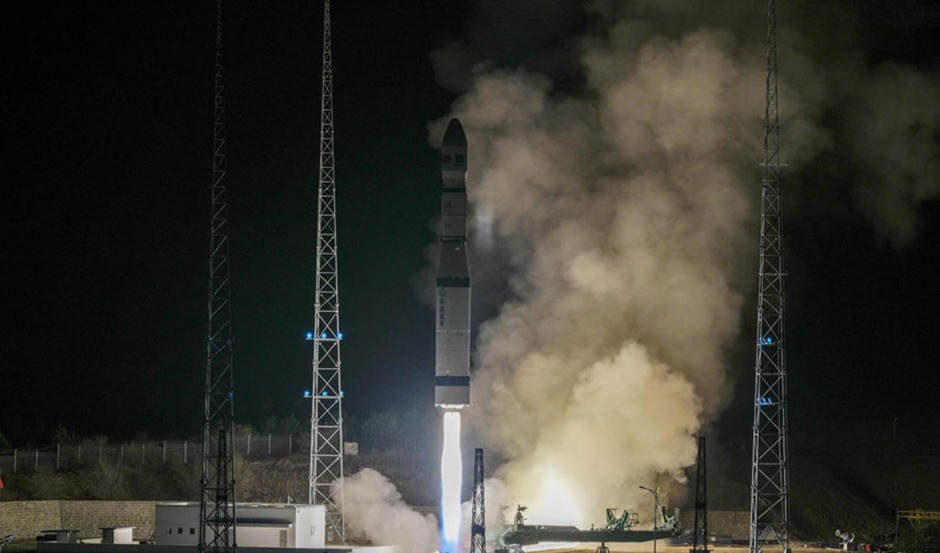
ISLAMABAD, May 20: Pakistan’s indigenous EO-3 satellite is expected to strengthen climate monitoring, disaster response, agriculture and urban planning by providing real-time space-based data, experts said.
The Space and Upper Atmosphere Research Commission launched EO-3 aboard China’s Long March-6 rocket from the Taiyuan Satellite Launch Centre on April 25, 2026. The launch completed Pakistan’s three-unit PRSC-EOS Earth observation constellation.
Pakistan launches indigenous EO-3 satellite, boosting space capability
The constellation includes EO-1, launched in January 2025, EO-2, launched in February 2026, and EO-3. Experts say the system gives Pakistan a domestic remote sensing network capable of advanced imaging and data collection.
According to the Foreign Office, EO-3 carries a Multi-Geometry Imaging Module, an advanced energy storage system and an onboard artificial intelligence-powered data processing unit for real-time analysis.
The satellite is seen as important for Pakistan because of the country’s exposure to climate-related disasters. The 2022 floods caused an estimated $15.2 billion in economic losses, while agriculture suffered damages of more than $14.9 billion, according to assessments by the World Bank, European Union and Asian Development Bank.
Agriculture contributes around 24 percent to Pakistan’s GDP and employs nearly 37 percent of the workforce. Analysts say access to reliable spatial data can help improve crop planning, irrigation management and food security monitoring.
Experts highlight practical uses
Dr Rehan Mahmood, Director of the Small Satellite Technology and Research Laboratory at the Institute of Space Technology, Islamabad, said EO-3’s real value would depend on converting satellite data into actionable information for disaster management authorities, agricultural departments, urban planners, environmental agencies, universities and researchers.
He said artificial intelligence-based image analysis, Geographic Information Systems and remote sensing technologies would be central to using the satellite effectively.
Dr Usman Mazhar, Assistant Professor at the Department of Geography, University of Gujrat, said EO-3 could help monitor flash floods, crop health and urban expansion in near real time.
He said onboard AI analytics could reduce delays by processing data in orbit instead of relying only on ground-based analysis.
Bilal Tariq, GIS Manager at the Punjab Urban Land Systems Enhancement Project, said EO-3 could support flood risk mapping, evacuation planning, infrastructure damage assessment and post-disaster loss estimation.
He said the satellite could also detect crop stress and water shortages, monitor irrigation and groundwater use, and help forecast production of key crops such as wheat and rice.
For urban planning, experts said EO-3 could help map unauthorized construction, monitor urban sprawl in major cities including Karachi, Lahore and Islamabad, and identify gaps in transport and utility infrastructure.
The satellite may also support monitoring of urban heat islands, air pollution and vegetation changes, helping authorities plan more sustainable cities.