
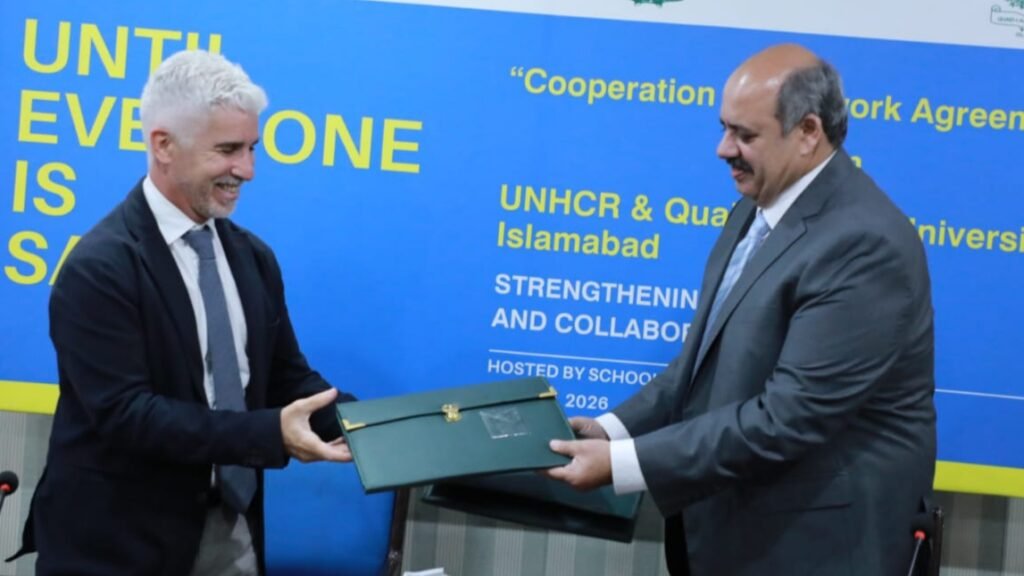
ISLAMABAD: Quaid-i-Azam University (QAU) and the United Nations High Commissioner for Refugees (UNHCR) have signed a cooperation framework agreement aimed at strengthening academic collaboration in refugee law, migration studies, statelessness, and forced displacement.
The agreement was signed during an event organized by the School of Law at Quaid-i-Azam University in connection with World Refugee Day. The partnership is expected to support research, curriculum development, training initiatives, and policy dialogue on issues related to refugees and migration in Pakistan.
The ceremony was attended by Chief Commissioner for Afghan Refugees Asmat Ullah Shah, Swiss Ambassador to Pakistan Georg Steiner, UNHCR Pakistan Deputy Representative and Officer-in-Charge Oscar Manuel, QAU Vice Chancellor Professor Dr. Zafar Nawaz Jaspal, Director School of Law Professor Dr. Hafiz Aziz-ur-Rehman, Director External Linkages Dr. Salma Malik, as well as faculty members, researchers, students, and representatives of partner institutions.
The agreement was formally signed by Oscar Manuel on behalf of UNHCR Pakistan and Professor Dr. Zafar Nawaz Jaspal on behalf of Quaid-i-Azam University.
Focus On Research And Academic Collaboration
According to officials, the cooperation framework establishes a structured platform for collaboration in academic research, curriculum design, professional training, advocacy initiatives, and knowledge-sharing activities.
The agreement will also support the coordination of the Pakistan Academic Consortium on Refugee Law and Migration (PACRAM), for which the School of Law at Quaid-i-Azam University serves as the coordinating institution and secretariat.
Stakeholders Highlight Importance Of Partnership
Speakers at the event emphasized the role of academic institutions in addressing issues related to displacement, migration, and refugee protection.
University officials highlighted the importance of research and education in supporting evidence-based policymaking, while UNHCR representatives noted that the partnership would contribute to capacity building and knowledge development in the field of refugee law.
Participants also discussed Pakistan’s experience in hosting refugees and the importance of collaboration among government institutions, universities, and international organizations.
Support For Refugee Law And Migration Studies
The event concluded with a renewed commitment from stakeholders to promote research, informed dialogue, and academic engagement on refugee protection and migration governance.
Officials said the partnership is intended to strengthen educational opportunities, policy research, and professional expertise in areas related to refugee law and displacement studies in Pakistan.
Also Read: Farabi Center inaugurated at Quaid-i-Azam University