
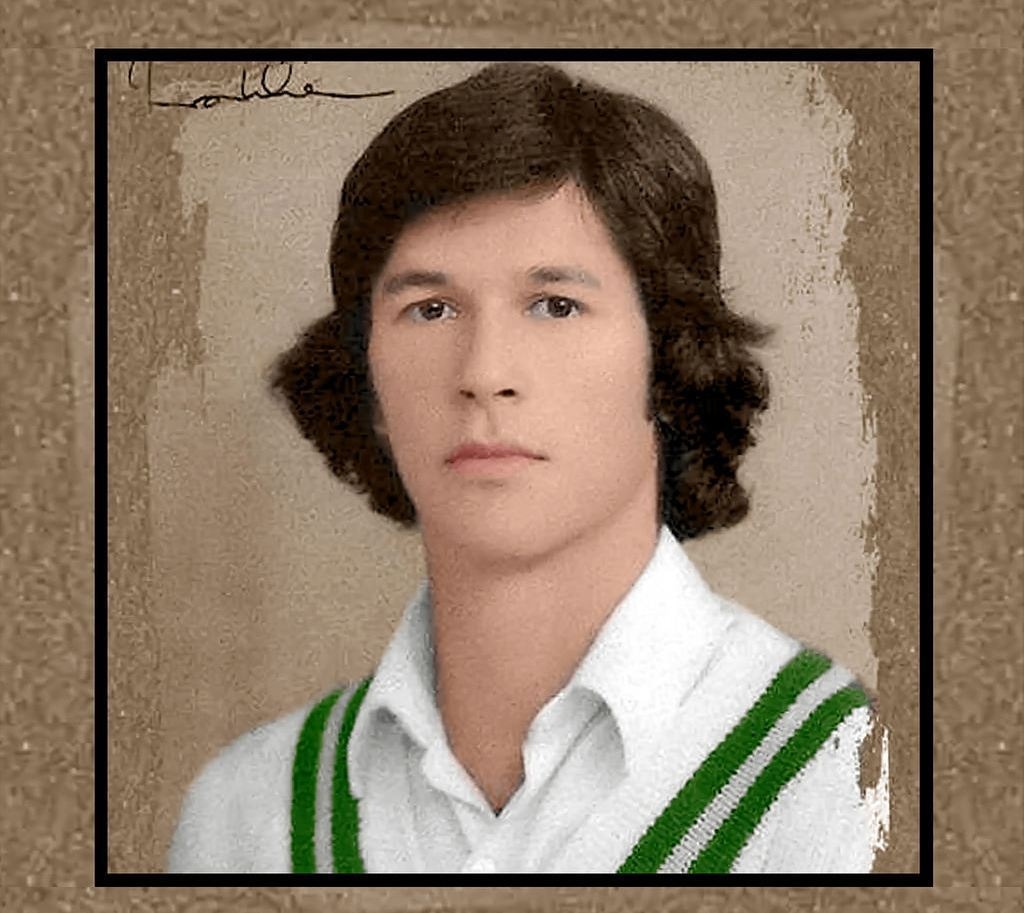
Few names in Pakistan’s sporting history carry the weight and emotion of Imran Khan. Before politics, before power and before controversy, there was Imran the cricketer — graceful, fearless and larger than life. For many Pakistanis, he was not just a sportsman. He was the man who gave the country confidence on the cricket field and showed that Pakistan could stand tall against the strongest teams in the world.
Born on October 5, 1952, in Lahore, Imran Khan grew up in an educated and privileged family. He studied at Aitchison College, where his interest in cricket began to grow. Later, he went to the Royal Grammar School Worcester in England and then to the University of Oxford, where he studied Philosophy, Politics and Economics. While at Oxford, he continued playing cricket and captained the university team in 1974.
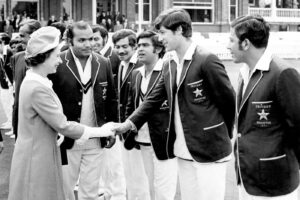
Cricket was already part of his family background. His cousins Javed Burki and Majid Khan had both played for Pakistan and also captained the national team. But Imran’s greatness was his own achievement. He worked hard, improved himself year after year and turned natural talent into world-class performance.
Imran made his Test debut for Pakistan in 1971. In the beginning, he was a promising fast bowler, but over time he became much more than that. By the late 1970s and early 1980s, he had grown into one of the best all-rounders in the world. He could bowl with pace, swing the ball dangerously and trouble the best batsmen. At the same time, he developed his batting so well that he could win matches with the bat too.
His style made him stand out. Tall, athletic and confident, Imran brought glamour to cricket in Pakistan. His smooth run-up, high delivery action and deadly reverse-swinging yorkers made him one of the most exciting fast bowlers of his time. He was admired not only in Pakistan but also in England, where he spent much of his cricketing life.
Christopher Stanford in his book on Imran (2009) describes Khan of the late 1970s and 1980s as a man who was a complete opposite of Zia.
Both Stanford and Tennant seem fascinated by Khan’s contrary personality. For example, in their respective books, they are at pains to figure out the nature of friendship between a ‘playboy’ celebrity and a conservative military dictator.
Khan told Tennant that he was never friends with Zia, even though it was on Zia’s persuasion that Khan decided to come out of retirement in 1987. But Khan agrees that Zia was a big fan of his and would often call him during Pakistan’s away matches.
In his book, ‘Pakistan: A Personal History,’ Khan is honest enough to confess that in the 1980s, he was so busy playing cricket and spending much of his time in England, that he didn’t quite know what Zia was really up to as a ruler back in Pakistan.
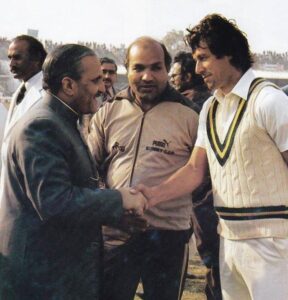
In 1982, Imran Khan became captain of Pakistan. This was the period when his real leadership qualities came forward. He was calm under pressure, bold in decision-making and clear in his vision. He wanted Pakistan to play without fear. Under his captaincy, the team became more aggressive, more united and more confident.
As captain, Imran performed at an even higher level. He led Pakistan in 48 of his 88 Test matches. The responsibility seemed to make him stronger. He scored important runs, took crucial wickets and often led from the front. Among the great all-rounders of the 1980s — Ian Botham, Richard Hadlee, Kapil Dev and Imran Khan — many regarded Imran as the most complete package because he kept improving with age.
Some of his finest performances came against India. In the 1982–83 series, Imran was almost unplayable. He took 40 wickets in six Tests, including a brilliant spell of 8 for 60 in Karachi. It remains one of the greatest bowling performances by a Pakistani fast bowler.
He also played memorable cricket against the West Indies, the strongest team in the world at that time. While many teams struggled badly against West Indian fast bowling, Pakistan under Imran fought bravely and managed to draw several series against them. This gave Pakistan cricket a new respect internationally.
Another major moment came in 1987 when Imran led Pakistan to their first Test series victory in England. His performance at Headingley, where he took 10 wickets in the match, was a reminder of his class and hunger for success.
After the 1987 World Cup, Imran first decided to retire. But he returned to international cricket in 1988, and that comeback changed Pakistan’s cricket history. Four years later, in 1992, he led Pakistan into the World Cup in Australia and New Zealand. The team started badly and seemed close to going out of the tournament. But Imran refused to give up. He told his players to fight like “cornered tigers,” and slowly Pakistan found its rhythm.
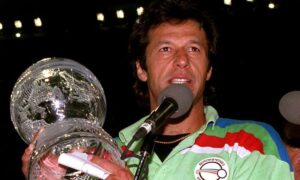
The final against England at the Melbourne Cricket Ground became the greatest day in Pakistan’s cricket history. Pakistan won its first World Cup, and Imran Khan, at the age of 39, lifted the trophy as captain. It was the perfect ending to a remarkable cricket career.
Imran retired after that victory, but his influence did not end. He inspired an entire generation of Pakistani fast bowlers. Players like Wasim Akram and Waqar Younis carried forward the fast-bowling tradition that Imran had strengthened. He also helped make reverse swing one of Pakistan cricket’s most powerful weapons.
After cricket, Imran turned towards public service and philanthropy. His biggest achievement in this field was the Shaukat Khanum Memorial Cancer Hospital in Lahore, built in memory of his mother, who died of cancer in 1985. The hospital opened in 1994 and became one of Pakistan’s most respected charitable institutions.
Imran Khan’s cricket story is not just about runs, wickets and trophies. It is about leadership, belief and national pride. He gave Pakistan a new cricketing identity and made millions believe that their team could defeat anyone. For Pakistanis, Imran Khan will always remain the captain who brought home the World Cup and changed the way the nation looked at cricket.
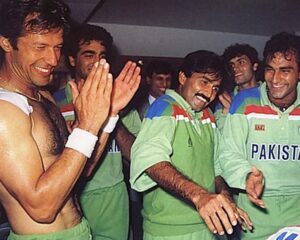
| Khan and his players celebrate the World Cup victory: |
Also Read More :