
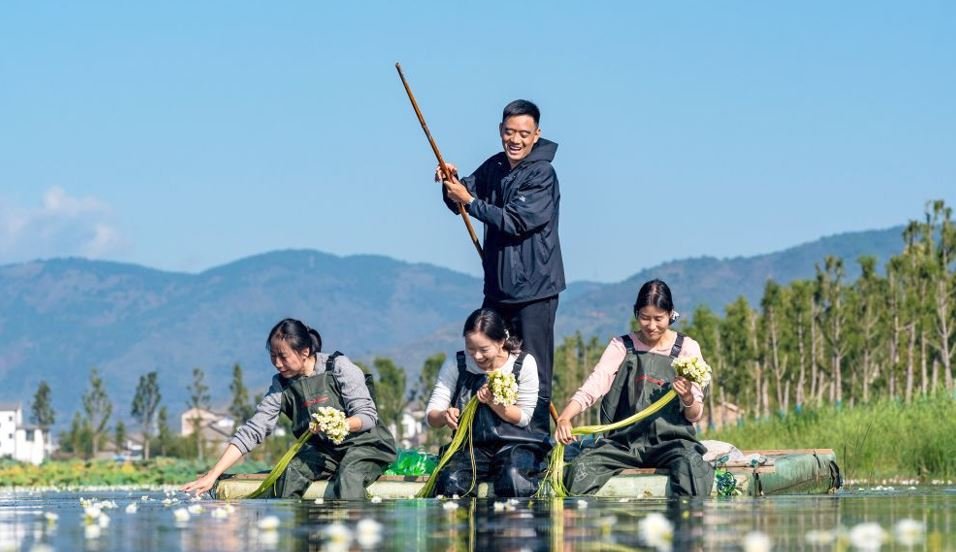
KUNMING: The large-scale return of Ottelia acuminata, a delicate aquatic plant that survives only in clean water, is offering fresh evidence of ecological recovery at Erhai Lake in southwest China’s Yunnan Province.
The plant, endemic to China and highly sensitive to water quality, has reappeared across wide areas of the lake after years of restoration work. Its presence is considered a natural indicator of healthy aquatic conditions because it requires clear, unpolluted water with specific mineral characteristics.
Official data show the plant’s coverage at Erhai Lake expanded from about 90,000 square metres in 2021 to 950,000 square metres in 2026, reflecting a sharp improvement in the lake’s ecological environment.
Erhai Lake Water Quality Improves
Erhai Lake faced serious pollution problems in the 1990s as agricultural runoff and other pressures contributed to worsening water quality.
A major blue-green algae outbreak in 1996 left the lake turbid and foul-smelling, while Ottelia acuminata nearly disappeared as conditions deteriorated.
Years of targeted pollution control and ecological restoration have since improved the lake’s water quality. From January to June 2026, Erhai maintained Grade II water quality, according to official data.
The recovery has created more favourable conditions for sensitive aquatic species, including Ottelia acuminata.
Ecological Recovery Brings Economic Benefits
The revival of the plant is also creating new economic opportunities for communities around Erhai Lake.
Ottelia acuminata is edible and has increasingly been cultivated for both environmental and commercial purposes.
In 2018, environmental worker Zhong Lan identified the plant’s potential for water purification and industrial development. With support from local authorities and Shanghai Jiao Tong University, she later established a company and built a research and cultivation base in 2024.
The project developed standardised planting methods designed to improve yields and allow repeated harvesting while creating jobs for local residents.
Villager Li Xinyuan, who had previously stopped growing the plant because of poor returns, resumed cultivation in 2023 and now earns a monthly salary of about 4,500 yuan, or roughly $663, at the base.
Another grower, Du Hongquan, earned more than 100,000 yuan last year from cultivating the plant and has expanded his planting area this year.
More Than 200 Hectares Under Cultivation
Eryuan County, which forms part of the source area for Erhai Lake, now has more than 200 hectares of Ottelia acuminata plantations.
The plant is also being developed into a growing range of commercial products, including tea, plant-based coffee and cookies.
Authorities and businesses are seeking to link ecological restoration with sustainable local industries, creating income while maintaining environmental protection.
China Strengthens Legal Protection for Lakes and Rivers
The recovery comes as China strengthens legal protections for aquatic ecosystems.
The country’s Ecological and Environmental Code includes provisions covering the protection and restoration of rivers and lakes, providing a broader legal framework for water ecosystem management.
China is also advancing its wider Beautiful China initiative, which focuses on environmental restoration, pollution control and green development.
At Erhai Lake, the return of Ottelia acuminata has become a visible sign of how long-term ecological restoration can improve both biodiversity and local livelihoods.