
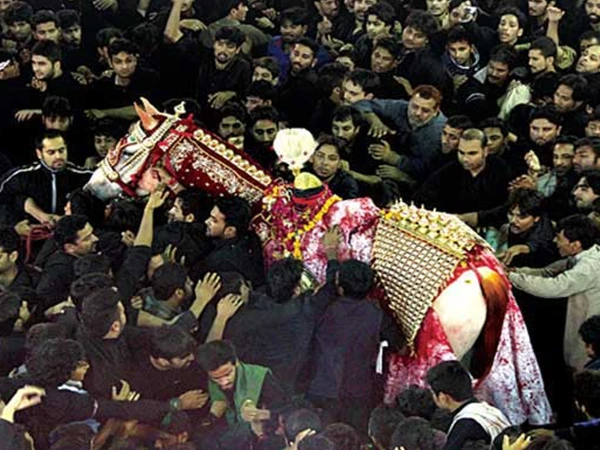
Karachi’s old neighbourhoods of Kharadar, Mithadar and Nishtar Road still preserve some of the city’s oldest Muharram traditions, including historic processions, wooden Zuljanah replicas and accounts of the first live Zuljanah procession in the city.
At the centre of this history are the Bara Imam area, Imambargah Safina-e-Najaf, Jhoola Karbala and several other old imambargahs that remain closely linked to Karachi’s religious and cultural memory. During Muharram, these narrow streets become a living record of the city’s pre-Partition past, its port history and its long association with mourning rituals for Karbala.
Several buildings in the area carry dates from the 19th and early 20th centuries, including 1803, 1836 and 1901. Local accounts suggest that around a dozen imambargahs once stood around Safina-e-Najaf and the old Bara Imam area, though about nine remain today.
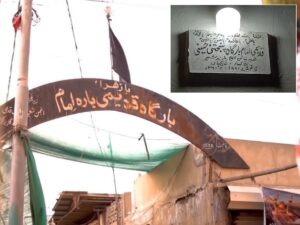
A pre-Partition tradition
Jowad Hussain Allah Ditta, son of the late Qamarullah Ditta, a former chairman of Imambargah Safina-e-Najaf, said his family has served the imambargah for three to four generations.
He said the area became known as Bara Imam because of the number of imambargahs located around it. According to him, Muharram processions were held in the area even before the creation of Pakistan.
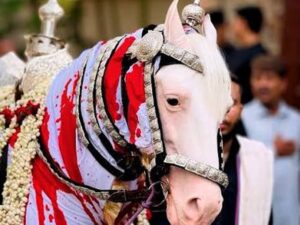
In earlier times, wooden Zuljanah replicas were brought out in processions. Jowad said Safina-e-Najaf later received permission in 1971 to bring out a live Zuljanah, with regular processions beginning after 1972.
“First we received the permit for the live Zuljanah, then permission for loudspeakers, and later formal approval for other processions,” he said.
According to local traditions, wooden Zuljanah processions in Kharadar and nearby areas are much older. Some residents say wooden Zuljanah replicas are still brought out in parts of Kharadar on 4 Muharram, continuing a tradition believed to be around 150 to 200 years old.
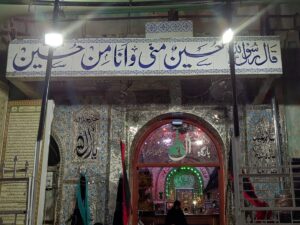
A stop for pilgrims before sea travel
The Bara Imam and Safina-e-Najaf area also held importance for pilgrims travelling to Iraq, Iran and Syria before air travel became common.
Because Karachi’s port was nearby, pilgrims from across Pakistan would first visit these imambargahs, offer prayers and then begin their journey by sea. Jowad said the area served as a major gathering point for pilgrims during the 1960s and 1970s.
“At that time, there was no other centre of this kind in Karachi. People from all over Pakistan came here before leaving for pilgrimage,” he said.
Amroha traditions and the 8 Muharram procession
The historic 8 Muharram procession is another important part of the area’s identity. It reflects the mourning traditions of the Amroha community, including old wooden alams, floral decorations and traditional forms of azadari.
The main procession reaches the area around Maghrib, where prayers are offered before mourning rituals continue.
Jowad said the 8 Muharram procession of the Amroha community and the 9 Muharram procession remain among the oldest traditions linked to Bara Imam and its surrounding imambargahs.
A 200-year-old alam at Jhoola Karbala
Near Bara Imam, Imambargah Jhoola Karbala, said to have been established in 1803, preserves an alam known locally as the “Basharati Alam.”
Professor Javed, one of the caretakers of Jhoola Karbala, said the alam was brought from Africa nearly two centuries ago and transported to Karachi by sea. Similar historic alams are also believed to exist in Kharadar, Chhota Imambargah and other nearby locations.
He said the alam was made of wood and, although some weakened parts have been repaired for preservation, its original structure has largely been maintained.
According to Professor Javed, the imambargah also preserves a British-era licence that allowed the procession to be taken out. He said the document has remained part of the imambargah’s historical record and was renewed over the years.
He added that the land was once associated with the Talpur rulers of Sindh before the British period, when formal permission for Muharram processions was granted.
A living part of Karachi’s collective memory
The Bara Imam, Safina-e-Najaf and surrounding imambargahs are not only religious sites. They are part of Karachi’s collective memory, linking the city’s port history, migrant communities, pilgrimage routes and centuries-old mourning traditions.
From wooden Zuljanah processions to the first live Zuljanah permit, and from historic alams to pre-sea-travel pilgrim gatherings, the area continues to carry stories that remain central to Karachi’s Muharram heritage.
Also Read: Karachi Traffic Plan for Muharram Announced: Key Routes to Remain Closed During Processions