
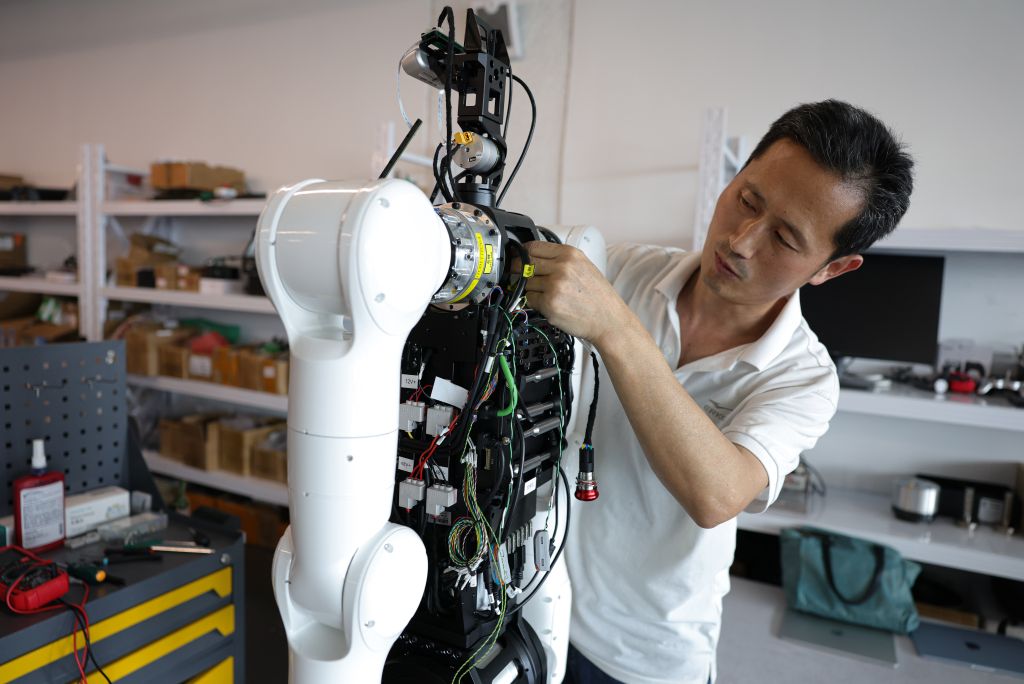
BEIJING: China is positioning itself at the forefront of the global digital economy by promoting a people-centered approach to artificial intelligence (AI), with policymakers, technology firms and industry experts highlighting innovations designed to improve healthcare, manufacturing and everyday life.
The vision was on display at the 2026 Global Digital Economy Conference in Beijing, where companies showcased AI-powered technologies aimed at solving real-world challenges while supporting sustainable economic growth.
One of the event’s highlights was an intelligent diagnostic system developed by Guanwei Intelligent Technology (Beijing) Co., Ltd. The AI-powered device analyzes facial features and eye characteristics to generate personalized health reports based on traditional Chinese medicine (TCM), reducing the need for conventional in-person consultations.
According to the company, the system has been digitized and standardized to modernize TCM while making its diagnostic capabilities accessible to users worldwide. The technology is currently available in more than a dozen languages, including English, Korean, Russian and Thai, and is expanding into international markets.
The conference also featured industrial AI solutions, including Xiaoyubot’s intelligent robotic welding system, designed to improve manufacturing efficiency while reducing workers’ exposure to hazardous conditions such as extreme heat, bright welding light and toxic fumes.
Company founder and CEO Qiao Zhongliang said embodied AI should ultimately serve the real economy by addressing practical industrial needs. Established in 2023, Xiaoyubot focuses on intelligent welding applications and plans to further support the digital transformation of manufacturing.
The conference reflected China’s broader push to integrate AI into daily life and industrial development. AI-powered travel photography services, robot dogs and other smart technologies are becoming increasingly common in Chinese cities, while Chinese digital platforms continue expanding internationally.
ByteDance’s TikTok now operates in more than 100 countries and regions, while its AI assistant Doubao’s overseas version, Dola, has gained growing international attention. Chinese AI company Zhipu AI has also launched large-model infrastructure projects in Singapore, the United Arab Emirates and Saudi Arabia.
Industry experts said China’s rapid progress stems from strong government support, technological innovation and collaboration between academia and industry.
Joe Weinman, founder of the International Institute for Future Industries, said China, particularly Beijing, has become a global leader in AI by combining data resources, advanced computing infrastructure, research capabilities and entrepreneurial talent to develop affordable digital solutions with worldwide applications.
Jiang Xiaojuan, professor at the University of Chinese Academy of Social Sciences, said China’s innovation model emphasizes openness, collaboration and meeting people’s needs. She noted that unlike traditional manufacturing, AI technologies are global from the outset, with open-source models lowering barriers to innovation and encouraging international cooperation.
China’s long-term strategy also reinforces this direction. The country’s 15th Five-Year Plan (2026-2030) prioritizes strengthening core digital economy industries, building globally competitive digital industrial clusters and expanding the use of digital technologies across healthcare, education, elderly care, culture, tourism, employment and consumer services.
As AI adoption accelerates globally, conference participants also stressed the need for stronger international cooperation on issues including cybersecurity, cross-border data governance and digital standards.
The 2026 Global Digital Economy Cities Report, released during the conference, identified people-centered digitalization, industrial collaboration, data openness, cybersecurity, mutual recognition of standards and international partnerships as key priorities for building a secure, inclusive and sustainable digital economy.
Chinese Institute of New Generation Artificial Intelligence Development Strategies Executive President Gong Ke said AI and the digital economy should ultimately serve humanity rather than becoming goals in themselves, emphasizing that technological development must contribute to sustainable human progress.