
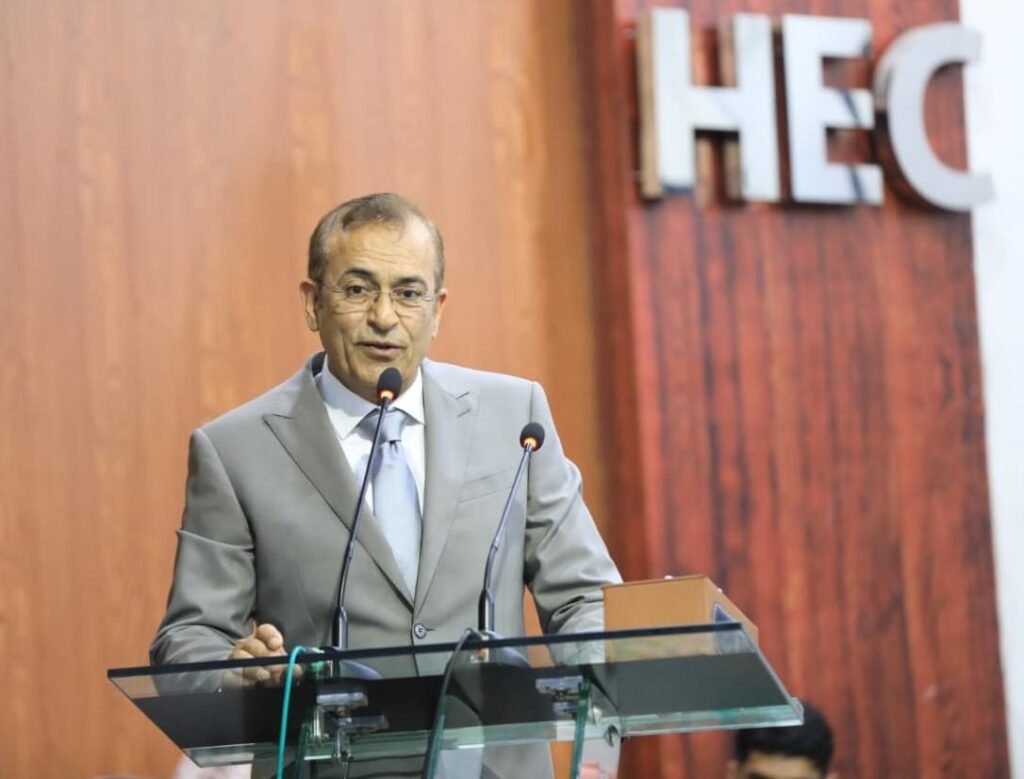
ISLAMABAD: The Higher Education Commission (HEC) has appointed National University of Sciences and Technology (NUST) Rector Dr Muhammad Zahid Latif as National Chair on Artificial Intelligence and Robotics, assigning the university a leading role in shaping Pakistan’s strategy for emerging technologies.
The appointment places NUST at the centre of a national initiative focused on artificial intelligence and robotics, two sectors increasingly linked to economic growth, industrial development, security systems and digital governance worldwide.
According to an HEC announcement, the National Chair will operate from the NUST campus in Islamabad and work with a panel of experts to guide policy direction, governance structures and strategic coordination for Pakistan’s AI and robotics ecosystem.
The initiative will also oversee the performance and long-term sustainability of HEC-supported institutions, including the National Centre of Artificial Intelligence (NCAI) and the National Centre of Robotics and Automation (NCRA).
National framework for AI and robotics
HEC said the appointment reflects confidence in NUST’s research and academic capabilities in advanced technologies and innovation.
In a statement, Dr Muhammad Zahid Latif said the initiative offers an opportunity to strengthen collaboration among universities, industry, government institutions and technology innovators.
“This initiative is not only a recognition of NUST’s academic and research contributions, but also a collective national opportunity to build long-term strategic coherence in emerging technologies,” he said.
The National Chair will also assess structural gaps, operational challenges and policy issues affecting the growth of Pakistan’s AI and robotics sector.
Focus on innovation and global standards
According to HEC, the initiative aims to benchmark Pakistan’s progress against international standards and develop a coordinated national framework for artificial intelligence and robotics.
The framework is expected to support institutional alignment, improve coordination among stakeholders and identify practical implementation strategies for future growth.
Officials said the initiative is intended to help accelerate Pakistan’s transition toward a knowledge-based economy driven by innovation, intelligent systems and advanced automation technologies.