
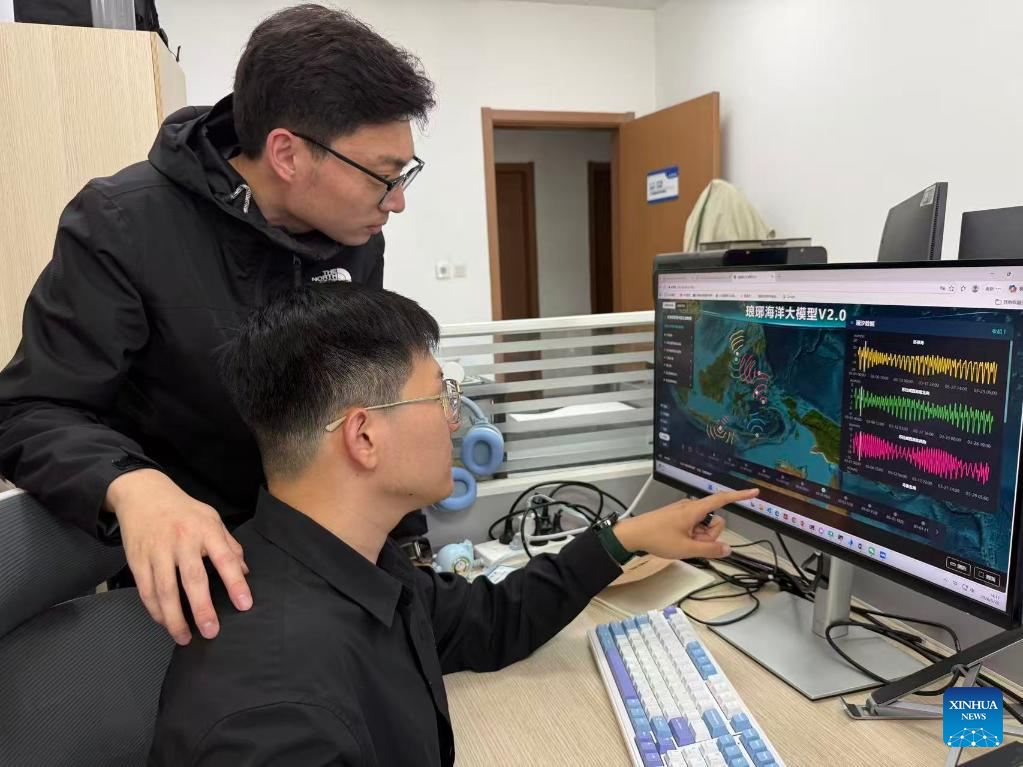
Qingdao: Chinese scientists have launched an upgraded artificial intelligence system capable of forecasting complex marine phenomena, including typhoons, extreme rainfall, storm surges, and Arctic sea ice, in a move aimed at strengthening disaster preparedness and ocean monitoring.
The new model, called LangYa 2.0, was unveiled at the Fourth China Digital Earth Conference in Qingdao, Shandong Province. Developed by the Institute of Oceanology under the Chinese Academy of Sciences (IOCAS), the system expands significantly on the capabilities of its predecessor, which focused primarily on forecasting ocean conditions such as temperature, salinity, and currents.
According to IOCAS, LangYa 2.0 can predict six major marine phenomena: typhoons, extreme rainfall, storm surges, internal solitary waves, mesoscale ocean eddies, and sea ice.
Researchers said the upgraded platform combines artificial intelligence, oceanographic observations, and physical modeling to provide forecasts intended to support disaster prevention, maritime operations, climate research, and navigation.
Expanded forecasting capabilities
The system consists of six specialized AI sub-models, each trained on different datasets and designed to analyze specific marine processes.
Wang Fan, president of IOCAS, said the new model represents a shift from forecasting general ocean conditions to predicting complex marine events that can directly affect coastal communities, shipping operations, and offshore infrastructure.
The typhoon forecasting component integrates atmospheric and oceanic data, satellite imagery, and historical storm tracks to improve predictions of rapid intensification and sudden changes in direction.
Researchers said these capabilities could help provide earlier warnings for communities in areas vulnerable to severe weather events.
Applications for shipping and climate research
LangYa 2.0 also includes tools for monitoring internal solitary waves, powerful underwater currents that can pose risks to offshore engineering projects and marine operations.
The system can forecast the development of these waves up to 30 days in advance and provide information on their speed and intensity.
In addition, the sea ice forecasting module has demonstrated strong performance in Arctic monitoring. According to the research team, the model ranked first among several international forecasting systems in a 2025 seasonal prediction of September Arctic sea ice extent, based on assessments by the Sea Ice Prediction Network.
Researchers said the model delivers monthly forecasts at a spatial resolution of three kilometres, providing information that may support Arctic shipping, climate studies, and polar navigation.
Future development plans
The research team said future versions of LangYa will incorporate climate and ecological data and explore the development of intelligent marine decision-support systems.
Scientists noted that the platform is designed to integrate multiple sources of environmental information to improve the speed, accuracy, and accessibility of marine forecasting services.
LangYa takes its name from an ancient Chinese term associated with precious jade and references the historic LangYa Terrace, a site known for astronomical observations in ancient China.
Researchers said the project reflects ongoing efforts to apply artificial intelligence to ocean science and improve understanding of marine environments through advanced forecasting technologies.
Also Read: Scientists use earthquake sensors and AI to track endangered whales in South China Sea