
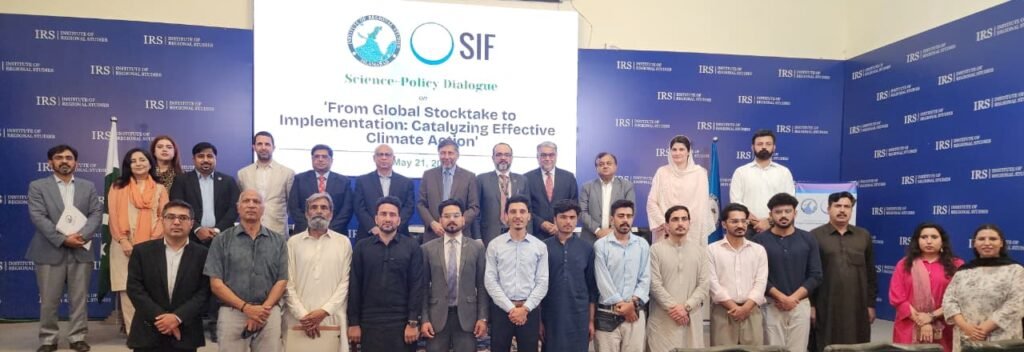
ISLAMABAD: The Institute of Regional Studies (IRS), in collaboration with Secours Islamique France (SIF)-Pakistan, hosted a high-level science-policy dialogue to discuss how global climate commitments can be translated into practical action in Pakistan and other vulnerable regions.
The event, titled “From Global Stocktake to Implementation: Catalyzing Effective Climate Action,” brought together representatives from international organizations, government institutions, development agencies, academia, and civil society. Participants examined climate governance challenges and opportunities following the first Global Stocktake under the Paris Agreement and subsequent international climate negotiations.
Focus on climate resilience and implementation
Speaking at the dialogue, Jauhar Saleem, President of the IRS, said Pakistan remains among the countries most vulnerable to climate-related disasters despite contributing only a small share of global greenhouse gas emissions.
He said climate change, water scarcity, environmental degradation, population growth, and sustainable development are closely linked challenges that require a coordinated national response. He emphasized the need for greater climate financing, resilient infrastructure, public awareness, and stronger governance mechanisms to improve long-term resilience.
Shiraz Shah, Assistant Resident Representative of UNDP Pakistan, highlighted the importance of converting policy commitments into effective implementation mechanisms. He stressed the need for stronger institutional coordination, locally driven solutions, integrated policy frameworks, and partnerships among governments, development organizations, and communities to support climate adaptation and sustainable development.
Climate risks to food security and development
Thomas Conan, Deputy Country Director of WFP Pakistan, warned that climate change is posing increasing risks to food security. He called for resilient food systems, climate-smart agriculture, anticipatory action, and stronger social protection measures to reduce vulnerabilities affecting agriculture, livelihoods, and supply chains.
Meanwhile, Muhammad Arif Goheer, Executive Director of the Global Change Impact Studies Centre (GCISC), outlined Pakistan’s climate challenges, including extreme weather events, glacial melt, water stress, and rising temperatures. He emphasized the importance of science-based planning, climate data systems, research, and institutional capacity-building to support informed policymaking and long-term adaptation.
Amir Khan Goraya, Chief Executive Officer of the National Disaster Risk Management Fund (NDRMF), highlighted the role of risk financing and innovative financial mechanisms in strengthening climate resilience. He stressed the importance of sustained investment in preparedness, disaster risk reduction, and community-level adaptation initiatives.
Call for stronger cooperation
Concluding the session, Altaf Abro, Head of Mission at SIF Pakistan, called for stronger climate governance, innovative risk-financing approaches, and enhanced collaboration among government institutions, academia, development partners, the private sector, and local communities. He also underscored the role of green technologies and practical climate solutions in addressing environmental and humanitarian challenges.
Anjum Rasheed, Head of the Climate Resilience Program at IRS, noted that the first Global Stocktake concluded at COP28 in 2023 represented a landmark assessment of global climate progress. She said the world remains off track to limit global warming to 1.5°C, while adaptation gaps continue to widen and climate finance remains insufficient for vulnerable countries.
She stressed the need to accelerate climate action through stronger Nationally Determined Contributions (NDCs), increased climate financing, enhanced implementation efforts, and greater international cooperation.