
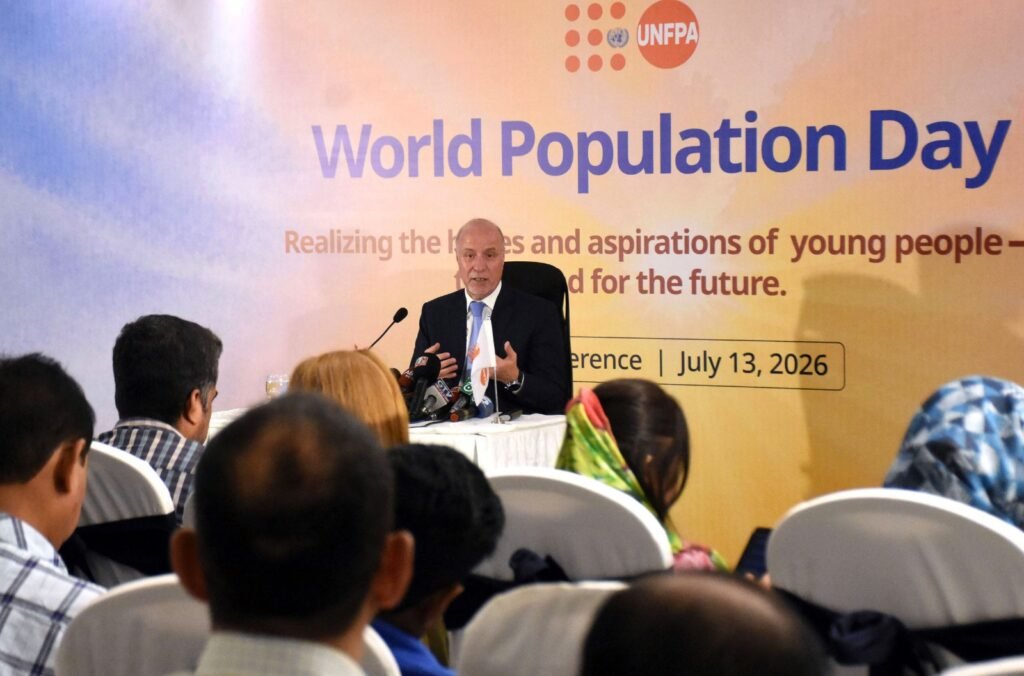
ISLAMABAD: Pakistan’s rapid population growth has become a national security concern requiring coordinated action from political, religious, military and social leaders, the United Nations Population Fund said on Monday.
UNFPA Pakistan Representative Dr Luay Shabaneh said the country’s population had reached about 257.2 million, with nearly one-third of citizens aged between 10 and 24. He warned that Pakistan must invest in education, healthcare, skills and employment to benefit from its large youth population.
Speaking at a media briefing ahead of World Population Day 2026, Shabaneh presented findings from the UNFPA report, Lives, Choices and Futures: What Young People Want and What Shapes Their Decisions About Relationships and Parenthood.
The global report is based on responses from more than 100,000 people aged 18 to 39 across 73 countries, including more than 1,700 respondents from Pakistan.
Youth Population Offers Opportunity and Risk
Shabaneh said Pakistan had an opportunity to achieve greater economic prosperity before its population began to age. However, he cautioned that the country could lose its demographic dividend without sufficient investment in young people.
He said population management should no longer be treated only as a health or economic issue because it also affects social stability, economic resilience and national security.
The UNFPA representative welcomed the government’s renewed focus on the issue, including Prime Minister Shehbaz Sharif’s chairing of the National Population Council.
He said the inclusion of Field Marshal Syed Asim Munir in the council indicated that population planning was increasingly being treated as a strategic national priority.
UNFPA Calls for Wider Leadership Role
Shabaneh said government departments could not address population growth alone and called for greater involvement from parliamentarians, provincial lawmakers, religious scholars and community leaders.
He said these groups could help promote responsible parenthood, birth spacing, girls’ education and accurate information about reproductive health.
According to the report, young people worldwide generally want stable relationships, meaningful lives and families, but economic uncertainty, housing shortages, conflict, gender inequality and climate concerns are increasingly shaping decisions about marriage and parenthood.
In Pakistan, 76% of respondents said they remained optimistic about the future. However, 53% identified conflict, security risks, economic insecurity, inequality, health concerns and environmental threats as major worries.
Survey Shows Gap in Desired Family Size
The survey found differences between the number of children respondents currently had and the number they ideally wanted.
Women in Pakistan reported having an average of 1.8 children but said they would ideally prefer 2.5. Men reported an average of 2.5 children and said they would prefer 3.4.
Among respondents aged 35 to 39 who did not have children, 65% said they wanted to become parents.
Shabaneh said decisions about having children were influenced by financial stability, secure employment, affordable housing, emotional readiness, healthcare access, gender equality and the availability of reliable public services.
Digital Access and Employment Highlighted
The UNFPA representative said internet access had become essential for education, employment, information and participation in public life.
He called for greater digital inclusion for girls, rural communities and marginalised groups, noting that Pakistan already had one of the world’s largest young freelance workforces.
UNFPA recommended expanding skills development and decent employment opportunities, particularly in the digital economy.
It also called for youth-friendly reproductive health services, wider access to birth-spacing services, stronger healthcare and midwifery systems, and sustained efforts to prevent child marriage.
Other recommendations included promoting gender equality, creating dignified employment for women and improving support for people affected by climate displacement and disability.
Shabaneh said World Population Day should remind policymakers that Pakistan’s future would depend not only on the size of its population but also on the quality of decisions taken today.
Also Read: Media Coalition Meeting in Swat Calls for Greater Investment in Population Stabilisation