
HEFEI: China’s expanding startup ecosystem is helping entrepreneurs transform ideas in artificial intelligence, advanced manufacturing and traditional crafts into commercial ventures, supported by financing, incubation services, training and government-backed programmes.
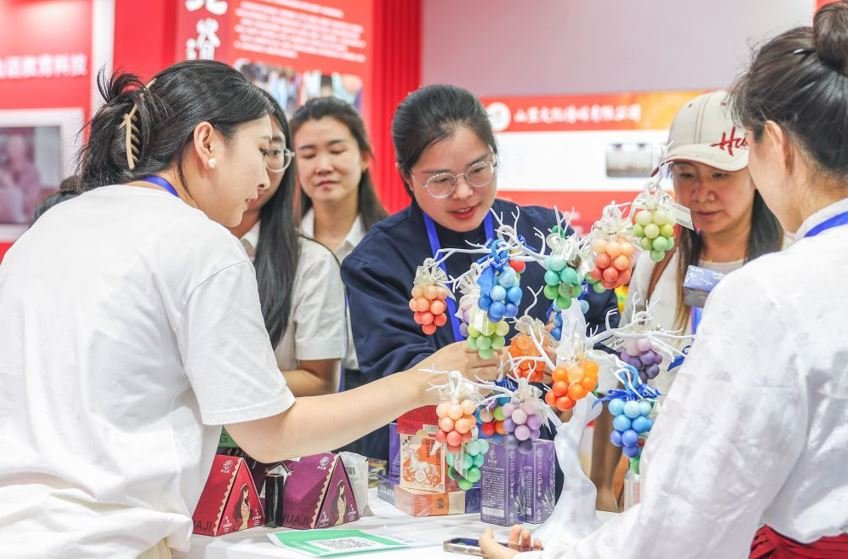
The trend was highlighted at the national finals of an entrepreneurship competition in Hefei, capital of eastern China’s Anhui province, where around 600 entrepreneurs showcased projects ranging from digitally recreated cultural products to smart industrial equipment.
The four-day event was jointly organised by China’s Ministry of Human Resources and Social Security and the Anhui provincial government.
Digital Technology Gives Traditional Crafts New Value
Among the participants was Wu Shuping from Jiangxi province, who presented a project that uses digital scanning and 3D-printing technology to reproduce porcelain cranes inspired by traditional root-carving artworks.
Wu’s team converts original sculptures into reusable three-dimensional files before producing porcelain moulds that are manually carved, glazed and fired at high temperatures.
The process has improved production efficiency while allowing traditional craftsmen to experiment with new forms of design.
Wu said the longer-term goal was to convert intangible cultural heritage into digital assets that could be licensed to museums, designers and international clients.
Artificial intelligence can also be used to modify the digital designs, allowing users to create new variations while preserving elements of the original craft.
According to Wu, local authorities helped the project secure workspace and establish links with a team developing a large language model for AI applications.
Traditional Brush Business Expands Into Robotics
Another participant, Zhang Mengni from Anqing in Anhui province, used support from local entrepreneurship programmes to transform a family brush-making business into a technology-focused enterprise.
After attending government-organised training and visiting universities in Shanghai and Zhejiang, Zhang began working with researchers to develop an autonomous robot for cleaning photovoltaic panels.
The machine uses visual obstacle detection and autonomous navigation to clean solar panels more efficiently.
Zhang said growing investment in solar power had increased demand for automated cleaning systems.
Her company’s products have been exported to 63 countries, while the project has created more than 1,200 jobs across its supply chain, according to information presented at the competition.
Loans and Incubation Support New Businesses
China has expanded financial and institutional support for entrepreneurs as part of broader efforts to promote employment and economic growth.
More than one million entrepreneurs receive government-supported loans with subsidised interest each year, according to official data cited by the event organisers.
During China’s 14th Five-Year Plan period from 2021 to 2025, more than 10 million new business entities were added annually on average.
Support available to startups includes financing, free or subsidised workspace, business training, technology partnerships and incubation services.
Competition organisers said these measures were intended to help entrepreneurs move from early-stage concepts to commercially viable companies.
Emerging Industries Create New Opportunities
Li Yu, a researcher at the Chinese Academy of Personnel Science, said the continued emergence of new technologies, industries and business models was creating wider market opportunities for entrepreneurs.
Policy support could improve startup survival rates and encourage more people to launch businesses, while successful enterprises could contribute to employment and economic development, he added.
The projects displayed in Hefei reflected a broader shift in China’s entrepreneurial landscape, where traditional industries are increasingly being combined with AI, robotics and digital manufacturing to reach new domestic and international markets.
Also Read: China-Russia Cross-Border Ropeway Nears Completion, Cutting Journey to Eight Minutes