
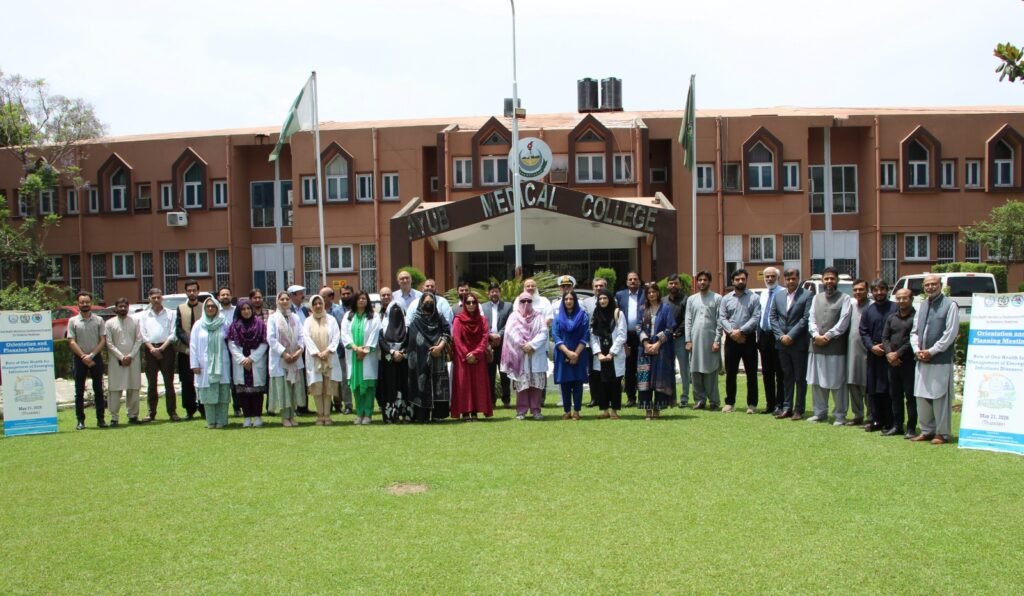
ISLAMABAD, June 3 (ABC): Health experts in Pakistan are calling for wider adoption of the One Health approach to improve the country’s ability to detect, prevent and respond to emerging infectious diseases. The recommendation comes as public health specialists, clinicians and government representatives seek stronger coordination between human, animal and environmental health systems to address disease threats that can spread across sectors.
The discussion took place during an advocacy seminar on managing emerging infectious diseases, organized by the Health Services Academy (HSA) and Ayub Medical College (AMC) under a project focused on workforce development and pandemic preparedness.
What is the One Health approach?
The One Health approach is a framework that recognizes the connection between human health, animal health and the environment.
Many infectious diseases, including several recent global outbreaks, originate in animals or are influenced by environmental factors. The One Health model promotes collaboration among medical professionals, veterinarians, environmental experts and policymakers to identify risks earlier and coordinate responses more effectively.
The approach is increasingly used worldwide to address zoonotic diseases, food safety risks, antimicrobial resistance and environmental health challenges.
Why does it matter for emerging infectious diseases?
Emerging infectious diseases are illnesses that are newly identified, increasing in frequency, or spreading to new geographic areas or populations.
Experts say disease surveillance systems often collect information from different sectors separately. When health, livestock and environmental data are not connected, warning signs may be missed or identified too late.
According to participants at the seminar, stronger coordination can improve outbreak detection, support faster responses and help prevent localized health threats from developing into larger public health emergencies.
What challenges did experts identify?
Participants noted that Pakistan already has several disease surveillance systems and data collection mechanisms.
However, experts said many of these systems operate independently, limiting their ability to provide comprehensive and timely information during disease outbreaks.
National One Health Coordinator Prof Dr Tariq Mahmood Ali emphasized the need to connect field-level reporting with decision-making processes at district and provincial levels. He said better integration of surveillance data could strengthen outbreak preparedness and response efforts.
Who is involved in the One Health framework?
The One Health approach involves multiple sectors rather than relying solely on healthcare institutions.
Representatives attending the seminar included stakeholders from:
- Human health services
- Livestock and animal health departments
- Food safety authorities
- Environmental agencies
- Planning and development institutions
- Public health organizations
- Medical teaching institutions
Experts said cooperation among these sectors is necessary because disease risks can emerge from interactions between people, animals and the environment.
What recommendations were discussed?
Speakers highlighted several measures that could strengthen implementation of the One Health framework.
These included improving coordination between hospitals, infection prevention and control systems, public health institutions and surveillance networks.
Prof Dr Umer Farooq, Dean and Head of Community Medicine at Ayub Medical College, proposed establishing district-level technical working groups that would bring together representatives from relevant sectors to coordinate disease prevention and response activities.
He also suggested that Abbottabad could serve as a pilot district for demonstrating integrated One Health coordination before similar models are expanded elsewhere.
What topics were covered at the seminar?
The seminar included discussions on several areas related to public health preparedness and disease prevention.
Key topics included:
- Workforce development for health emergencies
- Integrated disease surveillance systems
- Food safety challenges
- Water, sanitation and hygiene (WASH) risks
- Environmental factors affecting public health
- Pandemic readiness and response planning
Participants examined how these areas intersect and how coordination across sectors can improve preparedness for future health threats.
What happens next?
Experts at the seminar emphasized the need for sustained collaboration between government agencies, healthcare institutions, veterinary services and environmental organizations.
The discussions focused on strengthening coordination mechanisms, improving data sharing and developing integrated approaches to disease surveillance and outbreak response.
Supporters of the One Health framework argue that closer cooperation across sectors could enhance Pakistan’s capacity to detect and respond to future epidemics and pandemics while improving overall public health preparedness.