
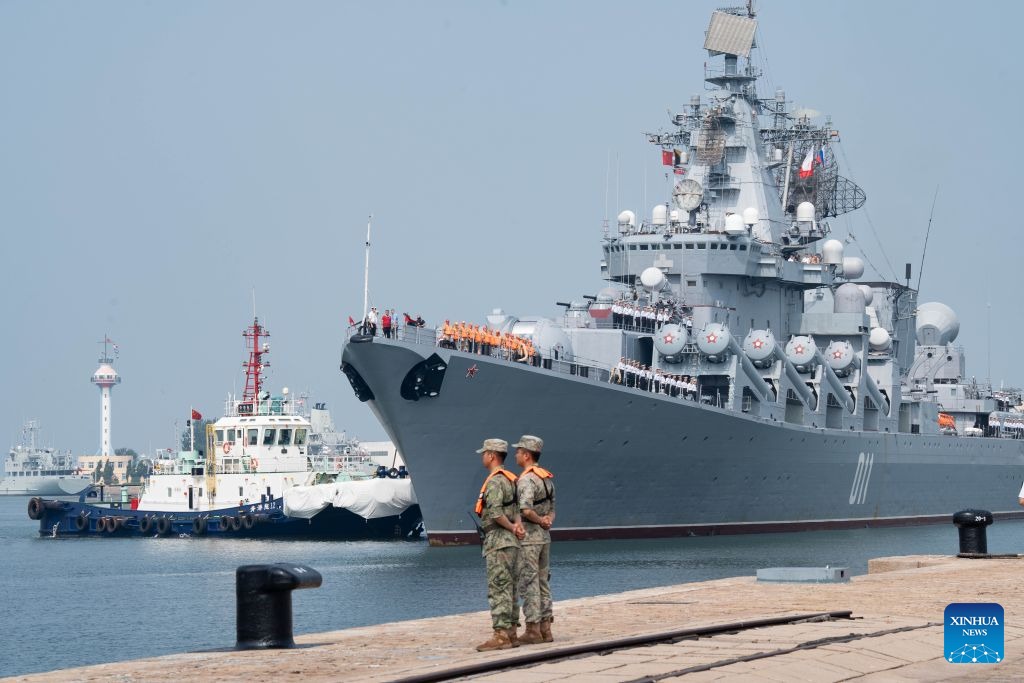
BEIJING: China and Russia have begun their annual joint naval exercise near the eastern Chinese port city of Qingdao, with the two countries also planning a coordinated maritime patrol in the Pacific Ocean as part of efforts to strengthen defense cooperation and address regional security challenges.
China’s Ministry of National Defense announced on Sunday that the “Joint Sea-2026” exercise will take place this month in waters and airspace off Qingdao in Shandong Province. Following the drills, naval forces from both countries will carry out a joint maritime patrol in relevant areas of the Pacific Ocean.
Military sources said Russian naval vessels participating in the exercise had already arrived at a military port in Qingdao, completing the assembly of all participating forces.
Russia has deployed a guided-missile cruiser, a frigate, a submarine and a rescue ship for the exercise. China’s contingent is primarily drawn from the Northern Theater Command Navy and includes guided-missile destroyers, a guided-missile frigate, a comprehensive supply ship, a rescue vessel and a submarine. Both sides will also field shipborne helicopters and marine units.
According to the Chinese defense ministry, the exercise is designed to enhance joint operational capabilities in responding to maritime security threats. The drills will be conducted in three phases, beginning with force assembly, followed by harbor-based planning before moving to at-sea operations.
Training activities will include joint reconnaissance missions, air and missile defense exercises, maritime strike operations and other coordinated combat scenarios aimed at improving interoperability between the two navies.
Beyond operational training, military personnel from China and Russia will participate in professional exchanges and organized visits aboard participating naval vessels to strengthen bilateral military cooperation.
The ministry said Joint Sea-2026 is part of the annual defense cooperation plan between China and Russia and is intended to improve coordination in addressing common security challenges while contributing to regional peace and stability.
The latest exercise underscores the continuing expansion of military ties between Beijing and Moscow as both countries increase joint training activities and maritime cooperation in the Asia-Pacific region.
Also Read: China Bets on People-Centered AI to Shape the Future of the Global Digital Economy