
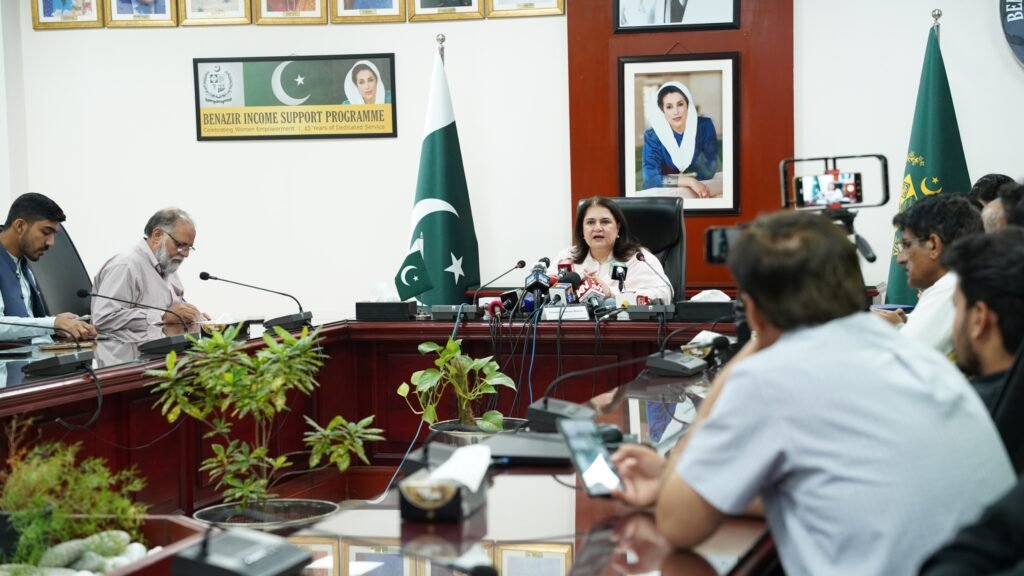
ISLAMABAD: The Benazir Income Support Programme (BISP) will transition all beneficiary payments to digital wallets from July 2026 as part of efforts to improve transparency, financial inclusion, and ease of access for millions of women receiving social protection assistance across Pakistan.
The announcement was made by BISP Chairperson Rubina Khalid during a press conference at BISP Headquarters in Islamabad on Sunday. She said more than 8 million free Benazir SIMs have already been distributed to women beneficiaries to facilitate the opening and operation of digital wallets.
According to BISP, the new payment mechanism is intended to reduce unauthorized deductions, improve payment security, and provide beneficiaries with greater control over their financial assistance.
Digital payments and financial inclusion
Rubina Khalid said beneficiaries will be able to access payments through multiple banking channels under an interoperability system introduced by the programme.
She added that women facing biometric verification issues, including those whose fingerprints cannot be verified, will also be able to receive funds through bank accounts.
The chairperson said BISP currently supports more than 10 million families across Pakistan and remains focused on expanding financial inclusion and social protection services for vulnerable households.
Re-certification system to improve transparency
BISP has also introduced a re-certification mechanism under which beneficiary households will be reassessed every three years.
Officials said the process is designed to ensure that assistance continues to reach eligible families, while households whose economic circumstances have improved can be replaced by newly deserving beneficiaries.
The programme’s National Socio-Economic Registry (NSER) continues to serve as a key database used by federal and provincial authorities for welfare programmes, subsidies, and social assistance initiatives.
Education, nutrition and skills programmes
The chairperson highlighted progress under several BISP initiatives, including the Benazir Nashonuma Programme, which currently supports more than 2.2 million pregnant and lactating women and their children.
According to BISP, the programme has contributed to a 22 percent reduction in child stunting.
Under the Benazir Hunarmand Programme, more than 6,000 young people have been enrolled in technical and vocational skills training, while over 1,000 participants have already received certificates.
BISP also reported that more than 12 million children are receiving support through the Benazir Taleemi Wazaif Programme. Among them, 503 students achieved A+ grades in matriculation examinations.
Nationwide service network
Rubina Khalid said BISP currently operates through a network of 647 centres across the country and remains committed to improving service delivery, transparency, and support for low-income families.
She described the programme as a key component of Pakistan’s social protection framework and said reforms would continue to strengthen access to financial assistance for vulnerable households.
Also Read: BISP Issues Important Deadline for Women Beneficiaries Across Pakistan