
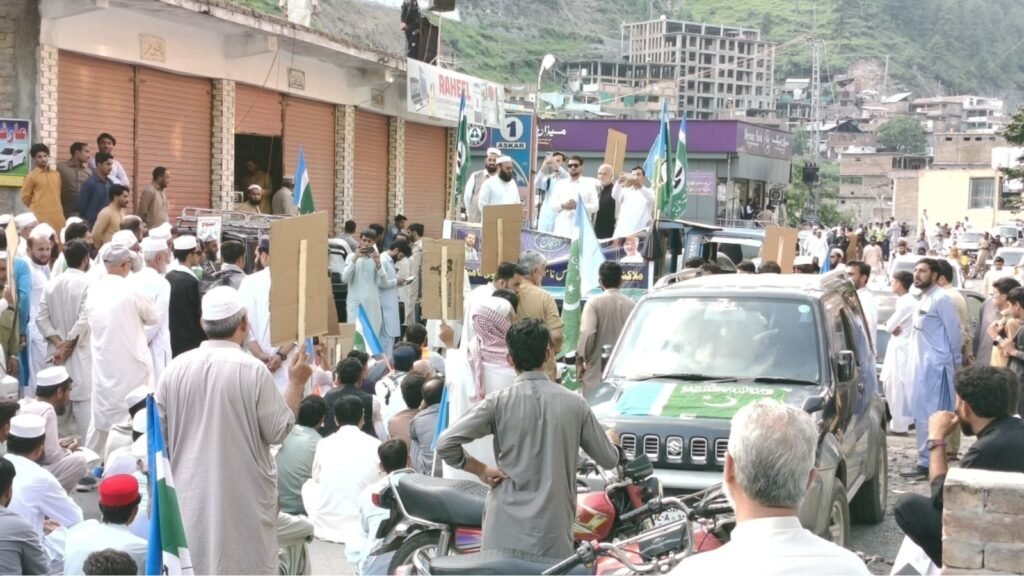
SHANGLA: A district-wide strike and protest demonstrations brought much of Shangla to a standstill on Friday after Jamaat-e-Islami (JI) called for a nationwide protest against rising inflation, new taxes, deteriorating law and order, higher electricity tariffs, repeated fuel price increases, and proposed changes to the special constitutional and legal status of the Malakand Division.
The strike disrupted transport and commercial activity across the mountainous district, with major roads blocked and markets partially closed in response to the protest call.
Roads blocked as transport services suspended
Protesters blocked the district’s main highways and several connecting roads, halting traffic for several hours and affecting the movement of passengers and goods.
Transporters, goods carriers, bus stand unions, traders’ associations, and business groups joined the strike, suspending services in solidarity with the demonstrations. The shutdown caused significant disruption to daily life and economic activity throughout the district.
Markets observe partial shutdown
Major commercial centres, including Alpurai, Bisham, Karora, Shahpur, Puran, and Aloch, witnessed a partial closure as many businesses remained shut during the protest.
Several markets reported low customer turnout due to road blockades and the suspension of public transport.
Protesters raise economic concerns
A large rally was held in Alpurai, where hundreds of demonstrators marched with banners and placards, demanding relief from inflation and opposing recent economic measures.
Participants called on the government to reduce the financial burden on citizens by controlling inflation, lowering electricity tariffs and fuel prices, and withdrawing newly imposed taxes.
Opposition to proposed taxation in Malakand
Addressing the gathering, local Jamaat-e-Islami leaders criticized the country’s economic situation, saying rising prices of fuel, electricity, gas, and essential commodities had placed severe pressure on ordinary households.
The speakers also opposed any move to alter the special constitutional and legal status of the Malakand Division, arguing that the region had already suffered from terrorism, natural disasters, floods, landslides, and prolonged underdevelopment.
They said imposing additional taxes on the region would further increase economic hardship instead of supporting development.
Warning of expanded protest movement
Protest leaders urged the federal and Khyber Pakhtunkhwa governments to preserve Malakand’s existing constitutional status, improve law and order, withdraw proposed taxes, reduce utility and fuel prices, and provide meaningful economic relief.
They warned that if their demands were not addressed, the protest movement would expand through larger demonstrations across the region.
According to local observers, the strike received broad support from traders, transporters, and business organizations, resulting in a significant slowdown in commercial activity throughout Shangla.
Also Read : Pakistan First Furniture Trade Show 2026 Opens in Karachi With 70% Discounts