
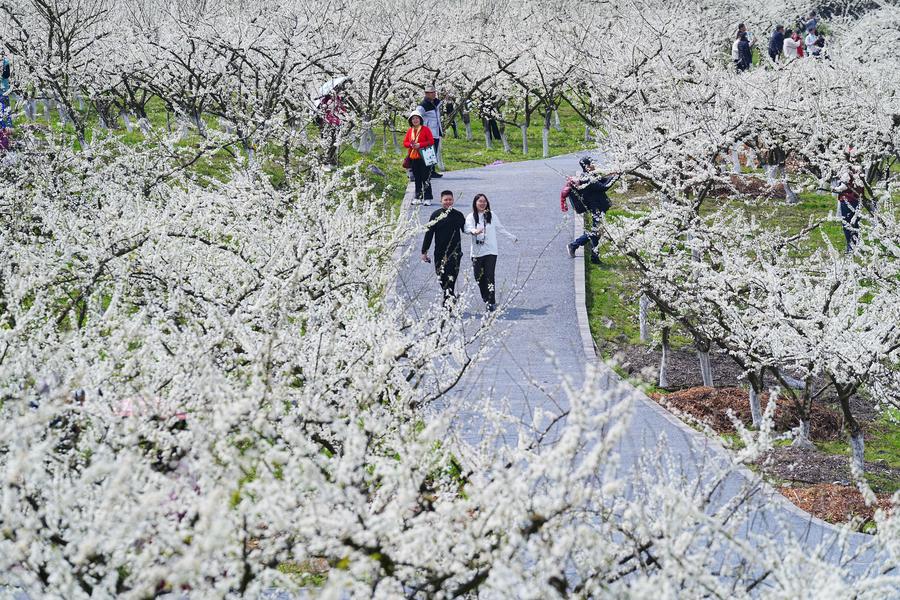
NANNING: China’s rural revitalization drive is attracting a growing number of international visitors, with improved infrastructure, visa-free travel policies and authentic cultural experiences drawing tourists beyond the country’s major cities.
Travelers from countries including the United Kingdom, Ireland and Canada are increasingly exploring villages across China, taking part in traditional farming activities such as harvesting jasmine flowers, picking tea leaves and working in rice fields to gain a deeper understanding of rural life.
In south China’s Guangxi Zhuang Autonomous Region, British travel blogger Alexander Charles Douglas Short described harvesting jasmine flowers alongside local farmers as a meaningful way to experience Chinese culture.
“Rural experiences are what many tourists come for to get a better understanding of what China is really like,” he said, adding that seeing the origins of China’s popular jasmine tea made the experience especially memorable.
Irish travel blogger Luke Wayne O’Farrell said China’s extensive high-speed rail network has made it easier for foreign visitors to reach destinations beyond major urban centers.
“The high-speed trains have made it so easy to travel outside big cities. It’s affordable, convenient and fast, giving tourists access to every part of China,” he said.
After visiting cities such as Beijing, Shanghai and Chongqing, many overseas travelers are now seeking hands-on experiences in China’s countryside, where rural communities have undergone significant transformation through infrastructure development and poverty alleviation initiatives.
According to China’s National Immigration Administration, the country recorded 8.32 million visa-free entries by foreign nationals during the first quarter of 2026, a 29.3 percent increase compared with the same period last year. China also welcomed more than 150 million inbound tourist visits in 2025, representing year-on-year growth of over 17 percent.
Although official data on foreign arrivals specifically to rural destinations are unavailable, videos showing international tourists harvesting rice, plowing fields with water buffalo and visiting traditional villages have gained widespread attention on Chinese social media.
In Guilin, one of China’s best-known tourist destinations, visitors are increasingly choosing interactive rural activities instead of traditional sightseeing. Tea plantations in Yangshuo County have become popular among overseas tourists interested in learning about Chinese tea culture while enjoying the region’s scenic landscapes.
Canadian visitor Victoria Caldwell said the countryside offered a different perspective on China.
“I’ve generally enjoyed the rural aspects of our trip more than the city aspects. It’s definitely shown China to me in a new light,” she said.
Many foreign visitors have also highlighted the modern amenities now available in rural China, including widespread 5G coverage, mobile payment services and reliable internet connectivity, making travel more convenient even in remote areas.
Official statistics show China expanded its rural infrastructure significantly during the 2021-2025 period. Rural roads now extend more than 4.64 million kilometers, connecting every township and more than 500,000 administrative villages nationwide.
Around 95 percent of administrative villages now have access to 5G networks, while broadband services reach more than 200 million rural households, with internet penetration nearing 70 percent in rural areas.
The improved connectivity has fueled strong growth in rural tourism. According to the Ministry of Culture and Tourism, rural destinations across China recorded 793 million visits during the first quarter of 2026, up 12.2 percent year on year. Tourism revenue reached 457 billion yuan (approximately 67.2 billion U.S. dollars), marking a 10.9 percent increase.
Dai Bin, president of the China Tourism Academy, said continued investment in transport, telecommunications, digital payment systems and cultural tourism facilities has significantly enhanced the appeal of China’s countryside for international travelers.
He said new attractions, including leisure trails, camping sites and workshops showcasing traditional cultural heritage, are helping position rural China as an increasingly attractive destination for inbound tourism.