
By Shen Shaotie, Yin Jie, People’s Daily
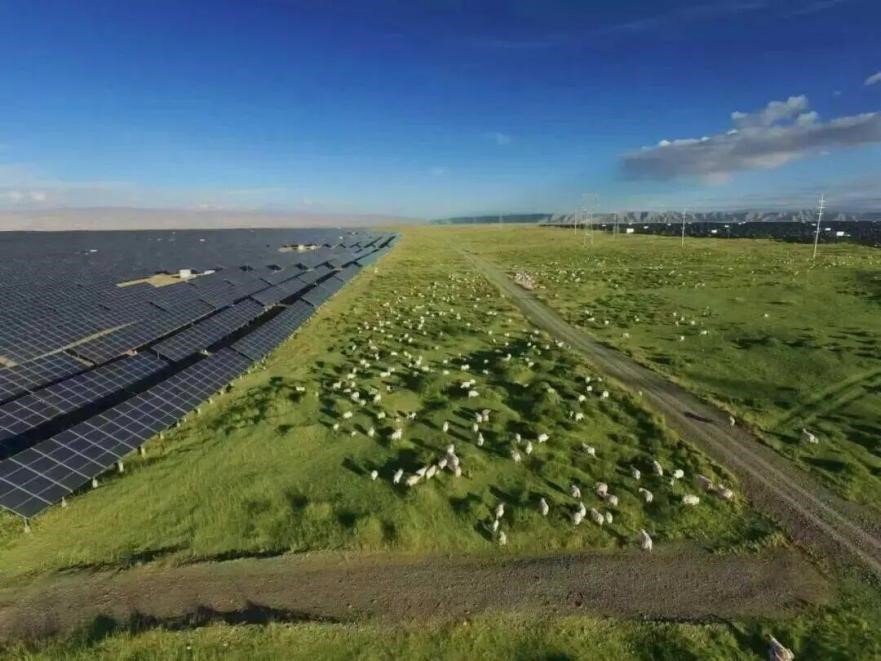
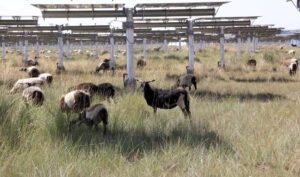
Under the summer sun, endless rows of photovoltaic panels shimmer like a sweeping blue sea. Beneath them, lush grass grows, and a flock of sheep grazes leisurely. This vibrant scene is unfolding at the photovoltaic park in Talatan of Gonghe county, Hainan Tibetan autonomous prefecture, northwest China’s Qinghai province.
Yehdor, a 50-year-old Tibetan herder from Xiahelesi village in Tiegai township, Gonghe county, rides his motorbike through the park in search of his flock. He has spent decades herding livestock.
“The grass inside the park is thriving. My sheep gain weight quickly and fetch better prices,” Yehdor said. “Grazing here is much more convenient — the land is concentrated, so I no longer need to move from pasture to pasture.”
Yehdor recalled that the village relies mainly on animal husbandry. “In the past, nearby pastures weren’t enough, so herders had to drive their flocks far away. Drought, sparse rainfall, and overgrazing gradually turned Talatan into a desert, where strong winds kick up clouds of sand.” Like many others, Yehdor left his hometown to graze in areas with better grass and water.
Talatan enjoys abundant solar resources, with an average of nearly 3,000 hours of sunshine per year, and its flat terrain is ideal for installing photovoltaic panels.
Since 2012, Hainan Tibetan autonomous prefecture has advanced the construction of a large-scale new energy base here. Today, the photovoltaic park covers more than 420 square kilometers, hosts over 80 solar companies, and is one of China’s 10 million-kilowatt-class photovoltaic parks.
“The park has brought not only economic benefits but also ecological ones,” said An Fengjun, director of the management committee of the green industrial development park in the prefecture.
As solar panels covered the desert landscape, wind and sand erosion remained a pressing challenge. Technical teams proposed an innovation solution: planting grass seed beneath the solar panels, hoping the roots would help hold the sand in place.
“At that time, no one expected the grass to grow well at all,” An said. But that same year, something unexpected happened.
The panels blocked the harsh sunlight and strong winds, reducing surface wind speed by 50 percent and water evaporation by 30 percent, which improved the local microclimate. Water used to clean the panels regularly dripped to the ground, while dew condensed beneath the panels at night — together functioning like a natural drip-irrigation system that helped the grass thrive.
“In summer, the grass grows so tall it blocks sunlight and affects power generation efficiency,” An said. Amid the dry, windy conditions of winter and spring, a fire breaking out across the park’s several-million-square-meter expanse could have serious consequences.