
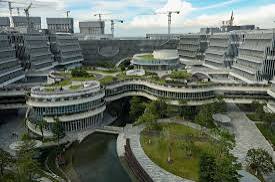
GUANGZHOU: China’s Guangdong-Hong Kong-Macao Greater Bay Area (GBA) is accelerating technological innovation by integrating research, industry and manufacturing across its three regions, creating a collaborative ecosystem that is driving advances in fields ranging from artificial intelligence and electric vehicles to traditional Chinese medicine.
Researchers at the Hong Kong University of Science and Technology (Guangzhou) are among those benefiting from the region’s interconnected innovation network. In one project, scientists are using virtual reality technology to study how cockpit features, including seat heating, can improve passenger comfort while reducing energy consumption in vehicles.
The research combines experimental data gathered in Guangzhou with vehicle simulation technologies developed by researchers in Hong Kong, enabling new solutions that enhance energy efficiency without compromising safety or comfort.
“Our research had previously focused on drivers’ behavior analysis with little attention paid to the cockpit environment as a potential influencing factor,” said He Dengbo, head of the university’s Traffic Psychology and Safety Laboratory. He said collaboration with Hong Kong researchers specializing in energy management and cockpit simulation has opened new directions for vehicle research.
The university has also partnered with Chinese automakers to translate research findings into commercial applications, reinforcing cooperation between academia and industry across the Greater Bay Area.
“We have established a self-reinforcing cycle integrating industry, academia, research and application within the Greater Bay Area,” He said.
Established in 2022, the Hong Kong University of Science and Technology (Guangzhou) has adopted a cross-disciplinary academic model covering 16 research areas, including artificial intelligence and advanced materials, with the goal of strengthening innovation across the region.
According to official data, universities from Hong Kong and Macao have established 31 research and development institutions in Guangdong Province, while the Greater Bay Area is home to 45 State Key Laboratories, supporting research in advanced technologies and scientific innovation.
Spanning Hong Kong, Macao and nine cities in Guangdong Province, the Greater Bay Area covers approximately 56,000 square kilometers and has become one of China’s leading economic and innovation hubs through integrated supply chains, efficient transport links and close cooperation among governments, universities and businesses.
Chen Yushan, deputy head of the Guangdong Institute of Science and Technology Information, said Guangdong’s manufacturing strength complements Hong Kong and Macao’s expertise in basic scientific research, frontier technologies and international collaboration.
He noted that cities such as Shenzhen provide strong commercialization capabilities, supported by major technology companies including electric vehicle manufacturer BYD and internet giant Tencent, enabling research breakthroughs to move more quickly into industrial production.
The Qianhai Shenzhen-Hong Kong Modern Service Industry Cooperation Zone has become a key platform for technology commercialization. Since 2025, it has supported the commercialization of 123 research projects originating from Hong Kong universities.
Many projects follow an integrated development model in which fundamental research is conducted in Hong Kong, commercialization takes place in Shenzhen, manufacturing is carried out across the Greater Bay Area, and companies later pursue listings in Hong Kong before expanding into international markets.
A similar cross-border innovation model has emerged in the Guangdong-Macao In-Depth Cooperation Zone in Hengqin, where traditional Chinese medicine (TCM) developed in Macao is manufactured in Hengqin to accelerate commercialization and international market access.
Wu Song, chairman of the Traditional Chinese Medicine Science and Technology Industrial Park of Cooperation between Guangdong and Macao, said the partnership will help connect China’s extensive traditional medicine resources with growing global demand while supporting Macao’s economic diversification.
Guangdong provincial authorities said future collaboration will focus on strategic sectors including artificial intelligence, life and health sciences, quantum technology and the low-altitude economy, while strengthening cooperation across the entire innovation chain—from scientific research and technology development to business incubation and industrial production.
Officials say the Greater Bay Area’s integrated approach is expected to further enhance China’s global competitiveness in science, technology and advanced manufacturing.