
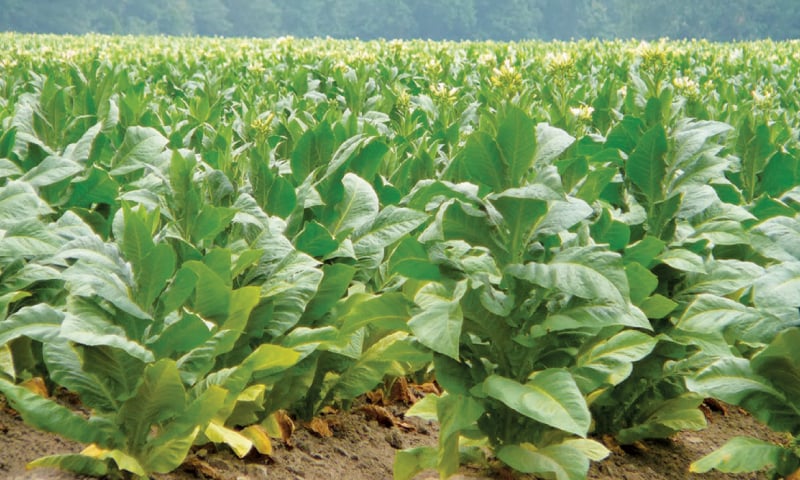
MARDAN: Tobacco growers in Mardan, Swabi and Buner have said the Rs390 per kilogram Advance Federal Excise Duty on tobacco may not legally be charged from farmers, but its economic burden is ultimately being passed down to growers through reduced buying, lower competition and pressure on prices.
Farmers associated with the tobacco sector said a recent press conference by a tobacco company claimed that the Rs390 per kilogram Advance FED does not directly apply to farmers and therefore does not affect their income or tobacco prices. The growers said the legal position may be correct, but the market impact is far wider because added costs on dealers, exporters and companies eventually affect the weakest part of the supply chain.
They said export tobacco is already subject to Rs16.35 per kilogram Federal Cess and Rs27.50 per kilogram Provincial Cess, in addition to the Advance FED. These payments, they added, are required at the procurement stage, even when export orders are not confirmed.
According to farmers, the upfront tax and cess burden ties up the capital of dealers and exporters before tobacco purchases begin. They said small and medium-sized buyers are gradually leaving the market, reducing procurement volumes and leaving farmers with fewer buyers for their crop.
Growers argued that when buyer competition falls, farmers are forced to sell at lower prices or wait longer for payments. They said the impact is felt most sharply by small farmers who invest throughout the year in land preparation, seed, fertilizer, pesticides, labour, irrigation and other production costs.
Farmers said many growers borrow money to cultivate tobacco and depend on timely sales after harvest. When buyers are limited, they said, rural indebtedness rises, household spending is affected, and families face pressure on education, healthcare and future cultivation plans.
Exporters Face Uncertain Quota System
Farmers also linked the issue to Pakistan’s tobacco export system, saying exporters face major uncertainty when applying for next year’s export quotas.
They said the Pakistan Tobacco Board invites applications for the following year’s requirements and export quotas in December, while the crop reaches the market in July. At the time of quota applications, crop size, quality, market prices and international orders are not known.
Under these conditions, farmers said, exporters are reluctant to obtain quotas worth millions of rupees without confirmed foreign orders. Those who do obtain quotas must bear the Rs390 per kilogram Advance FED, Federal Cess, Provincial Cess and additional costs for procurement, storage, warehousing, financing and transportation.
They said this discourages exporters from entering the market aggressively and directly affects farmers by reducing demand for tobacco.
Local Industry And Jobs Also Affected
Farmers said multinational companies may have stronger financial capacity, but local tobacco dealers, exporters and smaller industry players are under severe pressure from the current tax and cess structure.
They said declining procurement affects not only growers but also workers, transporters, packaging businesses, warehouse operators, loaders, agricultural input suppliers and local traders.
According to growers, tobacco remains a major source of income in several districts of Khyber Pakhtunkhwa, including Swabi, Mardan, Charsadda, Mansehra, Buner and nearby areas. Any decline in tobacco purchasing, they said, has a wider impact on the rural economy.
Farmers said the government may collect immediate revenue through the Rs390 per kilogram tax, but warned that reduced procurement, lower exports, declining employment and slower business activity could hurt overall economic activity.
Growers urged the government to review the Rs390 per kilogram Advance FED, Rs16.35 per kilogram Federal Cess and Rs27.50 per kilogram Provincial Cess on export tobacco.
They said easing the upfront burden on export tobacco could support farmers’ incomes, revive buyer competition, increase exports, protect rural jobs and help generate foreign exchange.
Farmers maintained that the central issue is not who legally pays the tax, but who ultimately bears its economic cost. Under the current system, they said, that burden is falling on tobacco growers, local industry, exporters, workers and the rural economy of Khyber Pakhtunkhwa.
Also Read: Permanent enforcement needed to curb tobacco shadow economy in Pakistan: ACT Alliance