
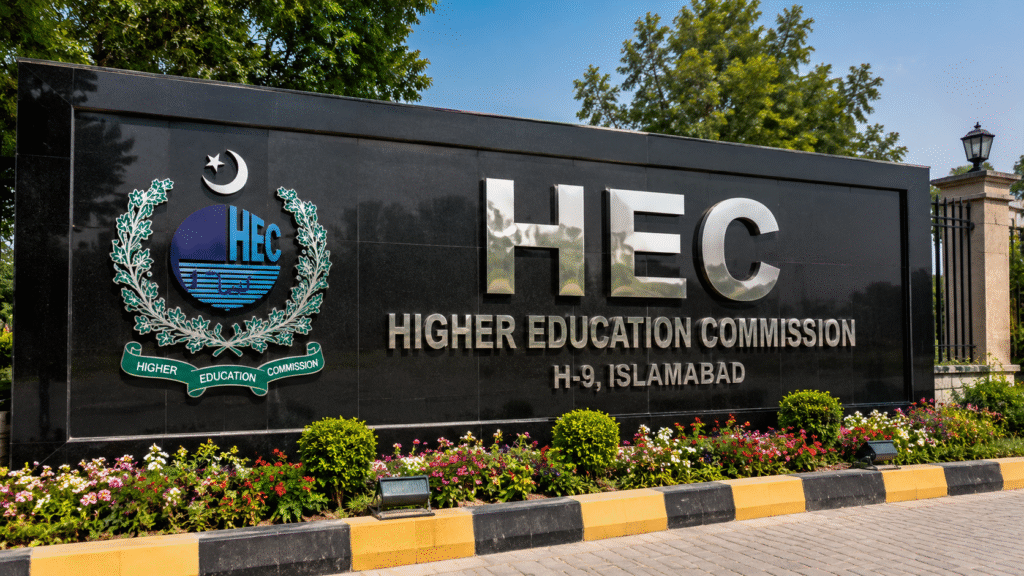
Nearly 25 years after Pakistan created the Higher Education Commission to reform universities and support a knowledge-based economy, education experts are calling for a fresh review of whether the country’s higher education system has delivered on its original goals.
The Higher Education Commission was established in 2002 after the government approved reforms proposed by the Steering Committee on Higher Education and the Task Force on Improvement of Higher Education. The reforms replaced the University Grants Commission with HEC and aimed to link human resource development, research and technology with long-term economic growth.
The original objective was to help Pakistan move toward a technologically driven economy by strengthening universities, improving research capacity and producing skilled graduates for emerging sectors.
A quarter century later, the performance of the higher education system is being assessed against measurable outcomes, including human development, innovation, competitiveness and the use of technology in the economy.
Indicators raise concerns over reform outcomes
Recent indicators show that Pakistan continues to face major challenges in human development, innovation and competitiveness.
The country’s position in the Human Development Index and Human Capital Index has declined, while Pakistan remains near the lower end of the Global Innovation Index. It was also ranked 113th out of 133 countries in the Global Competitiveness Index.
Pakistan’s position near the bottom of the Global Gender Gap Index has also raised concerns about unequal access to opportunities and the limited participation of women in education, employment and innovation-driven sectors.
At the same time, per capita incomes have stagnated, poverty has increased and the integration of technology into productive sectors, particularly exports, remains limited.
Gap between education and economic transformation
The reform agenda behind HEC was based on the idea that investment in higher education would strengthen Pakistan’s talent base and support technological advancement.
However, the expected connection between universities, research, skilled graduates and economic transformation has not fully materialised.
While several factors beyond higher education have contributed to Pakistan’s economic and social indicators, the limited impact of university reforms on technology adoption and productivity has renewed debate over the direction of higher education policy.
Analysts say the next phase of reform will need to focus on measurable results, stronger links between universities and industry, better research quality, employable skills and greater inclusion of women in higher education and the workforce.