
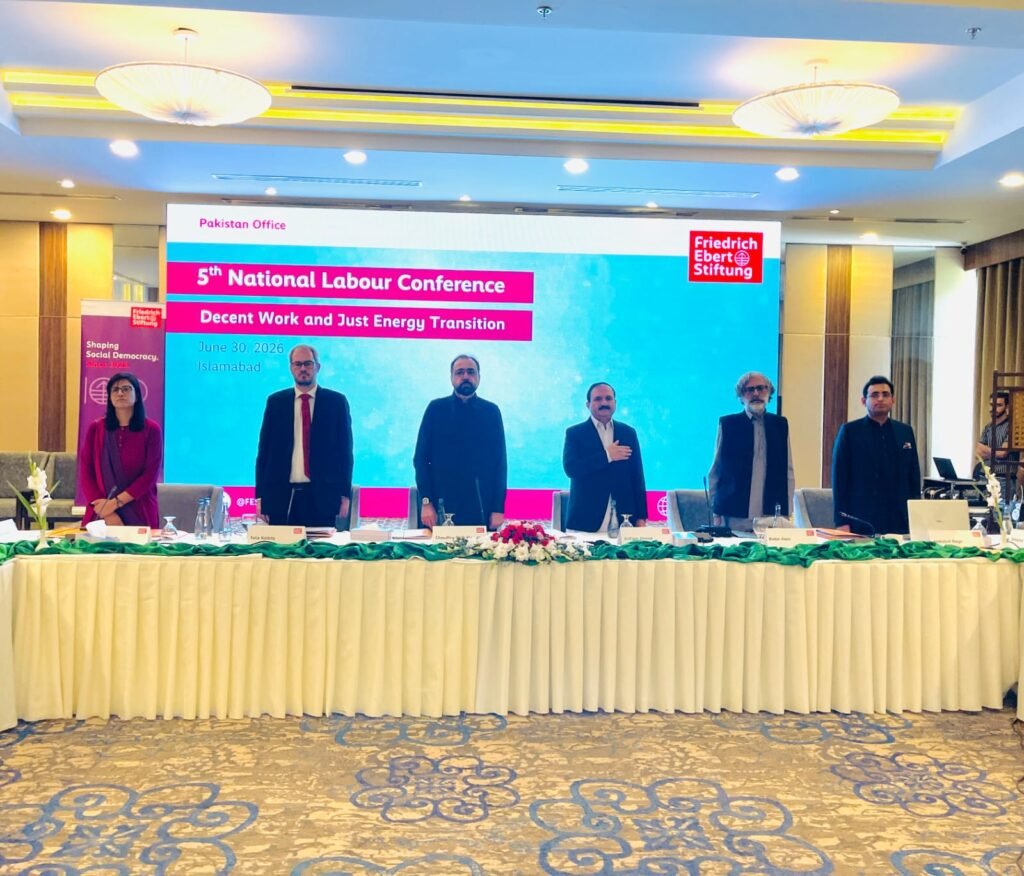
Islamabad — Pakistan’s transition toward a cleaner and climate-resilient economy must place workers at its core, labour leaders, policymakers, and development experts said at a national conference in Islamabad, where discussions focused on safeguarding jobs, strengthening social protection, and ensuring inclusive economic reform.
The call came during the 5th National Labour Conference on “Decent Work and Just Energy Transition,” organised by the Friedrich-Ebert-Stiftung in Islamabad. Participants said Pakistan’s shift toward a low-carbon economy — often described as a just energy transition — will only succeed if it protects vulnerable workers and integrates labour rights into national climate and energy planning.
Federal Minister for Overseas Pakistanis and Human Resource Development Chaudhry Salik Hussain inaugurated the conference, saying the government is focused on strengthening labour institutions and ensuring workers are not excluded from ongoing economic and environmental reforms.
He said Pakistan’s real challenge is not the absence of policy, but its effective implementation, particularly in areas linked to employment protection and social welfare.

Climate change and labour risks linked
Opening remarks by Felix Kolbitz highlighted how climate change, informal labour, and widening inequality are increasingly interconnected. He stressed that meaningful social dialogue and stronger labour protections are essential for a fair transition.
Sidra Saeed underlined the need for evidence-based policymaking to ensure climate action also strengthens employment security and social justice outcomes.
A keynote presentation by Badar Alam said a just transition framework in Pakistan must balance environmental goals with job creation, particularly for vulnerable workers and communities.
Policy focus on social protection and green jobs
In technical sessions, researchers discussed adaptive social protection for informal women workers, the role of trade unions in shaping energy transition policies, and the impact of power sector reforms on workers and consumers.
Participants said expanding social protection systems, improving skills development, and strengthening collective bargaining mechanisms will be critical as Pakistan restructures its energy sector.
Trade union representatives from across the country called for stronger labour laws, expanded social security coverage, improved workplace safety, and greater investment in green jobs. They also urged institutionalised dialogue between government, employers, and workers to manage the transition effectively.

Call for inclusive national framework
The conference concluded with a consensus that Pakistan’s energy transition must go beyond environmental targets and deliver equitable economic opportunities. Stakeholders urged the government, employers, and development partners to develop a comprehensive national framework that aligns climate goals with labour rights and social justice.
Organisers from the Friedrich-Ebert-Stiftung said the outcome reflects growing recognition that sustainable climate policy depends on placing workers at the centre of reform.
Also Read: SMEs vital to Pakistan’s export-led growth, says Haroon Akhtar