
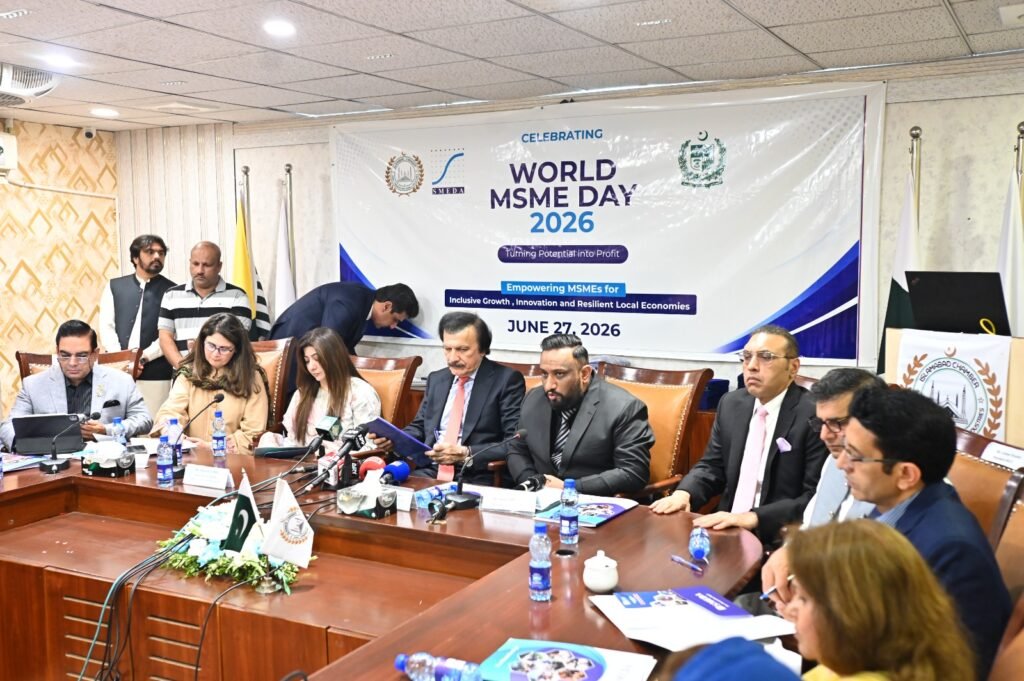
ISLAMABAD: Special Assistant to the Prime Minister on Industries and Production Haroon Akhtar Khan has said that Pakistan’s future economic growth depends on strengthening small and medium enterprises, innovation and entrepreneurship.
He was addressing an SME Networking Session organized by the Islamabad Chamber of Small Traders and Small Industries (ICSTSI) in collaboration with the Small and Medium Enterprises Development Authority (SMEDA) to mark World MSME Day 2026.
The session was chaired by ICSTSI President Muhammad Awais Satti, while SMEDA Chief Executive Officer Nadia Jehangir Seth also attended the event. Federal Secretary for Industries Humaira Zia Mufti, Usman Saifullah, representatives of chambers of commerce, entrepreneurs and SMEs from across the country were also present.
Haroon Akhtar said countries that empower entrepreneurs, small businesses and innovators eventually emerge as strong economic players. He said Pakistan’s prosperity was linked with a stronger SME sector capable of supporting exports, jobs and industrial growth.
He said the government was pursuing export-led growth through SME development, innovation and entrepreneurship. He added that SME financing had increased to Rs584 billion by March 31, while 53 percent of businesses had received enhanced financial support, helping industrial expansion and job creation.
The SAPM said the government had launched initiatives worth Rs30 billion to support SMEs. He said Prime Minister Shehbaz Sharif had placed special focus on improving access to finance, land availability, tax reforms, ease of doing business and issues linked with the State Bank of Pakistan.
“Every great economy has a story of entrepreneurs. Those who create jobs are the true builders of nations,” Haroon Akhtar said.
He paid tribute to Pakistan’s entrepreneurs, innovators and business owners, saying the country had strong entrepreneurial talent across all provinces. He said women entrepreneurs were playing an increasingly important role in economic development and needed more opportunities and encouragement.
SMEs called backbone of economy
Highlighting the role of small and medium enterprises, Haroon Akhtar said Pakistan had around seven million SMEs, contributing nearly 40 percent to GDP, around 30 percent to exports and employing nearly 80 percent of the non-agricultural workforce.
He said SMEDA was working to strengthen the SME ecosystem by improving access to finance, encouraging formalization and documentation of businesses, and increasing competitiveness in local and international markets.
The SAPM said business formalization was essential because registered enterprises could access bank financing and benefit from government support programmes more easily.
He said the government was connecting Pakistani SMEs with international markets through digital platforms. He added that a memorandum of understanding had been signed with Alibaba to promote online exports and e-commerce opportunities.
Haroon Akhtar said Pakistani SMEs were also being encouraged to participate in regional and international trade expos, while efforts were underway to facilitate visa access for exporters.
He said outreach programmes had been expanded to Gilgit-Baltistan, Balochistan and Khyber Pakhtunkhwa to connect regional industrial clusters with national and global markets.
Referring to export potential, he said Pakistan’s handmade products, furniture, honey, Sialkot sports goods and other traditional industries held strong value in international markets and required greater institutional support.
He said the government would provide SMEs with improved liquidity, easier financing, tax facilitation, land availability and regulatory reforms to improve the business environment.
ICSTSI urges lower business costs
Speaking on the occasion, ICSTSI President Muhammad Awais Satti said SMEs contributed nearly 40 percent to Pakistan’s GDP and around 35 percent to national exports, making them the backbone of the economy.
He called for reducing the cost of doing business, improving ease of doing business, ensuring affordable energy prices, simplifying documentation procedures and resolving issues related to labour laws, the Capital Development Authority and access to finance.
Awais Satti said interest rates should be maintained in single digits to support business expansion. He also appreciated SMEDA’s continued support for the SME sector.
He said the Islamabad Chamber of Small Traders and Small Industries was Pakistan’s first dedicated SME chamber, adding that similar chambers had now been established in around 20 cities across the country.
The event highlighted the growing importance of SMEs in Pakistan’s economic landscape and the need for policy support to help small businesses expand locally and compete in international markets.
Also Read: China’s AI Growth Offers Key Lessons for Pakistan’s Digital Future