
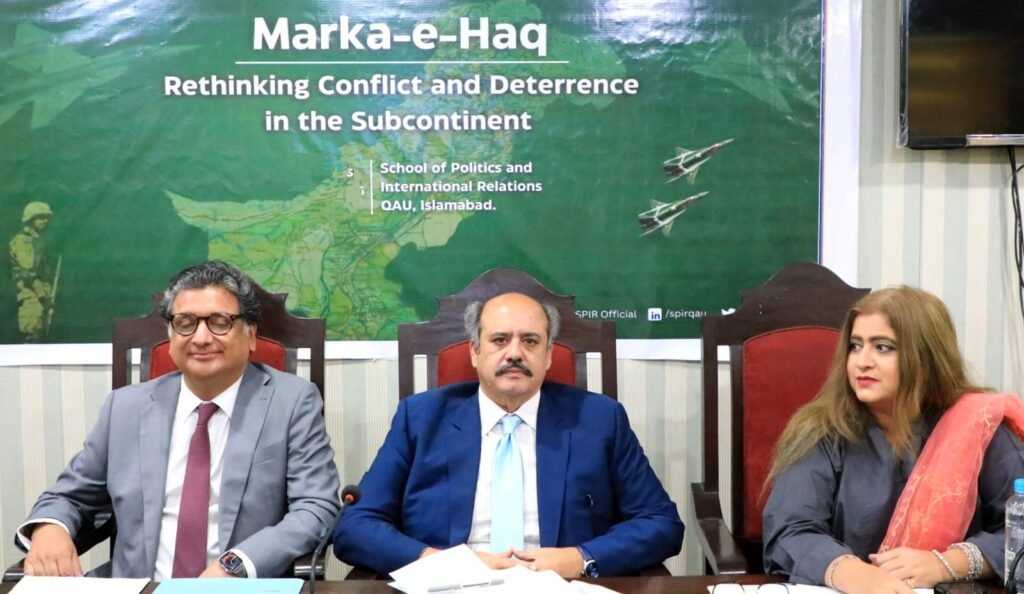
ISLAMABAD: Security experts, diplomats and academics gathered at Quaid-i-Azam University for a seminar examining conflict, deterrence and evolving warfare trends in South Asia following the May 2025 regional crisis.
The seminar, titled “Marka-e-Haq: Rethinking Conflict and Deterrence in the Subcontinent,” was organised by the School of Politics and International Relations (SPIR) and focused on regional security, strategic stability and the future of deterrence in the subcontinent.
Opening the session, SPIR Director Muhammad Nadeem Mirza said recent regional developments had reshaped geopolitical dynamics in South Asia and renewed international attention on Pakistan’s strategic position.
Experts discuss regional power balance
Speaking during the seminar, Zafar Nawaz Jaspal, Vice Chancellor of Quaid-i-Azam University and professor of international relations, said the May 2025 conflict altered perceptions of regional power and reintroduced strategic parity between Pakistan and India in global discourse.
He noted that deterrence and balance of power remain central to regional stability in South Asia.
Maria Sultan, President of the South Asian Strategic Stability Institute, discussed how modern conflicts are increasingly shaped by information warfare, cyber capabilities and strategic communications before traditional military engagement begins.
She said the conflict highlighted the growing importance of multi-domain warfare, where digital operations and narrative management influence strategic outcomes alongside conventional military capabilities.
Seminar highlights nuclear deterrence concerns
Former ambassador Zaheer Aslam Janjua addressed the issue of nuclear deterrence and strategic stability in South Asia.
He described the May 2025 episode as a major test for the region’s deterrence structure and raised concerns about escalation risks and evolving military doctrines in the region.
Participants at the seminar emphasized that long-term peace in South Asia would depend on strategic communication, conflict management mechanisms and sustained regional engagement.
The event brought together academics, researchers and policy experts to discuss the future of regional security in an increasingly complex strategic environment.