
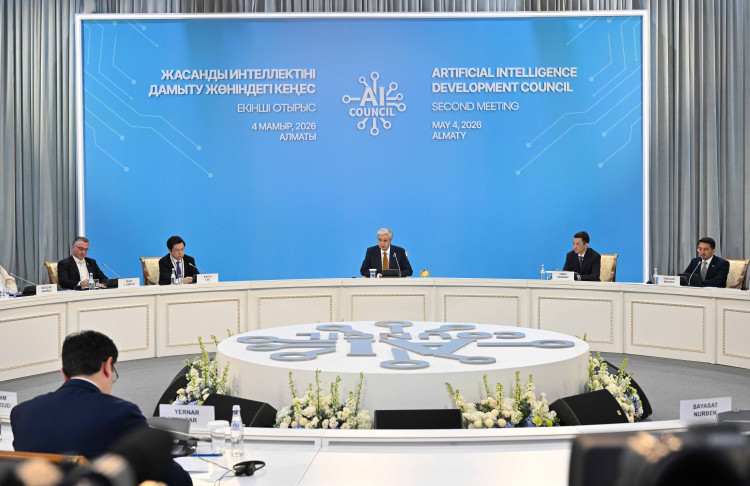
ASTANA — Kazakhstan is accelerating plans for a nationwide shift to an artificial intelligence-driven economy, with President Kassym-Jomart Tokayev warning that delays could leave the country trailing in the global technology race. Speaking at a May 4 meeting of the Council for the Development of Artificial Intelligence in Almaty, he said the country must move quickly to integrate AI across key sectors.
Addressing officials and international experts, Tokayev said artificial intelligence is no longer a future tool but a central driver of modern economic growth. He cautioned that slow adoption could widen the gap between advanced and developing economies, at a time when traditional growth models based on labor and natural resources are losing effectiveness.
Shift from traditional growth models
Tokayev said Kazakhstan is showing signs of a “middle-income trap,” where existing economic drivers are weakening while new ones have yet to fully emerge. He called for a transition from isolated digital initiatives to a coordinated, system-wide transformation.
A key challenge, he noted, is measuring the real contribution of digitalization and AI to economic output. Aggregate indicators such as GDP can obscure how much growth is driven by innovation. He instructed government agencies to develop clearer metrics to assess the impact of digital technologies.
Data infrastructure and real-time economy
The president emphasized that accessible and standardized data is essential for effective AI deployment. He urged rapid digitization of archives and the creation of unified data systems, warning that without machine-readable data, technological investments may not deliver results.
He also highlighted the need to build a “real-time economy,” where decisions are made in seconds rather than days through integrated digital platforms. Existing systems in customs, taxation, and financial monitoring were cited as examples that could be expanded to improve efficiency.
Private sector role and regional ambitions
Tokayev called for stronger private sector participation, including incentives for businesses to invest in digital platforms and innovation. He stressed the importance of developing a venture capital ecosystem and accelerating the commercialization of research.
Kazakhstan is also positioning itself as a regional digital and financial hub. Plans include expanding the use of the digital tenge, strengthening regulation of digital assets, and attracting international talent through simplified migration and residency policies.
Infrastructure and cybersecurity focus
The president said technological sovereignty will depend on robust infrastructure and cybersecurity. He announced plans for a large-scale “Data Center Valley” to support artificial intelligence and cloud computing.
Tokayev concluded that the success of AI will depend on its practical use in sectors such as industry, energy, agriculture, and logistics, rather than the scale of investment alone.