
ISLAMABAD: An international conference at International Islamic University Islamabad (IIUI) concluded with calls for urgent policy action on artificial intelligence, decolonial education and the protection of Indigenous knowledge systems, as scholars warned that AI technologies are increasingly shaping global knowledge structures.
The two-day conference, titled “Caliban Speaks,” brought together academics, researchers and technologists from multiple countries to discuss the relationship between technology, colonial power structures and education in the Global South.
The closing session was presided over by Ahmed Shuja Syed, Vice President for Research and Enterprise at IIUI, who said the recommendations developed during the conference would be forwarded to policy forums for further consideration and implementation.
Conference highlights AI and decolonial education concerns
Conference organisers said participants stressed that artificial intelligence should not be viewed as a neutral technological system, arguing that modern AI platforms often centralize data ownership and reproduce unequal global power dynamics.
Recommendations presented by Co-Convener Muhammad Sheeraz Dasti emphasized the need to integrate economic literacy into humanities education so that decolonial thought addresses material and institutional structures rather than remaining limited to theoretical debate.
The conference also called for AI literacy programmes in universities that encourage students to critically examine how digital tools operate, whose interests they serve and how they can support local knowledge systems instead of reinforcing external control over data and information.
Speakers call for Indigenous knowledge protection
In his closing remarks, Ahmed Shuja Syed described Indigenous thought as central to reconnecting individuals, society and broader systems of knowledge.
He argued that emerging technologies, including brain-to-brain communication systems, could further increase the importance of preserving Indigenous intellectual traditions and urged policymakers to engage with the conference recommendations without delay.
Asma Mansoor, convener of the conference, said decoloniality should move beyond academic theory and become part of practical educational and policy frameworks.
She also highlighted IIUI’s archives of Persian, Arabic and Islamic scholarship as important intellectual resources for future decolonial research and discussions on knowledge systems.
Scholars discuss technology, data sovereignty and language preservation
The second day of the conference featured discussions on postcolonial identities, gender, technology, literary resistance and political discourse across the Global South.
Research presented during the sessions included discussions on data sovereignty, algorithmic systems and the role of AI chatbots in preserving Indigenous languages.
A panel on decolonising technology included academics and technology experts such as Muneera Bano from Australia’s CSIRO Data61 laboratory, who discussed the relationship between technological infrastructure and decolonial frameworks.
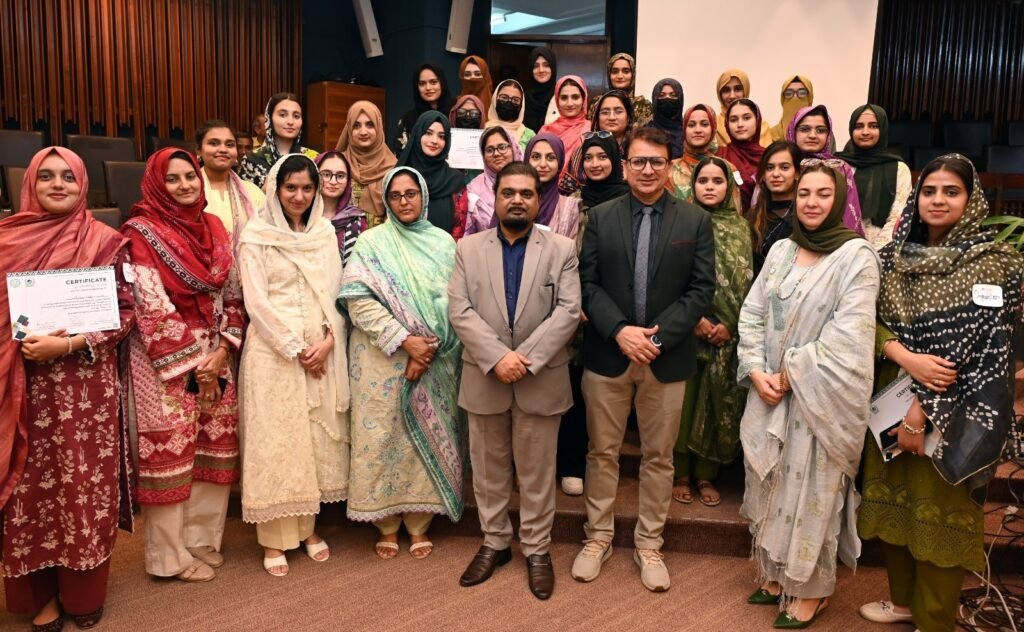
The conference concluded with a vote of thanks by Saiyma Aslam, followed by certificate distribution and the closing of formal proceedings.
According to organisers, the event included participants from Australia, South Africa, Oman, Singapore, Malaysia, Canada, Algeria and different regions of Pakistan.
Also read: Pakistan Pushes for Healthcare Self-Reliance at IIUI Natural Products Symposium