
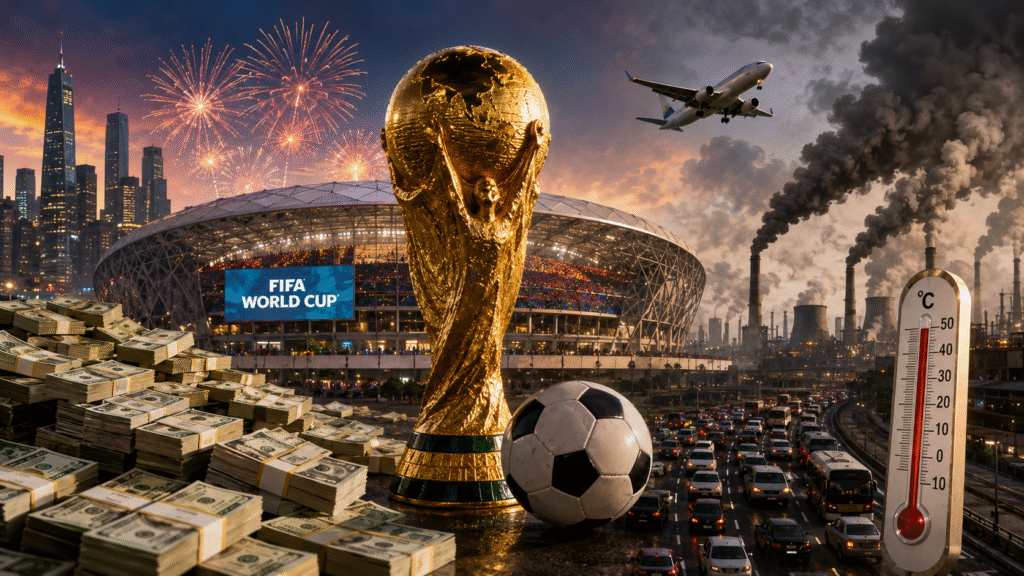
he expanded FIFA World Cup this summer is expected to generate record revenue but could also become the most polluting sporting event in history, according to environmental researchers.
The tournament will feature 48 teams for the first time and will be hosted across three countries: the United States, Canada and Mexico. Researchers at the University of Lausanne say the expanded format and long travel distances between venues are likely to sharply increase the event’s carbon footprint.
David Gogishvili, a geographer at the University of Lausanne, said the trend contrasts with the Olympic Games, where carbon footprints have fallen over recent editions.
According to the university’s calculations, the World Cup could generate between five million and nine million tonnes of carbon dioxide emissions. By comparison, the 2024 Paris Olympics produced around 1.75 million tonnes.
The projected emissions would also exceed previous World Cups, including Russia 2018 and Qatar 2022.
Travel between venues drives emissions concerns
All 16 venues for the tournament already existed when the event was awarded, a point highlighted by the United 2026 bid. However, researchers say the main environmental concern is the distance between stadiums.
The gap between Miami and Vancouver is more than 4,500 kilometres, increasing air travel for teams, officials, media and fans.
FIFA is targeting more than five million fans for the tournament, making travel the largest expected source of emissions.
Environmental analysts say the scale of international tournaments is a key factor in their climate impact. They argue that expanding the number of teams and matches increases travel, accommodation needs and related infrastructure pressures.
FIFA President Gianni Infantino has previously pledged to measure, reduce and offset emissions linked to World Cups. However, FIFA has not made a climate-neutrality guarantee for the 2026 tournament after being criticised over claims related to the 2022 World Cup.
The debate is likely to continue as future World Cups are also set to expand across large regions. The 2030 edition will be staged across six countries and three continents, while the 2034 tournament will be held in Saudi Arabia.