
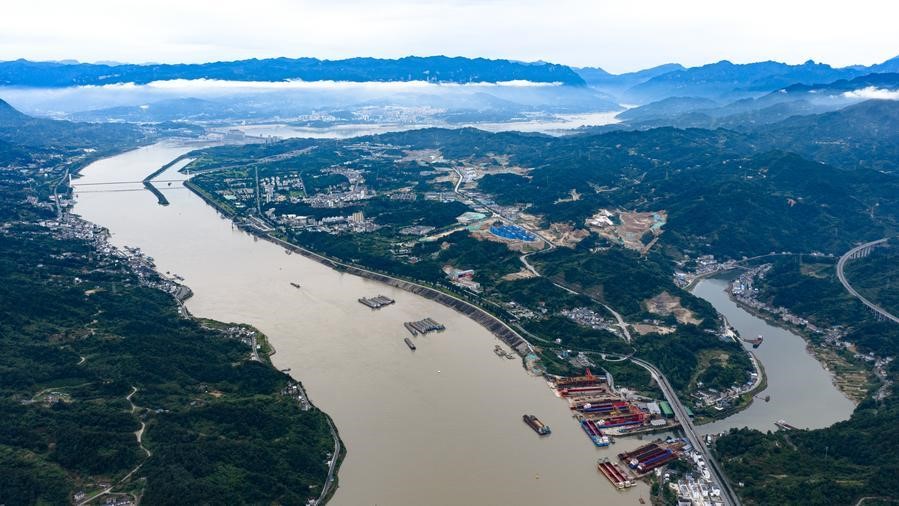
China has started construction of a major waterway project worth 77.2 billion yuan, or about $11.3 billion, to expand shipping capacity along the Yangtze River and ease pressure at the Three Gorges Dam, one of the busiest inland navigation points in the world.
The Yangtze River waterway project is aimed at improving freight movement between China’s inland and coastal regions, where rising cargo volumes have pushed existing navigation facilities beyond their original design capacity. Officials and experts discussed the project on China Economic Roundtable, an all-media talk show hosted by Xinhua News Agency.
The project, which broke ground on Monday, is the first major national infrastructure scheme launched during China’s 15th Five-Year Plan period from 2026 to 2030. The Yangtze River stretches more than 6,300 kilometres and supports an economic belt covering 11 provincial-level regions that together account for nearly half of China’s national GDP.
New Ship Lock to Expand Capacity
The existing ship lock at the Three Gorges Dam exceeded its designed annual cargo capacity of 100 million tonnes in 2011, nearly two decades earlier than expected.
“The navigation system has been under sustained pressure for many years,” said Wang Hui, an official with China’s Ministry of Transport.
Wang said freight traffic on the Yangtze is expected to keep increasing as the Yangtze River Economic Belt continues to drive goods movement between inland provinces and coastal markets.
The project will add a five-tier, dual-track ship lock north of the existing lock at the Three Gorges Dam. It will also upgrade navigation facilities at the downstream Gezhouba Dam.
Once completed, the annual throughput capacity at the Three Gorges Dam is expected to rise to 336 million tonnes. The Gezhouba Dam’s total capacity will reach 360 million tonnes.
Gao Peng, deputy chief engineer of the China Three Gorges Corporation, said the new system would allow mutual backup, coordinated operations and classified vessel passage, improving shipping efficiency along the middle and upper reaches of the Yangtze River.
Engineering Challenges and Technology
Officials said the project faces major engineering challenges because the new facilities must be built within the existing Three Gorges and Gezhouba dam complexes.
Zhang Yunchang, an official with China’s Ministry of Water Resources, said the limited construction space and strict engineering requirements made the project highly complex.
Gao said the new locks would have to manage a water-level drop comparable to the height of a 37-storey building, with rock slopes rising about 200 metres.
Engineers spent more than a decade developing technical solutions with domestic research institutes, according to Niu Xinqiang, an academician of the Chinese Academy of Engineering. These include a high-pressure water movement system for the locks and a 1,440-tonne gate.
The project will involve moving about 160 million cubic metres of rock and earth. Gao said crews would use advanced blasting techniques to reduce the impact on nearby residents, the environment and aquatic ecosystems.
Wang said the completed waterway would use smart scheduling, smart channels and smart locks. The system will rely on big data, high-precision maps, live monitoring and digital sensors to guide vessels and detect equipment issues.
Logistics, Jobs and Inland Trade
Experts said the project is expected to reduce logistics costs and support lower-carbon freight transport. Niu said academic studies indicate that water transport produces about half the carbon emissions of rail and about 20 percent of road transport per tonne-kilometre.
The Three Gorges new ship lock and its approach channels are scheduled to be completed in 112 months, including a 12-month preparation period. The Gezhouba upgrade is expected to take 95 months, also including preparation time.
Zhang said the construction phase would require large volumes of bulk materials and heavy equipment, creating demand across related industries and supporting employment.
Wang said the upgraded waterway would strengthen ports as cargo consolidation hubs and improve links between inland cities and international markets.
He said goods arriving in Chongqing from Europe and Central Asia through China-Europe freight trains could be transferred to Yangtze River shipping, while cargo from Southeast Asia and coastal areas could move further into western China through river-sea intermodal transport.
Officials said the project would help improve domestic connectivity and expand the role of inland cities as trade gateways linking China’s interior with regional and global markets.