
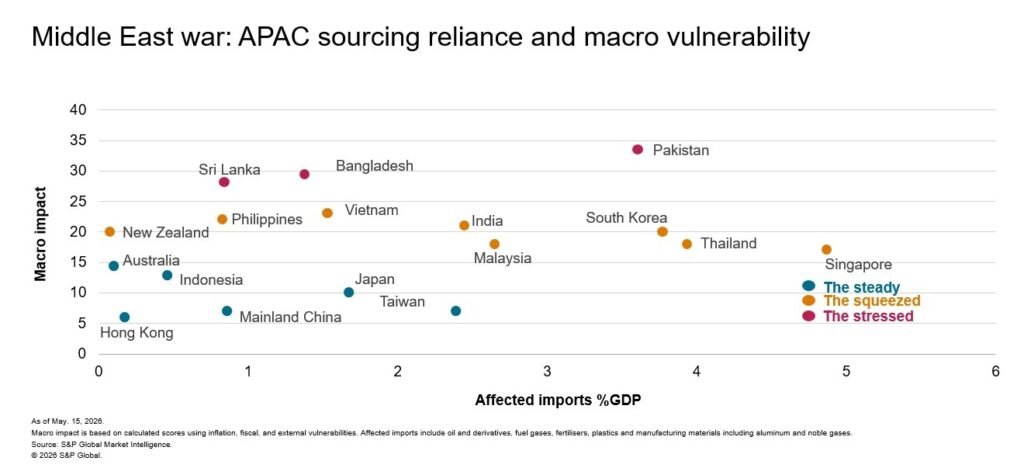
ISLAMABAD, May 18: Pakistan faces the highest macro-financial risk among major Asia-Pacific economies if the Middle East conflict is prolonged, according to a new assessment by S&P Global Market Intelligence.
The assessment said Pakistan’s exposure is driven by its heavy reliance on Gulf crude supplies, dependence on workers’ remittances from Gulf Cooperation Council countries, large external financing needs and limited fiscal space. It projected Pakistan’s real GDP growth to ease to 3.2 percent in fiscal year 2027, with risks tilted to the downside.
S&P Global Market Intelligence said a prolonged conflict in the Middle East could raise energy prices, disrupt supply chains and increase pressure on Pakistan’s external account. The report said these pressures could affect inflation, currency stability, industrial production and household consumption.
Ahmad Mobeen, Principal Economist at S&P Global Market Intelligence, said Pakistan was likely to face the most acute impact of a prolonged Middle East war shock among major APAC economies because of its dependence on imported energy and industrial inputs from the region.
He said higher energy prices could reverse recent gains in the current account, increase depreciation pressure and keep inflation elevated. He added that Pakistan’s next policy phase may involve difficult trade-offs between maintaining stability, supporting growth and continuing fiscal consolidation under existing IMF programmes without additional bilateral and multilateral funding.
Energy prices and exports under pressure
According to the assessment, higher energy prices, supply constraints and possible trade route disruptions could weigh on manufacturing and export growth.
The report said imported input costs may rise, adding pressure on industries that depend on external raw materials and energy supplies. It also flagged the risk of fertilizer shortages, which could affect farmers’ incomes and crop yields.
S&P Global Market Intelligence said second-round effects of energy price inflation could reduce private consumption and affect the services sector. Transport and retail were identified as particularly exposed sectors.
Remittances and external financing risks
The assessment also pointed to the risk of slower remittance growth from Gulf countries if the conflict affects regional economic activity.
Pakistan remains heavily dependent on remittances from GCC economies, making any prolonged instability in the region important for household incomes and the country’s balance of payments.
S&P Global Market Intelligence said Pakistan’s external buffers had improved in the near term, supported by a new Saudi deposit, expected rollovers of existing facilities and continued access to IMF-linked multilateral and bilateral financing.
However, the report said refinancing risks remain elevated. It noted that Pakistan’s recent $3.5 billion repayment to the United Arab Emirates showed the scale of upcoming debt obligations.
Market Intelligence projected Pakistan’s gross external financing needs to average about $24 billion annually during the 2026–30 period.
The assessment said Pakistan’s ability to manage these pressures would depend on energy prices, regional stability, external financing flows and continued policy support.