
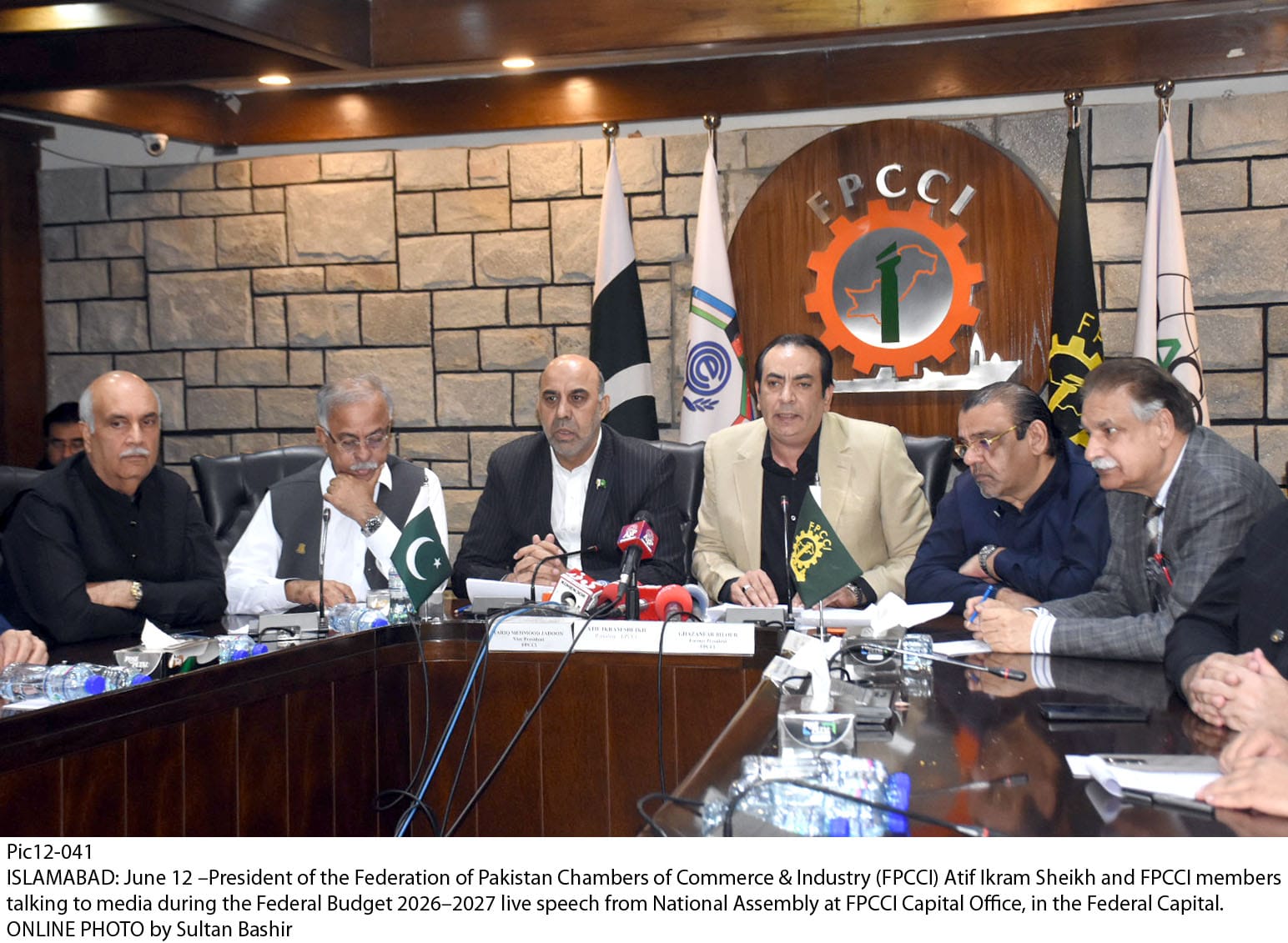
The Federation of Pakistan Chambers of Commerce and Industry has welcomed signs of macroeconomic stabilisation in the federal budget for 2026-27, while cautioning that ambitious tax and petroleum levy targets could add to inflationary pressure.
FPCCI President Atif Ikram Sheikh said the Rs18.7 trillion federal budget reflects continuity in economic policy and shows progress toward fiscal discipline. He said the government now needed to move from stabilisation toward sustained industrial and economic growth.
Addressing a post-budget session with the business community and media, Sheikh congratulated Prime Minister Shehbaz Sharif and the government’s economic team, saying the fifth consecutive federal budget under the current leadership showed policy continuity.
He said Pakistan’s economy had shown encouraging signs, citing GDP growth of 3.7 percent, a reduced fiscal deficit of 0.7 percent of GDP and a 23 percent decline in public debt servicing costs.
However, Sheikh said the federal budget should not be viewed only as a revenue and expenditure statement. He said it must serve as a policy framework for shifting the economy from basic stabilisation to stronger growth.
FPCCI welcomes relief measures
The FPCCI said several of its recommendations had been included in the budget, indicating a partial shift toward a growth-driven model.
The business body welcomed the abolition of capital value tax on foreign assets and the removal of federal excise duty on international business class travel.
It also noted reforms in the super tax regime, including abolition of the tax on six income slabs up to Rs500 million, reduction of the rate from 10 percent to 8 percent for income above Rs500 million, and a complete waiver for exporters.
The FPCCI also welcomed relief for the salaried class, including the removal of surcharge on salaried individuals and reductions in tax rates across different slabs.
For the technology and construction sectors, Sheikh pointed to the extension of the 0.25 percent final tax exemption on IT exports until June 2029 and a 50 percent reduction in withholding tax for filers in the construction sector.
The FPCCI also supported a new 1 percent fixed sales tax scheme for retailers with annual sales below Rs200 million. Under the scheme, retailers would be exempted from point-of-sale machines and routine audits through a green QR code system.
For exporters, the federation noted the revised 1.25 percent minimum tax, replacing the previous structure of 1 percent minimum tax and 1 percent advance tax.
Concerns over tax targets and investment
Despite welcoming several measures, Sheikh said FPCCI remained concerned about the broader economic environment.
He said the investment-to-GDP ratio remained stagnant at 14.38 percent, while the savings rate had declined to 14.13 percent. He also expressed concern over urban poverty rising from 11 percent to 17 percent, saying it reflected pressure on business activity and household incomes.
The FPCCI president raised reservations over the Federal Board of Revenue’s tax collection target of Rs15.2 trillion, which represents a 17 percent increase. He also warned that the petroleum levy target of Rs1.7 trillion, an 18 percent increase, could fuel inflation at a time of elevated international oil prices.
Sheikh said several FPCCI proposals aimed at supporting industrialisation and export competitiveness were not addressed in the budget speech.
These included restoration of the final tax regime for exporters, reductions in corporate tax and turnover tax under Section 113, elimination of the minimum tax regime and further tax, withdrawal of the repeal of Section 8B of the Sales Tax Act, and broader digitalisation of the economy.
FPCCI to review Finance Bill
Sheikh said the budget sent mixed signals on sustained industrialisation, job creation and higher economic growth. He said the next phase of reforms should focus on productivity, export diversification and reducing the cost of doing business.
The FPCCI said it was too early to issue a final assessment of the budget. The federation will review the Finance Bill over the next 48 hours in consultation with member chambers, trade associations and stakeholders across the country.
A detailed response with the business community’s complete observations and recommendations will be issued after the review.
The FPCCI said it would continue constructive engagement with the government to support a more competitive and growth-oriented economy.
Also Read : Adnan Arif appointed to FPCCI Central Standing Committee on Media Broadcasting