
Fauji Fertilizer Company has grown from a single urea plant in Punjab into Pakistan’s largest fertilizer producer, making it one of the most important companies behind the country’s agriculture sector. Founded in 1978, FFC is a flagship Fauji Foundation enterprise whose products, including prilled urea and other fertilizers, support millions of acres of farmland and play a direct role in crop productivity, rural income and national food security.
Headquartered in Rawalpindi, FFC employs roughly 3,500 people and is led by MD/CEO Jahangir Piracha. The company is listed on the Pakistan Stock Exchange under the symbol FFC and has a market capitalization on the order of PKR 811 billion. Its growth over more than four decades reflects Pakistan’s continuing need for reliable local fertilizer production.
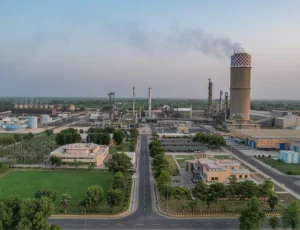
FFC began as a joint venture between Fauji Foundation and Denmark’s Haldor Topsoe. Its first 570,000-ton-per-year urea plant at Goth Machhi near Sadiqabad went live in June 1982. A second 635,000-ton plant at the same site came online in 1993, taking total Sadiqabad capacity to around 1.33 million tonnes per year. In 2002, FFC acquired the Pak-Saudi Fertilizer plant at Mirpur Mathelo, later renamed FFC-III, adding another roughly 557,000 tonnes per annum of capacity. Today, the plants’ rated urea output stands at about 695kt, 635kt and 718kt.
Over time, FFC expanded beyond its core fertilizer business. In the 2010s, it diversified through investments including a 43 percent stake in Askari Bank and the Fauji Fresh n’ Freeze dairy unit, now Fauji Foods. It also developed non-fertilizer projects such as a 49.5 MW wind farm. In 2024, FFC took a major step by merging with sister company Fauji Fertilizer Bin Qasim Ltd, a deal completed in December 2024 through a court-approved share swap. The merger brought FFBL’s 551kt urea and 445kt DAP complex, along with its non-fertilizer ventures in sugar, petrochemicals and power, into FFC’s wider business base.
FFC’s three fertilizer plants now give it roughly 2.0 million tonnes per year of urea capacity. In FY2024, covering July to December 2024 for the merged entity, combined urea production was 2.842 million tonnes, including 0.287 million tonnes from the Bin Qasim plant. Aggregate urea off-take was 2.942 million tonnes, while DAP sales stood at 0.653 million tonnes. In FY2025, production rose to 2.903 million tonnes of urea and 0.837 million tonnes of DAP. These output figures imply capacity utilization of 112 to 124 percent.
Company data suggest FFC now commands about 48 percent of Pakistan’s urea market and 61 percent of the DAP market, placing it well ahead of other players in the sector. In practical terms, its Sona Urea brand remains one of the most widely used fertilizer products in Pakistan’s farming regions, from Punjab to Khyber Pakhtunkhwa.
Financial Strength And Market Position
FFC is one of Pakistan’s largest and most profitable companies on the stock market. Its revenues and profits have surged since the FFBL merger. In FY2024, the merged entity reported consolidated revenue of PKR 373.5 billion and net profit of PKR 64.7 billion. In comparison, FY2023 revenue was PKR 159.5 billion, with profit after tax of PKR 29.7 billion. In FY2025, revenue climbed further to around PKR 432.4 billion, while profit reached PKR 73.6 billion. Earnings per share stood at Rs51.7 in 2025.
The company’s balance sheet remains strong. As of end-2025, FFC held over PKR 160 billion in assets and maintained conservative leverage. Profits grew faster than sales, and the company declared a 370 percent overall dividend in FY2025. In FY2024, it also paid a total of Rs34.86 per share, including a final dividend of Rs21.00 and an interim dividend of Rs13.86, making it one of the largest dividend payers in Pakistan that year.
These financial results are supported by diversified income streams. Alongside fertilizer sales, FFC earns sizeable dividend income from subsidiaries and associates, including Askari Bank. That dividend income stood at PKR 22.4 billion in FY2025, in addition to interest and investment income. FFC’s earnings profile has made it one of the more closely watched large-cap companies on the Pakistan Stock Exchange. As of mid-2026, its market capitalization was around PKR 811 billion, reflecting a share price of about Rs565. Its return on capital employed, at around 34 percent, and net profit margins of roughly 17 to 18 percent are well above industry norms.
Economic Impact And Corporate Role
FFC’s scale gives it major economic importance. The company generated more than 8,000 direct jobs, along with many more indirect jobs through dealers, suppliers and related businesses. In 2025, it contributed PKR 110.1 billion in taxes, duties and levies, compared with PKR 94.1 billion in 2024.
Its local production also helps reduce dependence on imported fertilizer. Locally produced urea saved roughly USD 1.2 billion to USD 1.4 billion in foreign exchange annually. In 2024 and 2025, the government’s subsidy burden was also partly eased by FFC’s efficiency.
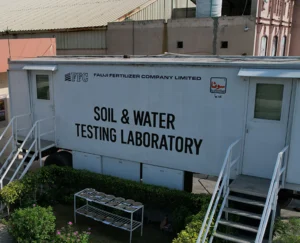
Beyond production and sales, FFC operates 75 Sona retail outlets and works with around 3,000 dealers nationwide. It also provides agronomic support through soil testing labs and farmer training programmes aimed at improving yields. These initiatives underline FFC’s core role in supporting Pakistan’s food security and farm income.
Challenges And Outlook
FFC faces both opportunities and challenges in the years ahead. Pakistan’s growing population and climate risks are increasing pressure on the agriculture sector, and as the country’s largest urea producer, FFC is well positioned to meet part of that demand. The company is also exploring more value-added products, including specialty fertilizers and chemical byproducts, along with energy-efficiency measures such as waste-heat power. The merger with FFBL also gives FFC exposure to sugar, oleochemicals and power, potentially diversifying revenues during strong crop seasons or energy cycles.
At the same time, FFC’s cost structure remains sensitive. All its plants are natural-gas fueled, with supplies sourced from Mari Petroleum and domestic pipelines. Rising gas prices or supply bottlenecks can therefore squeeze margins. Volatile urea prices, whether shaped by global markets or local subsidy policies, are another risk. In FY2025, the fertilizer industry faced oversupply and erratic weather, which raised inventories. FFC’s advantage was its efficient operations, as it maintained historically low inventories.
Regulatory changes, including any shift in fertilizer tariffs or subsidy policy, can also affect the company’s business. Environmental pressure linked to nitrogen run-off and emissions may push FFC to invest further in greener products and research, a trend the company is monitoring through its R&D work.
Overall, FFC’s future remains closely tied to Pakistan’s agricultural needs. Its strong balance sheet gives it room to invest in expansion or new plants if required, while its broader business base, including Askari Bank and Fauji Foods, provides additional stability. As CEO Jahangir Piracha noted, FFC’s mission is to keep the fertilizer supply chain secure while improving farmer productivity. With Pakistan seeking greater self-sufficiency in key crops, FFC is likely to remain central to the country’s agricultural and food security strategy.
Company At A Glance
Founded: 1978
Headquarters: Rawalpindi
Sector: Fertilizers and chemicals
CEO: Jahangir Piracha
Employees: Around 3,500
Market Cap: Approximately PKR 811 billion on PSX
FY2025 Revenue: PKR 432.4 billion
FY2025 Profit: PKR 73.6 billion
Urea Capacity: Around 2.0 million tonnes per year
Dividend 2025: 370 percent
Major Shareholder: Fauji Foundation, around 50 percent
Sources: FFC corporate reports; PSX filings; industry analysis; financial data from PSX and official statements.
Also Read: FFC posts Rs17.5bn profit in Q1 2026, declares interim dividend