
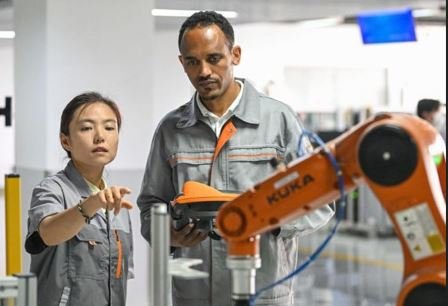
WINDHOEK, Sunday, September 20, 2026: From industrial robotics in Angola to e-commerce in Rwanda and technical training in Kenya, expanding China-Africa vocational education cooperation is providing young Africans with practical skills aimed at improving employment and entrepreneurship opportunities.
The partnership spans vocational colleges, skills competitions, teacher training and specialised technical programmes across several African countries. China has established 17 Luban Workshops in 15 African countries, while additional training programmes are planned under commitments made at the 2024 Beijing Summit of the Forum on China-Africa Cooperation.
The growing focus on technical skills will also be visible at the 48th WorldSkills Competition in Shanghai from September 22 to 27, where young competitors from Namibia, Kenya, Egypt, South Africa, Morocco and other countries will demonstrate their vocational expertise.
African youth prepare for WorldSkills Shanghai
Among them is 22-year-old Namibian Wilhemina Amadhila, who has been preparing for the competition at a workshop in Ongwediva in northern Namibia.
Amadhila will join 16 other young Namibians competing in different categories in Shanghai, where participants from around the world will test their skills and exchange technical knowledge.
African students have also participated in previous skills competitions in China.
At the 2025 World Vocational College Skills Competition in Tianjin, Angolan student Massak Ventura Noquena Eduardo won silver after developing skills in industrial robotics and automated production lines with Chinese instructors.
Eduardo said he hoped to use the expertise to contribute to Angola’s industrialisation.
At the Angola-China Institute of Technology, students receive training in areas including mechatronics, industrial robotics and automation.
Chinese instructor Guo Xiaoyu said practical learning was central to vocational education. After a semester of training in circuit assembly and fault diagnosis, more than 90% of participating students met the required standard, according to Guo.
Practical training expands across Africa
Similar programmes are operating elsewhere on the continent.
At Ethiopia’s Holeta Polytechnic College, students studying animal science receive practical training alongside classroom instruction. Chinese teachers demonstrate procedures including surgical suturing before students practise using training equipment.
Twenty Chinese teachers are currently working across six vocational colleges in Ethiopia.
In Cameroon, vocational training has been taken directly to construction sites.
China First Highway Engineering Co., Ltd., Cameroon’s Ministry of Higher Education and the National Advanced School of Public Works launched the country’s first certification programme for surveyors in August.
Cameroon’s Higher Education Minister Jacques Fame Ndongo said the programme was designed to turn construction sites into practical classrooms while connecting university education with major infrastructure projects.
China plans 60,000 training opportunities
Under an action plan announced at the 2024 Beijing Summit of the Forum on China-Africa Cooperation, China plans to continue expanding vocational education partnerships with African countries.
The programme includes jointly developing engineering technology schools, establishing or upgrading 10 Luban Workshops and providing 60,000 training opportunities, primarily for African youth and women.
China has already established 17 Luban Workshops across 15 African countries and trained tens of thousands of professionals, according to figures cited in the report.
The programmes cover technical fields intended to match skills training more closely with employment and industrial requirements.
Skills training creates employment and business opportunities
For some participants, vocational education has provided a pathway into employment or entrepreneurship.
Thirty Rwandan students returned home at the end of 2025 after completing a year of advanced training at Jinhua University of Vocational Technology in China’s Zhejiang Province.
Among them was 23-year-old e-commerce graduate Aimable Tuyishime, who studied logistics, warehouse management and data analysis. He is now developing an online shopping platform for consumers in Rwanda.
In Tanzania, the Kilimanjaro Institute of Technology and Management launched a Chinese culinary programme earlier this year, combining video instruction from chefs in China with practical training in local kitchens.
Hospitality student Ruth Washima Seni said the skills could help graduates distinguish themselves in the labour market and potentially establish their own businesses.
Skills competitions are also creating employment opportunities. Gold medallists in cooking and restaurant service at Namibia’s national skills competition last year received three-month apprenticeships with a local hospitality group.
Focus shifts to training African instructors
Long-term cooperation is increasingly focusing on developing local teaching capacity so African institutions can train future generations independently.
In Cote d’Ivoire, seven vocational schools built by Chinese contractors opened in September 2025. Covering around 83,000 square metres, the institutions can accommodate approximately 5,600 students across 15 trades, including machining, automotive repair and agro-processing.
A total of 184 Ivorian teachers and administrators received four months of training in China on equipment operation and maintenance, while 15 school managers received management training. Two Chinese vocational institutions are also helping operate five of the schools.
In Kenya, 69 institutions are expected to receive equipment for 70 vocational training workshops, while 1,190 instructors and technicians are due to receive training in Kenya and China.
Esther Thaara Muoria, principal secretary of Kenya’s State Department for Technical and Vocational Education and Training, said investing in instructors and modern workshops could have a lasting impact because trained teachers can pass their expertise to successive generations of students.
For young African competitors heading to Shanghai, the WorldSkills Competition will provide another opportunity to test those skills internationally and bring practical experience back to their countries.