
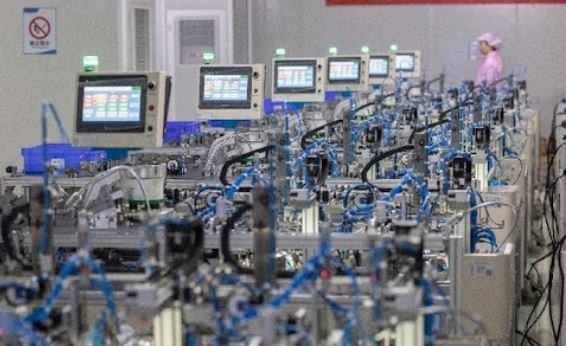
BEIJING, Sunday, September 20, 2026: China has unveiled a five-year development plan for its electronic information manufacturing industry, targeting more than 30 trillion yuan ($4.4 trillion) in combined revenue among major enterprises by 2030 as Beijing seeks to strengthen the hardware and industrial base supporting artificial intelligence and the wider digital economy.
The China electronic information manufacturing plan for 2026-2030, jointly issued by the Ministry of Industry and Information Technology (MIIT) and the National Development and Reform Commission, covers semiconductors, electronic components, sensors, photonics, computing systems and consumer electronics. It also targets research and development investment intensity of 3.5% across the sector.
The strategy forms part of China’s 15th Five-Year Plan period and seeks to move the industry beyond its existing scale towards stronger technological capabilities, more resilient supply chains and higher-quality manufacturing.
China targets stronger semiconductor and electronics base
China’s electronic information manufacturing industry has become one of the country’s largest industrial sectors. By the end of 2025, it had ranked first among China’s 41 major industrial sectors by revenue for 13 consecutive years.
The new plan sets out measures to strengthen integrated circuits, electronic components and materials, intelligent sensors, specialised electronic equipment and measuring instruments, as well as the photonics industry.
Liu Bin, an MIIT official, said the strategy was designed to address bottlenecks in key technologies and strengthen the country’s industrial foundation.
In photonics, for example, authorities plan to support breakthroughs in core technologies and establish pilot-testing platforms that can serve key industries and shared technological requirements.
The government expects such infrastructure to help move technologies from research and development towards commercial production.
AI demand drives growth in China’s chip industry
Artificial intelligence is also creating new demand for high-performance computing and memory chips, adding momentum to China’s integrated circuit industry.
According to customs data cited in the report, China’s integrated circuit exports reached $216 billion in the first seven months of 2026, an increase of 99.5% from a year earlier and already above the total recorded for all of 2025.
The five-year strategy calls for stronger supply-chain resilience in key technologies and the development of a more robust domestic computing ecosystem.
It also seeks closer coordination between hardware and software as AI systems place greater demands on computing infrastructure, data processing and electronic components.
Smartphones, computers and VR devices in focus
Consumer electronics will remain another major component of the strategy.
The plan calls for innovation in products including high-end smartphones, personal computers and virtual reality devices as manufacturers adapt hardware to rapidly developing AI capabilities.
China maintained a leading global position in the production of major consumer electronics, including mobile phones and computers, during the 2021-2025 Five-Year Plan period.
Liang Linjun, a researcher at the China Academy of Information and Communications Technology, said consumer devices provide an important channel through which smart technologies reach hundreds of millions of users.
He said the next phase would require work on standards covering AI agent collaboration, high-speed computing interconnections and hardware-software compatibility.
Liang also called for longer-term investment suited to technology development cycles and greater training of professionals with expertise spanning both artificial intelligence and electronics manufacturing.
China moves to curb excessive industry competition
The plan also addresses concerns about intense competition and excess capacity in parts of the electronics industry.
It calls for industry standards to be updated when necessary, improved coordination of production capacity across subsectors and early-warning mechanisms to identify potential imbalances.
Authorities also want measures to curb what the plan describes as cutthroat competition as China shifts its focus from manufacturing volume towards quality, technological capability and sustainable industrial growth.
Ao Li, vice president of the China Academy of Information and Communications Technology, said turning industrial scale into broader systemic strength would be a major challenge for the sector during the 2026-2030 period.
The strategy ultimately seeks greater cooperation among government, manufacturers, universities, research institutions and technology users to strengthen China’s industrial base, improve supply-chain resilience and accelerate innovation across electronics and AI-related hardware.