
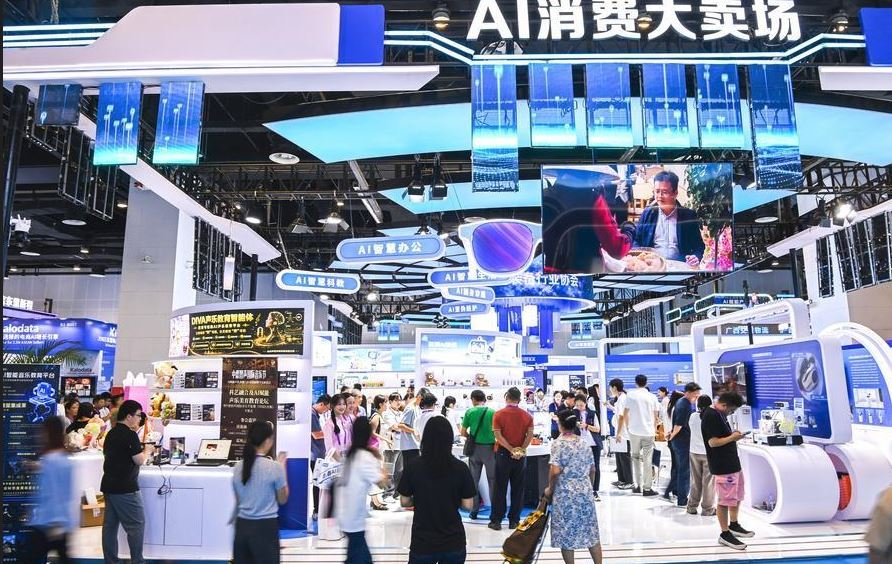
NANNING, Sunday, September 20, 2026: The 23rd China-ASEAN Expo has launched its first dedicated artificial intelligence marketplace in Nanning, bringing Chinese AI companies and Southeast Asian buyers together as China and ASEAN expand cooperation in the digital economy.
The China-ASEAN AI marketplace features technologies ranging from large language models and AI chips to smart robots, AI glasses and healthcare devices. Organisers say the platform is designed to match Chinese technology solutions with practical demand across ASEAN markets and support commercial partnerships beyond the five-day expo.
The China-ASEAN Expo is being held from September 17 to 21 in Nanning, capital of south China’s Guangxi Zhuang Autonomous Region.
More than 400 AI products showcased for ASEAN market
This year’s AI section has been divided between a main venue and a sub-venue, with each focusing on different areas of the industry.
The main venue showcases technologies including large language models and AI chips, while the sub-venue features more than 400 products from 60 companies aimed at ASEAN markets.
Products on display include AI-powered glasses, smart robots and rehabilitation and nursing-care devices. Visitors and potential buyers can test products at the venue and place orders directly.
Chinese technology companies including Huawei, iFlytek and Unitree Robotics are presenting developments in areas such as embodied intelligence, large-model applications and urban governance.
Organisations from ASEAN countries, including Thailand and Indonesia, are also showcasing locally developed AI technologies.
AI marketplace to remain open after expo
Unlike a conventional temporary exhibition, the AI sub-venue is expected to remain open throughout the year after the China-ASEAN Expo concludes.
The permanent platform is intended to provide Chinese AI consumer products with continued access to potential buyers and partners from Southeast Asia, turning products showcased during the expo into longer-term commercial opportunities.
Lu Xinning, vice chairperson of the Guangxi regional government, said the focus was not simply on displaying the most advanced technologies or the largest range of products.
“What we are striving for is the best fit with ASEAN and the most solid on-the-ground results,” Lu said.
The expo has also introduced an area presenting projects and technology requirements from ASEAN countries in transportation, smart logistics, artificial intelligence, urban management and industrial park development.
A separate 10,000-square-metre “AI Plus Finance” zone has also been added to the financial exhibition area.
Digital economy gains focus in China-ASEAN cooperation
The expanded emphasis on artificial intelligence comes as China and ASEAN move towards implementing the China-ASEAN Free Trade Area 3.0 Upgrade Protocol, signed in October 2025.
The upgraded framework covers emerging areas including the digital economy and green development, alongside broader economic and trade cooperation.
Organisers see AI as an increasingly important link between Chinese technology providers and Southeast Asian businesses and institutions seeking digital solutions.
The marketplace model is intended to connect technology suppliers directly with specific ASEAN requirements rather than focusing solely on technology demonstrations.
China-ASEAN trade exceeds $1 trillion
The push for greater digital cooperation comes amid expanding economic ties between China and the Association of Southeast Asian Nations.
Bilateral trade exceeded $1 trillion for the first time in 2025, reaching $1.05 trillion, according to figures cited by expo organisers. That represented an increase of 7.4% from the previous year.
China-ASEAN trade reached $744.41 billion in the first seven months of 2026, up 24.7% year on year and accounting for 21.8% of China’s total foreign trade during the period.
China has remained ASEAN’s largest trading partner for 17 consecutive years, while ASEAN has been China’s largest trading partner for six consecutive years.