
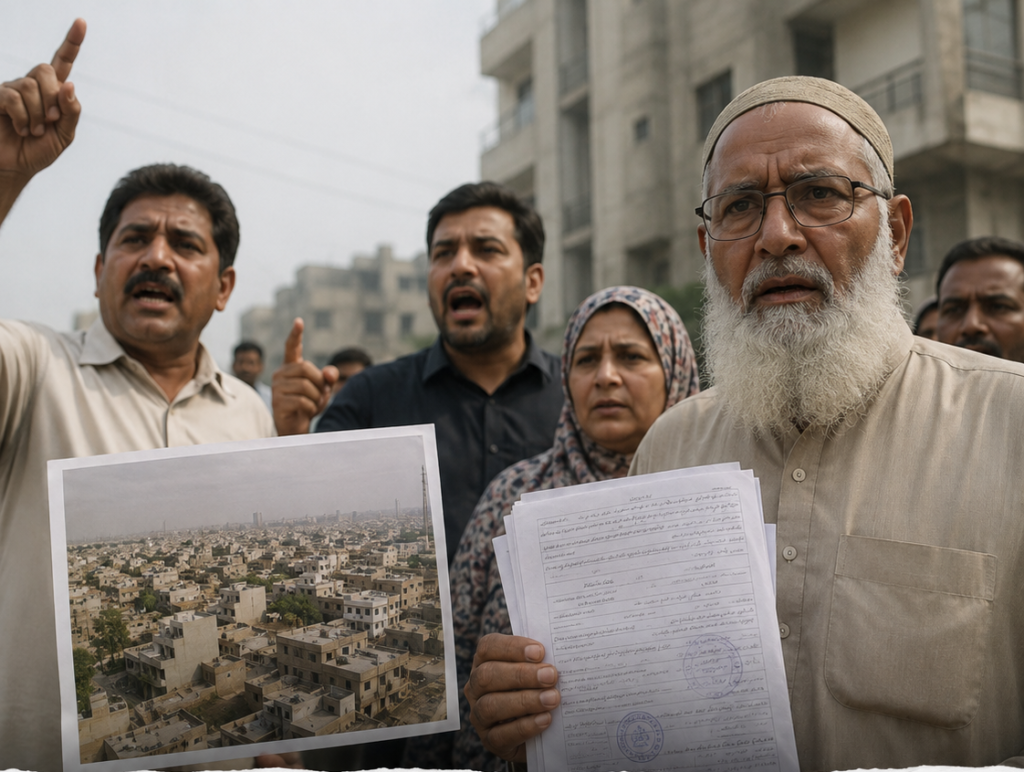
ISLAMABAD: A sprawling residential settlement housing thousands of families on the outskirts of Islamabad is facing a long-running administrative paradox: its residents vote, own documented properties and have access to much of the capital’s utility infrastructure, yet many say they remain largely on their own when it comes to roads, sanitation, streetlights, water supply and other basic civic services.
Residents of Ghauri Town, spread across several phases from the Khanna Pul-Koral side towards Tarlai and adjoining localities, say they have spent years caught between the Capital Development Authority’s regulatory position and disputes linked to the scheme’s developers.
For the CDA, the legal position remains clear. Its current list of illegal housing schemes includes “Ghouri Town, all Phases Islamabad Expressway.” The authority says private schemes are required to obtain approval of their layout plans followed by a no-objection certificate before development and sale of plots can lawfully proceed.
For residents, however, the issue has moved far beyond the original planning dispute.
Ghauri Town has developed over the years into a densely populated urban settlement containing thousands of houses, markets, streets and utility networks. Residents argue that whatever violations may have been committed at the development stage, ordinary families who bought homes and have lived there for years should not remain indefinitely deprived of municipal services.
‘Why Are Residents Being Punished?’
Muhammad Zubair, president of Shaheen Welfare Group, Ghauri Town Phase 4-A, said residents had no role in the regulatory dispute between the authorities and those who developed the scheme.
“The people living here are ordinary citizens who purchased plots and houses with their hard-earned money. They have registered documents and have been living here for years. If there is a legal dispute with the developers, the government should resolve it instead of punishing the residents,” he said.
The frustration is not new.
In March 2019, Ghauri Town residents staged a protest outside CDA headquarters over restrictions on new utility connections. At the time, residents argued that land transfers and construction had been allowed to continue while the scheme expanded, only for homeowners to face restrictions after investing their savings. Dawn reported that CDA regarded all phases of Ghauri Town as illegal because the required approvals had not been obtained.
Residents staged another protest in 2021, again demanding utility connections and arguing that restrictions imposed after large-scale construction had left existing families bearing the consequences.
Gas Connections Remain a Long-Running Issue
The dispute over natural gas has also been formally acknowledged at the federal level.
In a written response to the National Assembly, the Petroleum Division confirmed that a ban had been imposed on gas supply to Ghauri and Shaheen Towns because they had been declared illegal or unapproved by the CDA. The ministry stated that gas connections would be provided subject to the issuance of a CDA NOC.
Residents say the situation has become increasingly difficult to understand because gas infrastructure exists in parts of the locality while many households remain unable to obtain new connections.
For them, the question is no longer merely whether the original housing scheme complied with planning laws, but what responsibility the state has towards a large population already living there.
Residents Pay for Services Themselves
Zahid Ali Khan, chairman of the Phase 4-A Welfare Group, said the absence of regular municipal services had forced residents to make private arrangements for functions normally associated with city administration.
“We have roads, houses, markets and thousands of residents, but when it comes to public services, nobody accepts responsibility for us. Residents are paying from their own pockets for security, streetlights, sanitation and waste collection,” he said.
According to Khan, road conditions have deteriorated badly in parts of the locality.
“Many roads are in a dilapidated condition. We have repeatedly asked the authorities to repair them, but the answer is always that Ghauri Town is illegal. If the government has a legal objection, resolve it. How long can the residents be left without basic civic facilities?” he asked.
Residents say formal waste collection remains unavailable in many areas, while welfare groups arrange sanitation, security and streetlighting themselves.
Water is another persistent concern, with households in several localities relying on private arrangements where government supply is unavailable.
Issue Has Reached Islamabad High Court
The legal status of Ghauri Town and the rights of people living there have also repeatedly reached the courts.
Rana Abdul Qayyum, an advocate of the High Court and longtime representative of Ghauri Town residents, said residents have sought judicial intervention over the non-provision of civic facilities and restrictions affecting utility connections.
“The residents are not asking the state to ignore the law. They are asking the state to apply the law fairly and resolve the legal status of the area. Thousands of families cannot be kept in limbo indefinitely because of a dispute between the authorities and the developers,” he said.
A 2023 Islamabad High Court judgment concerning Ghauri Town addressed its exclusion from the notified urban area for application of the Islamabad Rent Restriction Ordinance.
The court ultimately held that the rent law should extend throughout the Islamabad Capital Territory irrespective of whether a locality was registered, approved or unapproved. The case arose after a petitioner argued that his Ghauri Town property had been excluded despite payment of government taxes and approval-related charges.
While that judgment concerned tenancy law rather than regularisation of Ghauri Town itself, residents cite it as an example of the difficulties created when large populated areas remain outside parts of Islamabad’s formal administrative framework.
Phase 7 Demolition Dispute Adds New Dimension
The issue returned to the Islamabad High Court in March 2026.
A month earlier, on February 24, 2026, CDA issued a notice relating to Ghauri Town Phase 7, describing it as an illegal or unauthorised housing scheme and alleging development and construction in violation of applicable planning and building regulations.
On March 20, the Islamabad High Court restrained the CDA from taking adverse action against houses covered by a petition challenging demolition notices in Phase 7.
The petition also sought regularisation of the locality and provision of basic utilities, including electricity and gas. The court issued notices to the respondents while granting interim protection to the petitioner.
The proceedings underline the complexity of a dispute in which the CDA continues to assert its regulatory powers while a substantial resident population seeks protection and basic services.
‘Citizens at Election Time, Illegal at Development Time’
For many residents, the most difficult contradiction is electoral.
Rozina Ali, an Islamabad-based broadcast journalist and resident of Ghauri Town Phase 4-B, said people living in the locality are recognised as citizens for electoral and documentation purposes but encounter a different response when seeking municipal services.
“We are citizens of Islamabad. We have CNICs, our votes are registered, our properties are documented and we pay for the services that we can obtain privately. But when we ask for a road, sanitation, streetlights, water supply or other civic services, we are told that this is an illegal area,” she said.
“Then the question is: if the government considers us citizens for elections, why are we not citizens when it comes to basic municipal services?”
Residents say that question becomes even more significant when they compare their locality with neighbouring areas receiving public-sector development.
Development Next Door, But Not Here
Residents point to Tarlai Khurd, where they say road paving and other development projects have been carried out close to Ghauri Town.
According to local residents, a street approximately 100 feet from Ghauri Garden has recently received concrete paving and associated development work. They associate the projects in the wider area with development initiatives involving MNA Raja Khurram Shahzad Nawaz.
Official National Assembly records identify Raja Khurram Shahzad Nawaz as the member from NA-48, while Election Commission results show that he contested and was elected from the constituency as an independent in the 2024 general election. Later parliamentary monitoring records list his affiliation as PML-N.
Residents stress that their complaint is not that neighbouring communities are receiving development.
“We are not asking why development is taking place in Tarlai Khurd. We are asking why development cannot take place here,” Zubair said.
“If a road can be constructed just a few steps away, why is a road in Ghauri Town beyond the reach of the state?”
The specific development works cited by residents could not independently establish any change in Ghauri Town’s regulatory status. The CDA continues to list all phases of Ghauri Town among unauthorised housing schemes.
Enforcement Alone Has Not Resolved the Problem
CDA has repeatedly warned the public against buying or investing in unauthorised schemes, arguing that approval of a layout plan and an NOC are mandatory safeguards for planned development.
Its current public information continues to identify Ghauri Town among schemes lacking the required approval or NOC.
But residents argue that the enormous scale of existing construction means the problem can no longer be addressed simply as a case of stopping a new unauthorised project.
Families are already there.
Homes have already been built.
Businesses are operating.
Children have grown up in the locality.
The population participates in Islamabad’s electoral, commercial and social life.
Residents therefore want the federal government, Ministry of Interior, CDA and Islamabad administration to devise a comprehensive legal and administrative solution.
They propose a detailed review of land ownership, road networks, layout plans, amenity areas, environmental requirements, building regulations and infrastructure to determine which areas can be regularised, what deficiencies must be rectified and where enforcement may still be necessary.
“What we are asking for is a decision,” Advocate Rana Abdul Qayyum said.
“If the area cannot be regularised in its present form, tell the residents what the lawful mechanism is. If it can be regularised subject to conditions, impose those conditions. But leaving thousands of families without basic civic services is not a solution.”
A Question for Islamabad’s Authorities
Residents say the dispute may have originated with developers and regulatory failures, but those who live with its consequences today are homeowners, families, workers, taxpayers and voters.
Their appeal is directed to the federal government, the Interior Ministry, CDA and the Islamabad administration: resolve the legal status of Ghauri Town and establish clearly which institution is responsible for delivering essential municipal services to its existing population.
For people who have lived there for years, the question is straightforward:
If the state knows where they live, registers their votes and recognises them as citizens, who is responsible for providing them the basic services of a city?
Until there is a definitive answer, residents say Ghauri Town will continue to exist physically, socially and electorally — while remaining caught in administrative limbo.
Also Read:RIDA Holds Oath-Taking Ceremony for Newly Elected Office-Bearers