
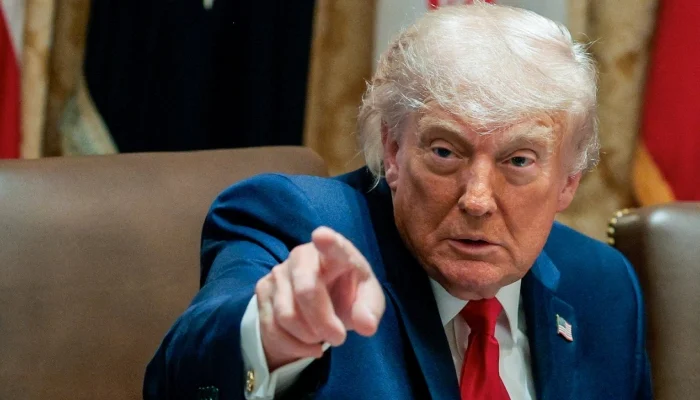
WASHINGTON: US President Donald Trump will only approve a peace agreement with Iran if it meets Washington’s key conditions, a White House official said on Friday, as uncertainty continued over negotiations aimed at ending the conflict and restoring regional stability.
The remarks came after Trump held a two-hour meeting in the White House Situation Room to review options related to the ongoing crisis. While discussions took place, no final decision was announced, highlighting continued differences between the two sides on the terms of a potential agreement.
A White House official told AFP that Trump would only support a deal that aligns with US interests and meets his stated requirements, including a commitment that Iran will not develop nuclear weapons.
Iranian officials, however, said no final agreement had been reached. Foreign Ministry spokesperson Esmaeil Baqaei said exchanges between the two countries were continuing but stressed that negotiations had not yet produced a definitive outcome.
Iranian President Masoud Pezeshkian also indicated that Tehran remained open to a settlement, telling Qatar’s emir that Iran was prepared to pursue a “dignified framework” to end the conflict, according to state news agency IRNA.
Disputes over terms of a potential deal
Trump said in a social media post that a future agreement could include the reopening of the Strait of Hormuz without tolls, the removal of naval mines and coordination on Iran’s enriched uranium stockpiles.
Iranian state-affiliated media disputed several of those claims, reporting that some proposed terms described by Trump were either inaccurate or not included in the current discussions.
According to Iran’s Fars news agency, Tehran is seeking the release of frozen Iranian assets before advancing to the next stage of negotiations.
Baqaei also stated that no talks were currently taking place regarding Iran’s nuclear programme, while suggesting that Washington’s approach had slowed progress toward a broader agreement.
Regional tensions remain high
The uncertainty surrounding negotiations has continued to affect global energy markets, with investors closely monitoring developments involving the Strait of Hormuz, one of the world’s most important oil shipping routes.
The United States and Iran have recently accused each other of violating a temporary truce around the strategic waterway. Iranian state television reported that commercial shipping traffic had continued through the strait but warned that vessels from countries considered hostile could face military action.
Meanwhile, fighting also continued on the Lebanon front. Israeli Prime Minister Benjamin Netanyahu said Israeli forces had advanced further into southern Lebanon, while Hezbollah claimed responsibility for drone attacks targeting Israeli military positions.
Despite ongoing diplomatic efforts, regional tensions remain elevated as negotiations continue without a final agreement.
read more