
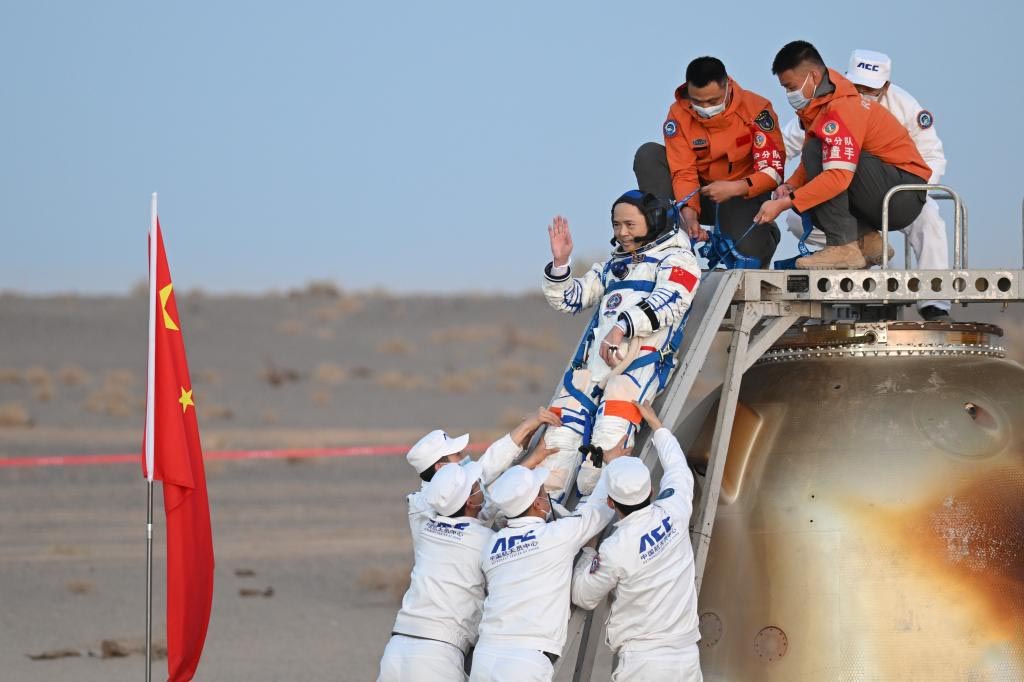
JIUQUAN, China: The three astronauts of China’s Shenzhou-21 mission have safely returned to Earth after spending 210 days aboard the Tiangong space station, completing the longest single-crew mission in the country’s space program.
The crew, consisting of Zhang Lu, Wu Fei and Zhang Hongzhang, landed at the Dongfeng landing site in Inner Mongolia on May 29. The China Manned Space Agency (CMSA) confirmed that all three astronauts were in good health and declared the mission a complete success.
According to the CMSA, the return sequence began when the Beijing Aerospace Control Center issued a command for re-entry. The return capsule touched down at 8:11 p.m. Beijing time, and all crew members exited the capsule safely within an hour.
Mission commander Zhang Lu, a veteran astronaut on his second spaceflight, thanked the support teams, his family and the Chinese people following the successful landing.
During the mission, Zhang completed multiple extravehicular activities, becoming the Chinese astronaut with the highest number of spacewalks to date.
Scientific research and space station operations
The Shenzhou-21 crew carried out a wide range of scientific experiments and technology demonstrations during their stay in orbit.
Research projects covered microgravity physics, materials science, life sciences, aerospace medicine and emerging space technologies. The astronauts also conducted experiments involving lithium-ion batteries, fluid dynamics and combustion science.
For the first time aboard China’s space station, the crew successfully carried out closed-environment breeding of mice, a development expected to support future mammal-related space research.
The astronauts also achieved the first aeroponic cultivation of cherry tomatoes and wheat on the station and conducted experiments involving new propulsion technologies.
Spacewalks and maintenance tasks
In addition to scientific work, the crew completed three spacewalks and carried out maintenance and inspection activities.
Their tasks included inspecting spacecraft equipment, photographing the return capsule viewport window of a visiting spacecraft, installing protective shielding against space debris and conducting cargo transfer operations.
The mission also involved an unusual spacecraft arrangement after concerns emerged regarding a suspected debris impact on the return capsule window of an earlier spacecraft. Chinese authorities subsequently launched another spacecraft to provide a safe return vehicle for the crew.
Milestone for China’s space program
Launched on Oct. 31, 2025, the Shenzhou-21 mission represents another major step in China’s long-term human spaceflight program.
The mission combined scientific research, technology testing and space station maintenance, while setting a new duration record for a single crew aboard the Tiangong space station.
Chinese space authorities said the results obtained during the mission will support future research and contribute to the continued development of the country’s space program.
Also Read: Shenzhou-21 heads for space: New milestones in China’s space program