
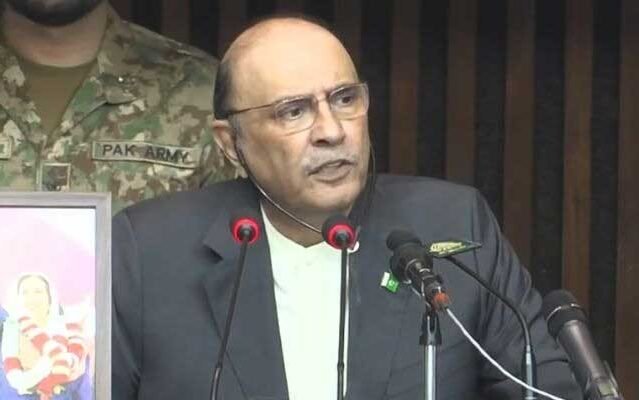
President Asif Ali Zardari on Monday urged India to pursue dialogue instead of confrontation, warning that any renewed aggression against Pakistan would draw a decisive response. Addressing a joint sitting of parliament at the start of the new parliamentary year, he called for negotiations to ensure regional stability while reaffirming Pakistan’s diplomatic support for the people of Jammu and Kashmir.
“Make no mistake. We are ready for you,” the president said, cautioning against miscalculation. He added that dialogue was the only path toward regional security and stressed that Pakistan would continue to support what he described as the just cause of Kashmiris.
The session, co-chaired by Senate Chairman Syed Yousuf Raza Gilani and National Assembly Speaker Sardar Ayaz Sadiq, was attended by Prime Minister Shehbaz Sharif, members of both houses of parliament, provincial leaders and diplomats. Opposition lawmakers staged a protest during the address.
Regional tensions and security operations
President Zardari condemned the conflict involving Iran and expressed support for the sovereignty and territorial integrity of regional states. He also called for restraint following attacks reported in several Gulf countries, urging adherence to international law and respect for territorial integrity.
Referring to recent military operations, including Marka-e-Haq and Operation Ghazab lil-Haq, the president said Pakistan had initially exercised restraint but responded decisively when required. He praised the armed forces and security agencies for what he described as professional conduct and national unity during the crises.
Pakistan launches Operation Ghazab Lil Haq with airstrike in Nangarhar
He warned that any aggressor should be prepared for consequences, while reiterating that Pakistan is a responsible nuclear state committed to defending itself if necessary.
Afghanistan and counterterrorism
On Afghanistan, the president said Pakistan had pursued diplomatic efforts to prevent escalation but would not tolerate cross-border militant activity. He urged Afghan authorities to dismantle militant networks and avoid allowing their territory to be used against Pakistan.
He reiterated that Pakistan seeks dialogue and regional cooperation but will act to safeguard its sovereignty and security.
Foreign policy and economic outlook
Highlighting foreign relations, President Zardari said Pakistan’s ties with the United States had opened new avenues for strategic and economic cooperation. He described relations with China as strong and said the second phase of the China-Pakistan Economic Corridor would enhance infrastructure and connectivity.
He also emphasized deepening partnerships with Gulf states, Azerbaijan and Turkiye, and reiterated Pakistan’s support for the establishment of an independent Palestinian state based on pre-1967 borders with Al-Quds Al Sharif as its capital.
On the Indus Waters Treaty, the president criticized what he called unilateral actions affecting river flows, stating that Pakistan would defend its water rights through legal and diplomatic channels.
Turning to domestic matters, he said the economy had shown signs of stabilization but called for inclusive growth to provide relief to salaried individuals, pensioners and small traders. He urged reforms in taxation, energy and governance, alongside support for social protection programs such as the Benazir Income Support Programme.
President Zardari concluded by calling for unity, institutional reform and sustained efforts to protect sovereignty, counter terrorism and translate macroeconomic gains into tangible public relief.




 Today's E-Paper