
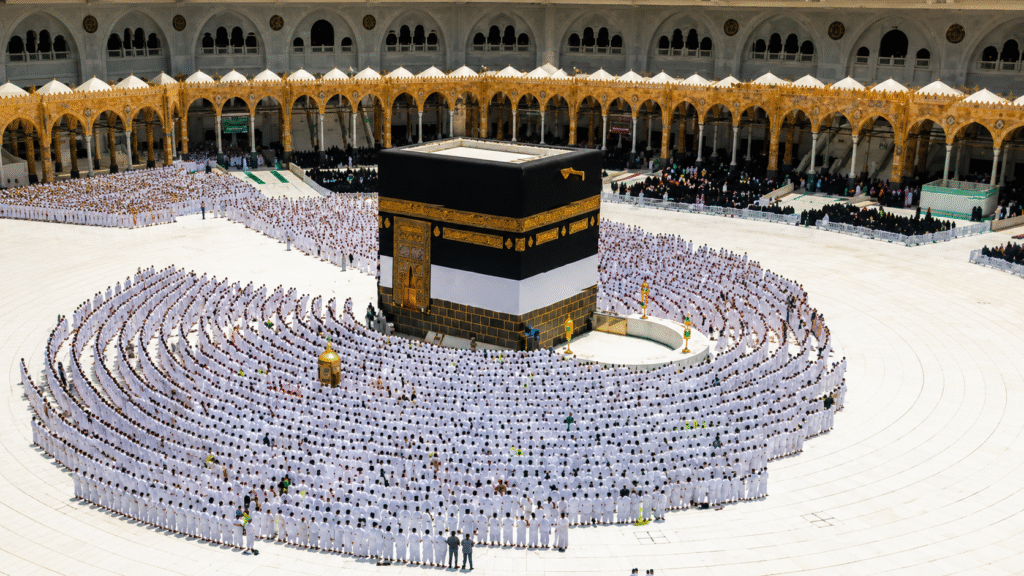
Hajj pilgrims often face practical questions about stoning the Jamarat, staying overnight in Mina, missed rites and movement inside Masjid al-Haram. These rulings matter because some acts are essential for the validity of Hajj, while others require compensation if missed without a valid excuse.
This explainer brings together key Hajj questions in a clear sequence, including whether stoning can be performed by proxy, whether a pilgrim must still stay in Mina, what happens if Arafat is missed, and why one side of the Mataf courtyard does not have Ottoman-style arcades.
Can someone perform stoning of the Jamarat on behalf of another pilgrim?
Yes. A pilgrim who is elderly, ill, physically weak or genuinely unable to reach the Jamarat may appoint another person to perform the stoning on their behalf.
This permission applies to the act of stoning only. It does not automatically remove other Hajj obligations.
Does appointing someone for stoning remove the duty to stay in Mina?
No. Stoning the Jamarat and spending the nights in Mina are separate matters.
Spending the nights in Mina during the Days of Tashriq is considered a wajib act of Hajj. If a pilgrim leaves Mina without a valid excuse, a compensatory sacrifice, known as dam, may become necessary.
If tents or accommodation are available in Mina and the pilgrim is able to stay there, they should remain in Mina. If illness, serious weakness or another genuine hardship prevents this, the pilgrim should consult a qualified scholar or official Hajj guide for a case-specific ruling.
What happens if any act of Hajj is missed?
The ruling depends on the type of act missed. Hajj acts are generally divided into three categories: pillars, wajib acts and sunnah acts.
A pillar is essential for the validity of Hajj. A wajib act is necessary, and leaving it without a valid excuse may require dam. A sunnah act does not invalidate Hajj if missed, but it reduces the completeness and reward of the pilgrimage.
What is the role of Ihram in Hajj?
Ihram, with intention and Talbiyah, is the basic condition for entering Hajj.
If a person does not enter Ihram at all, they have not entered Hajj, and their Hajj does not take place.
Which acts are essential pillars of Hajj?
After Ihram, two major acts are central to the validity and completion of Hajj: Wuquf at Arafat and Tawaf al-Ziyarah.
What if a pilgrim misses Wuquf at Arafat?
Wuquf at Arafat on the 9th of Dhul Hijjah is the greatest pillar of Hajj.
If a pilgrim completely misses Arafat, their Hajj is not valid, even if they perform other rites later. Missing Arafat cannot be compensated by dam.
A person who misses Arafat entirely should immediately consult a qualified scholar or Hajj authority about the required next steps and performing Hajj again.
What if Tawaf al-Ziyarah is delayed?
Tawaf al-Ziyarah is performed after Arafat and is necessary for the completion of Hajj.
If it is delayed beyond its prescribed days, dam may become necessary. Marital relations also remain unlawful until Tawaf al-Ziyarah is performed.
What are wajib acts of Hajj?
Wajib acts include necessary duties such as staying in Mina during the required nights, staying in Muzdalifah and stoning the Jamarat, according to the relevant fiqh ruling.
If a wajib act is missed without a valid excuse, dam becomes necessary.
What if a sunnah act is missed?
If a sunnah act is missed, Hajj remains valid and dam is not required. However, the pilgrim loses the reward and completeness attached to that sunnah.
What if someone slept in a hotel and missed Arafat?
If a person stayed asleep in a hotel on the 9th of Dhul Hijjah and completely missed Wuquf at Arafat, the matter is very serious.
Arafat is the central pillar of Hajj. If it is missed entirely, the Hajj is not valid. Missing Muzdalifah or Mina is a separate issue, but missing Arafat cannot be repaired through dam.
Why is there no Ottoman-style arcade on one side of the Mataf?
The Ottoman arcade on one side of the Mataf courtyard was removed because of limited space.
That side of Masjid al-Haram could not be pushed further back because the Mas‘a, the passage between Safa and Marwah, lies next to it. It is also the side where Tawaf begins and ends opposite the Black Stone, where crowd pressure is highest.
Open space is also needed behind Maqam Ibrahim for the two rak‘ahs after Tawaf. Pilgrims beginning Sa‘i from Safa also face the Ka‘bah from this direction for Istilam and supplication.
For these reasons, the arcade was removed from that side to widen the Mataf and improve movement for pilgrims, including those coming from upper floors and the rooftop.
Also Read: Hajj Guide 2026: What Should Pilgrims Know About the Final Days of Hajj?