
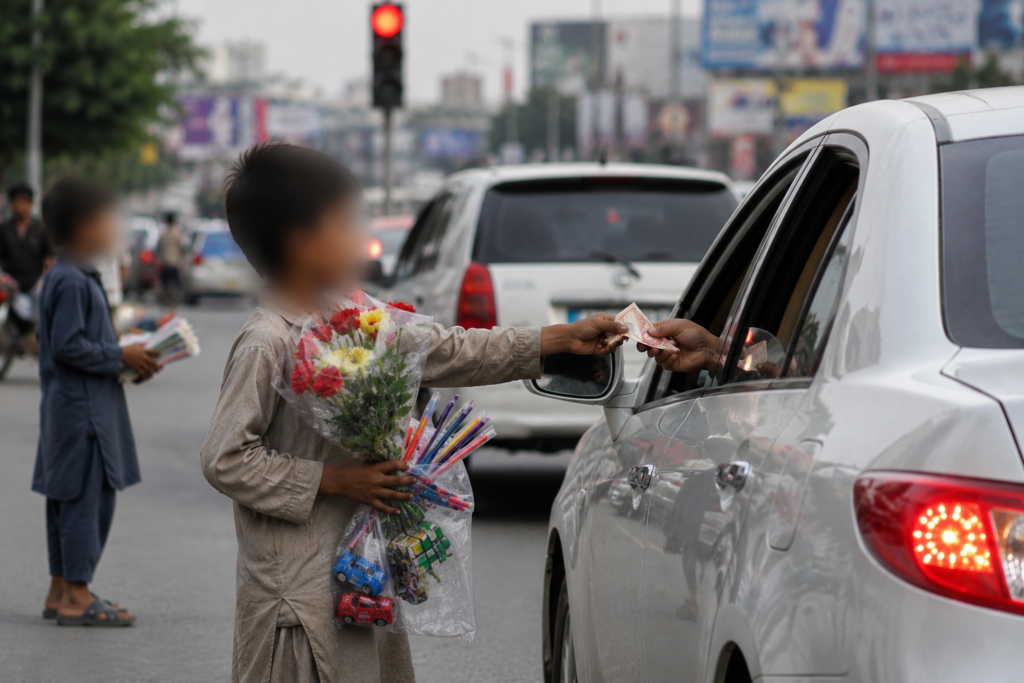
ISLAMABAD/RAWALPINDI: Children, women and elderly people selling flowers, pencils, toys, books, tissues and other inexpensive items at busy markets and traffic signals have become an increasingly visible sight in the twin cities, raising concerns among social experts about the possible use of street vending as a form of disguised begging.
At first glance, the individuals appear to be earning a livelihood by selling low-cost products. However, experts say that in some cases the emphasis can shift from the product itself to emotional appeals about poverty and hardship, with sellers receiving money substantially higher than the actual value of the items.
Such vendors are frequently seen at busy locations in Islamabad, including Aabpara Market, Jinnah Super Market, F-10 Markaz, Blue Area, Karachi Company and G-9 Markaz. Similar scenes have been reported around Raja Bazaar, Saddar, Commercial Market and Murree Road in Rawalpindi.
Some children approach motorists carrying flowers, pencils or toys, while others sell tissues, books and other inexpensive products. According to social experts, the situation becomes more concerning when children are sent to crowded areas primarily to attract sympathy and collect money rather than to engage in genuine commercial activity.
Concerns Over Child Exploitation
UNICEF’s 2024 reporting has highlighted that street-connected children in Pakistan remain largely undocumented, while such children are present in major urban centres including Islamabad, Rawalpindi, Karachi, Peshawar, Lahore and Multan.
The US Department of Labor’s 2024 findings have also identified begging, street vending and forced begging among risks associated with child exploitation.
Research conducted by scholars at the University of Okara involving 45 beggars across 15 districts of Punjab found that displaying poverty, making emotional appeals and using children to generate public sympathy were among practices associated with begging.
Other research has suggested that begging practices can differ according to age and gender. A 2025 study by the University of Management and Technology also linked child begging with broader economic and administrative challenges. Interviews with adolescents indicated that some children may not have control over the money they earn, with their income potentially going to parents, guardians or other individuals.
Experts Call for a Careful Distinction
Psychologists say emotional appeals based on hardship can influence people’s willingness to provide financial assistance. As a result, some people may pay considerably more for an inexpensive product because they are responding to the seller’s circumstances rather than the value of the item.
Child-rights experts, however, caution against automatically labelling every street vendor as a beggar. They say many people genuinely depend on small-scale street vending to support themselves and their families.
The concern is particularly serious when children are provided with inexpensive goods and placed at traffic signals or commercial areas primarily to obtain money through emotional appeals.
Experts say authorities should investigate whether children working at such locations are genuinely engaged in vending or are being subjected to organised begging, forced labour or other forms of exploitation.
Need for Protection and Rehabilitation
As a journalist i would like to say the issue cannot be reduced to whether citizens should give money to people on the streets. Authorities need to distinguish between genuine poverty, child labour, legitimate street vending, organised begging and exploitation.
Residents of Islamabad and Rawalpindi have called for stronger monitoring of children and vulnerable people working at major traffic signals, commercial centres and roads.
Experts recommend coordinated action by law-enforcement agencies, child-protection authorities and social-welfare departments to identify individuals who may be working under coercion or exploitation.
They stress that any intervention should prioritise child protection, education, rehabilitation and access to dignified livelihood opportunities, rather than simply removing vulnerable people from the streets.
Also Read : AI Photo Marriage Fraud Case Involving Former MPA Takes New Turn