
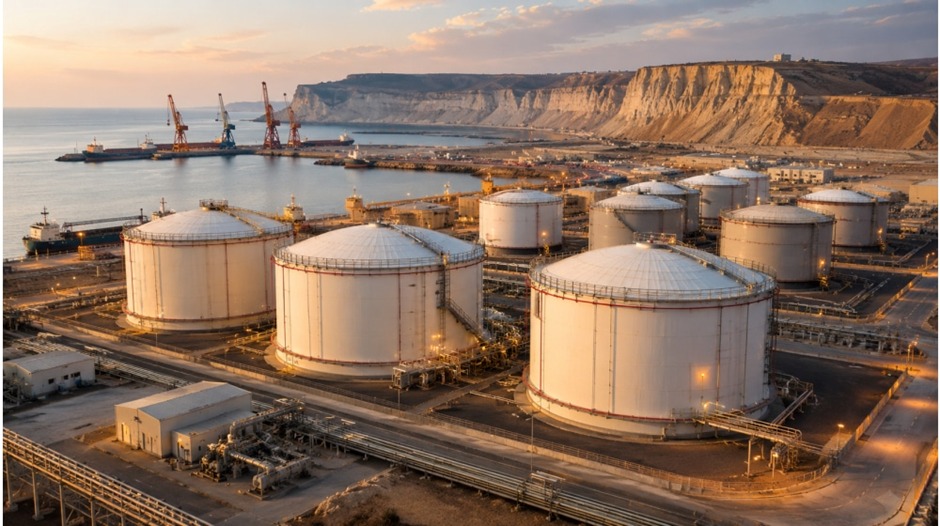
Islamabad, June 17: Pakistan’s proposed Gwadar Energy City could help strengthen the country’s fuel security and support its development as a regional storage and logistics hub, industry experts said, as petroleum imports and domestic fuel consumption continue to rise.
The project is being viewed as a potential strategic facility for crude oil, petroleum products, LNG and LPG near Gwadar Port. Experts say expanded storage capacity could reduce Pakistan’s dependence on Karachi-based fuel handling infrastructure and improve the country’s ability to respond to global supply disruptions.
According to the Pakistan Economic Survey 2024-25, Pakistan imported 12.53 million metric tonnes of petroleum products during July-March FY2025, up 12.5 percent from 11.14 million tonnes in the same period of FY2024. The petroleum products import bill reached $8.40 billion during the nine-month period.
Crude oil imports also increased by 8.8 percent to 6.76 million tonnes during July-March FY2025, with an import value of $4.11 billion.
Domestic consumption of petroleum products rose to 13.17 million tonnes during the period under review, compared with 12.30 million tonnes a year earlier. The transport sector remained the largest consumer, using 10.54 million tonnes, or nearly 80 percent of total petroleum demand.
Gwadar’s Role In Energy Storage
The proposal to develop Gwadar as an energy storage hub gained fresh attention in May 2026 after Pakistan decided to encourage oil-producing countries to establish strategic crude oil reserves at the proposed Energy City at Gwadar Port. The plan also includes LNG and LPG terminals, while Kuwait has reportedly shown interest in the project.
Gwadar Port Authority describes Gwadar as Pakistan’s third deep-sea port, located on the Arabian Sea near the entrance to the Persian Gulf and close to major international shipping routes. Under the China-Pakistan Economic Corridor framework, Gwadar Port, the Free Zone and the Gwadar Smart Port City Master Plan are identified as key development projects.
Muhammad Ali, Head of Supply Chain at Attock Petroleum Limited, said Gwadar’s main advantage lies in creating an additional fuel storage location outside Karachi.
“Gwadar can provide an additional strategic storage location that enhances energy security and reduces vulnerabilities during supply disruptions,” he said.
He said rising petroleum imports and transport-sector demand show the need for larger and more diversified storage facilities. Bonded storage, bunkering services and re-export facilities could help Gwadar develop into a regional energy logistics platform, he added.
Experts Call For Wider Energy Infrastructure
Syed Ahsan, Commercial Manager at Pakistan Refinery Limited, said the Energy City should not be limited to storage facilities alone.
“Pakistan should integrate storage facilities with future refining capacity, petrochemical industries, LNG and LPG terminals, and pipeline infrastructure so that Gwadar can support both strategic reserves and commercial energy trading,” he said.
He said the project’s success would depend on clear regulations, long-term policy certainty and investor protection.
“Clear tariff structures, transparent land policies, robust safety regulations and investor protection mechanisms will be essential. Without these measures, foreign oil-producing countries may remain reluctant to place significant strategic reserves in Pakistan despite Gwadar’s geographical advantages,” he said.
Analysts say the project could become significant for Pakistan as fuel imports continue to grow and the transport sector remains heavily dependent on petroleum products. They said modern infrastructure, credible regulations and foreign investment would be needed to turn Gwadar Energy City into a functional regional hub.
If implemented effectively, the project could help Pakistan expand fuel storage capacity, improve emergency supply planning, generate storage and transit revenues, and strengthen Gwadar’s role in regional trade and energy supply chains.
Also Read: Tariff cuts at Gwadar Port expected to boost Pakistan’s trade competitiveness