
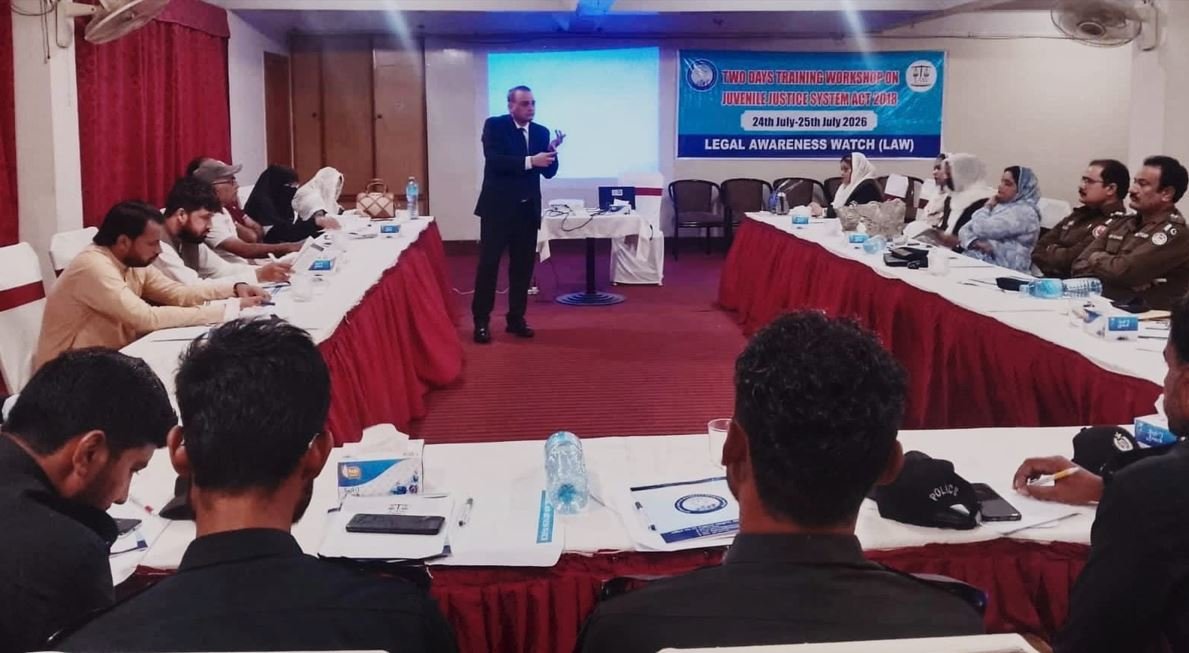
BAHAWALPUR: Legal experts, police officials and child rights advocates have called for stronger implementation of the Juvenile Justice System Act 2018, warning that weak enforcement continues to leave children in conflict with the law vulnerable to abuse, delayed justice and inadequate legal protection.
The concerns were raised during a workshop organised by Legal Awareness Watch Pakistan to promote awareness of the Juvenile Justice System Act 2018 and examine gaps in its implementation.
Participants were briefed on legal safeguards available to juvenile suspects, including protection from physical remand at police stations, handcuffing, abuse in custody and capital punishment.
Speakers said the law recognises every person below the age of 18 as a child and requires juvenile suspects to be treated separately from adult offenders throughout investigation, trial and detention.
LAW Director Sarmad Ali Advocate and other legal experts told the workshop that a child below the age of 16 accused of an offence carrying a prison term of up to 10 years is legally entitled to bail.
They added that parents or guardians must be informed through a probation officer following the arrest of a juvenile. The child must also be produced before a Juvenile Court within 24 hours and provided free legal assistance and medical treatment during detention.
According to the speakers, a juvenile who remains in judicial custody for six months is also entitled to bail under the law.
Participants stressed that children facing criminal proceedings should be placed in observation homes during investigation and later transferred to rehabilitation centres, rather than being detained in police stations or ordinary prisons.
The workshop, however, identified several legal and administrative shortcomings affecting the juvenile justice system.
Speakers noted that rules required under Section 24 of the Act have yet to be notified, while Juvenile Justice Committees formed under Section 10 remain largely inactive at the provincial level.
They said the lack of effective committees was contributing to delays in resolving cases and increasing pressure on the courts.
Concerns were also raised over the absence of dedicated funds for free legal aid to juvenile offenders, despite legal provisions guaranteeing such assistance.
Participants said authorities and sections of the media were also failing to fully protect the identities and confidentiality of children involved in criminal cases.
The speakers recommended using scientific methods to determine the age of juvenile suspects, improving the professional training of probation officers and strengthening coordination among police, prosecution and probation departments.
They urged all relevant institutions to immediately notify probation officers whenever a juvenile is arrested to ensure compliance with the law and protect the child’s fundamental rights.
The participants unanimously agreed that children in conflict with the law should not be stigmatised or treated as hardened criminals, regardless of the allegations against them.
They maintained that rehabilitation and reintegration should remain central to the juvenile justice system, with every person below 18 receiving the protections guaranteed under the law.
Former Sessions Judge Muhammad Saeedullah Mughal, Punjab Bar Council Member Afzal Dharala, District Bar Association Bahawalpur General Secretary Muneeb-ur-Rehman, Director Social Welfare Bahawalpur Uzair Ahmed and Supreme Court Advocate Syed Munawar Bukhari were among those attending the event.
Police officials, lawyers, representatives of Borstal Jail Bahawalpur, the Child Protection Bureau, civil society organisations and the media also participated.
The workshop concluded with group discussions in which participants prepared and submitted written recommendations for improving enforcement of the Juvenile Justice System Act 2018.
Also Read: Married Woman Found Dead in Rawalpindi, Police Launch Investigation