
By Ajmal Bhatti
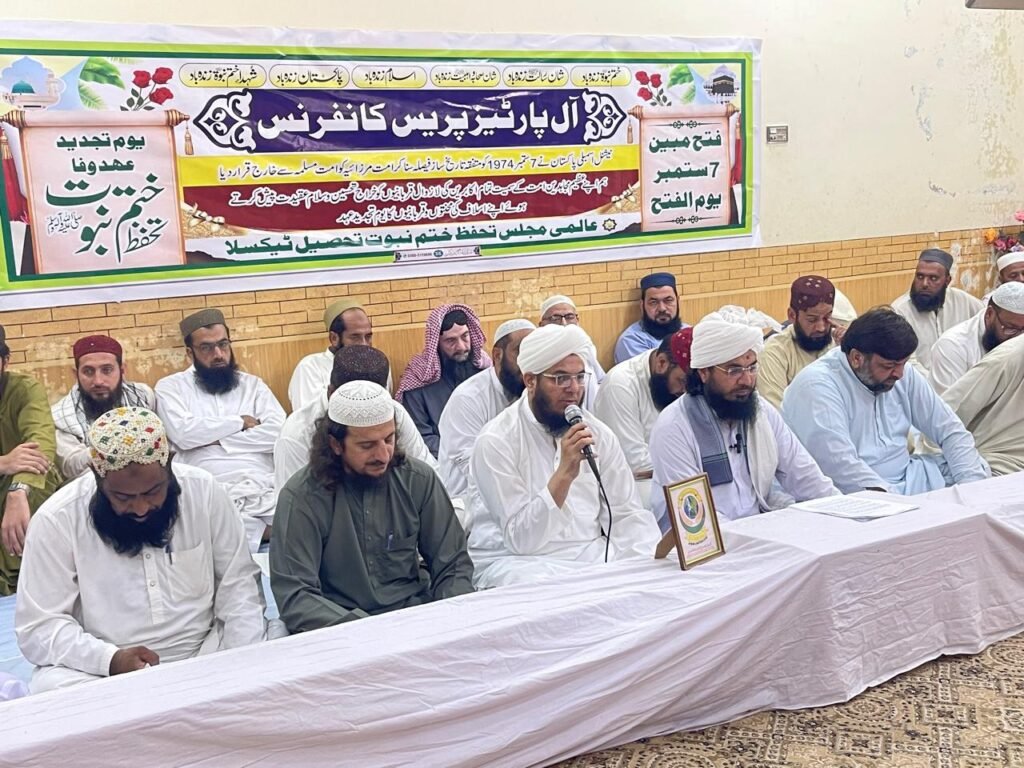
TAXILA: An all-parties conference on the protection of Khatm-e-Nabuwwat was held in Taxila on September 7 to mark Youm-e-Khatm-e-Nabuwwat, bringing together religious, political, social and legal representatives from across the tehsil.
The conference was organized at the Khatm-e-Nabuwwat Office, Tehsil Taxila, under the auspices of Khanqah Saadia Naqshbandia Mujaddidia.
Representatives of Jamiat Ulema-e-Islam, Sunni Ulema Council, Sunni Salamati Council, Tanzeem Ahl-e-Taxila, Jamaat-e-Islami, Jamiat Ahl-e-Hadith, Milad Committee, Ishat-ut-Tauheed-wal-Sunnah, Al-Farooq Foundation and Muttahida Ulema Forum attended the gathering. Political and social figures, members of the legal fraternity and representatives of the business community were also present.
A joint declaration was presented by Sahibzada Maulana Muhammad Zakaria Qureshi, Ameer of Aalmi Majlis Tahaffuz-e-Khatm-e-Nabuwwat Taxila.
According to the declaration, the religious, political and social leadership of Tehsil Taxila, along with members of the legal and business communities, expressed support for the Aalmi Majlis Tahaffuz-e-Khatm-e-Nabuwwat and pledged to continue advocating for the constitutional provisions concerning the finality of Prophethood and related laws.
Participants paid tribute to those involved in the Khatm-e-Nabuwwat movements of 1953 and 1974, recalling that Pakistan’s National Assembly passed legislation on September 7, 1974, constitutionally recognizing Ahmadis as a non-Muslim minority. They also referred to the 1984 Ordinance, which introduced additional legal restrictions concerning Ahmadi religious practices.
Speakers said they would oppose any move that, in their view, could weaken or amend constitutional provisions concerning Khatm-e-Nabuwwat and other Islamic provisions.
The conference also featured criticism of government policies toward the Ahmadi community. Participants called for the government to enforce existing laws and constitutional provisions relating to Ahmadis and raised demands concerning their appointment to sensitive or key government positions.
The participants also condemned a recent incident at the Rawalpindi Press Club, where, according to the conference speakers, the blasphemy law was described as a “black law.” They called for legal action in accordance with applicable law.
The gathering further called for the implementation of court sentences in blasphemy cases and urged authorities to take action within the existing legal framework.
Participants also raised demands concerning groups they alleged were associated with the Ahmadi community, calling for investigations into their activities and finances where legally warranted.
The conference additionally called for stronger legal protections concerning the sanctity of the Prophet Muhammad (PBUH), his Companions and Ahl-e-Bait, and urged authorities to resolve outstanding legal issues involving mosques and religious seminaries in Rawalpindi district.
The participants welcomed the Azad Jammu and Kashmir government’s decision to officially observe September 7 as Youm-e-Khatm-e-Nabuwwat each year and urged the federal government to consider a similar official observance.