
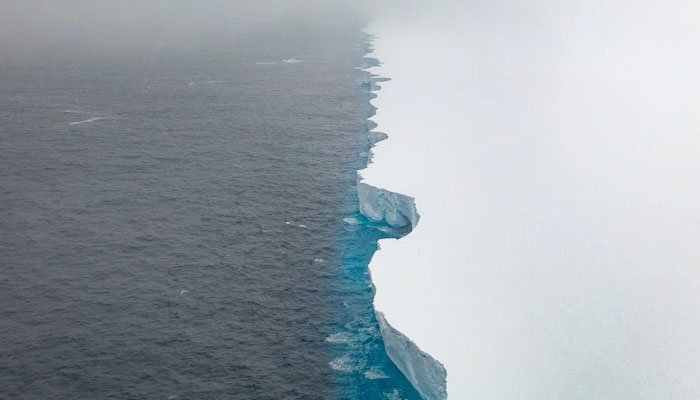
The world’s largest floating iceberg, A23a, has almost completely disappeared after drifting through Antarctic and Southern Ocean waters for nearly four decades, according to reports based on satellite observations.
A23a broke away from Antarctica’s Filchner Ice Shelf in 1986 and later separated from the larger A23 iceberg in 1991. At its largest, it covered about 2,000 square miles, an area roughly comparable to the island of Bali.
Four Decades of Movement
For decades, A23a remained largely trapped in the Weddell Sea, with its underside resting on the seabed. The iceberg eventually began moving in 2020 and reached the open Southern Ocean in November 2023.
After entering open waters, A23a took an unusual path. Instead of continuing north, it became caught in a powerful ocean current known as the Taylor Column in March 2024 and remained trapped in a rotating pattern for around eight months before breaking free in November.
As it moved into warmer waters, the iceberg continued to lose mass. In March 2025, it became grounded again near South Georgia, about 70 miles from the island.
Iceberg Breaks Into Smaller Pieces
By June 2025, A23a’s area had fallen below 1,200 square miles, meaning it was no longer the world’s largest iceberg.
Satellite imagery captured in January 2026 showed chlorophyll plumes around the iceberg. By March and April, images indicated that A23a was breaking apart into smaller pieces that were spreading through the Southern Ocean.
The US National Ice Center stopped officially monitoring A23a in March 2026 after its size fell below the threshold required for continued tracking.
Researchers continued identifying smaller fragments believed to have originated from A23a. By May, scientists were still able to observe remnants from space, but after surviving for almost 40 years, most of the giant iceberg is now believed to have melted away.