
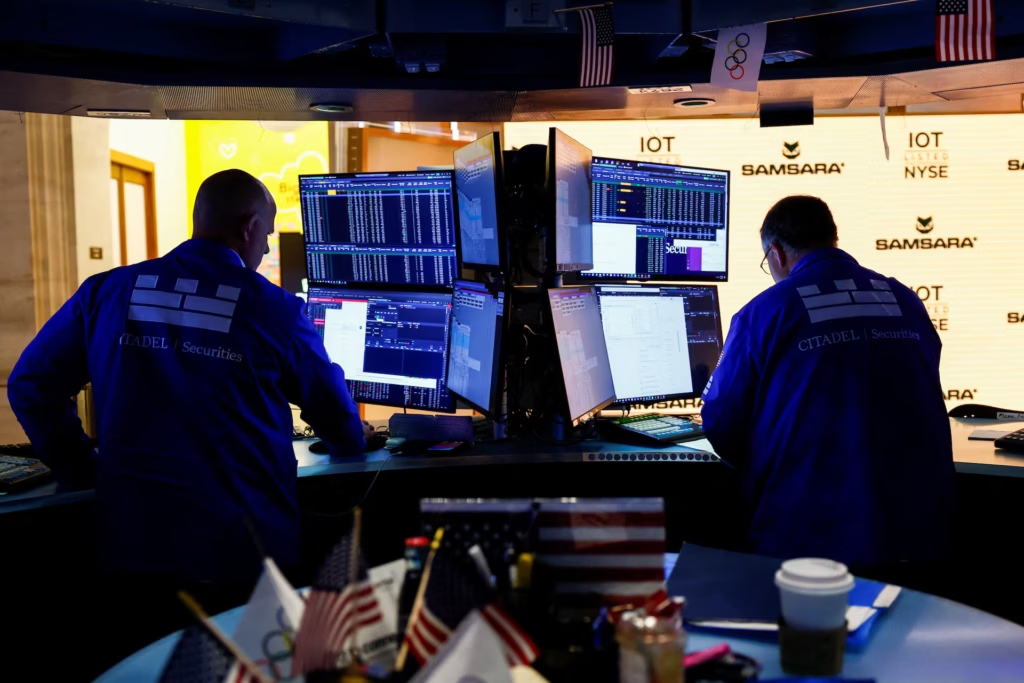
NEW YORK, November 6, 2026: US stock markets suffered their steepest decline in 19 months as a post-election rally on Wall Street reversed sharply, wiping trillions of dollars from market valuations amid heavy selling in artificial intelligence and semiconductor stocks.
According to US media reports, investors initially welcomed Democratic gains in the midterm elections, anticipating that a shift in the balance of power in Congress could reduce political and economic uncertainty.
However, optimism quickly faded as concerns emerged that greater Democratic influence in Congress and state governments could lead to tighter regulations on AI data centres, electricity consumption and technology-sector investment.
The uncertainty prompted investors to sell shares in major technology companies, particularly those whose valuations had risen sharply on expectations of continued AI expansion.
Nasdaq, S&P 500 and Dow Jones record steep losses
Technology stocks led the sell-off, with semiconductor manufacturers among the hardest hit.
The Nasdaq Composite plunged 5.52%, while the S&P 500 declined 4.36% and the Dow Jones Industrial Average dropped 3.44%, according to the reported market figures.
The semiconductor index suffered an even sharper decline of approximately 12%, reflecting widespread selling pressure across chipmakers and AI-related businesses.
Nvidia, one of the world’s leading AI chip manufacturers, reportedly lost approximately $450 billion in market value during the downturn.
Meanwhile, the S&P 500’s combined market capitalisation fell by an estimated $3 trillion, highlighting the scale of the sell-off across US equities.
AI investment concerns unsettle investors
Market analysts attributed the decline partly to growing concerns over the sustainability of heavy investment in artificial intelligence infrastructure.
Technology companies have committed substantial resources to building data centres, expanding computing capacity and developing advanced AI systems.
However, investors are increasingly examining whether these investments can generate sufficient revenue and profits to justify elevated stock valuations.
Concerns about possible restrictions on data centre construction and rising electricity demand have added to uncertainty surrounding the sector’s future growth.
Analysts said the market reaction suggested a shift in investor priorities, with greater attention being paid to corporate earnings and the financial returns generated by AI investments rather than long-term growth expectations alone.
The sharp reversal also underscored how quickly market sentiment can change when political developments intersect with concerns about technology valuations and regulatory risks.