

A senior US counterterrorism official has resigned over the ongoing war in Iran, stating that the country did not pose an imminent threat to the United States. The resignation of Joe Kent marks the first high-level departure from the administration of Donald Trump since the conflict began three weeks ago.
Kent, who headed the National Counterterrorism Center, said he stepped down because he could not support the war. In his resignation letter, he wrote: “I cannot in good conscience support the ongoing war in Iran. Iran posed no imminent threat to our nation.”
Resignation letter outlines concerns
In the letter addressed to President Trump, Kent said the decision to go to war was influenced by external pressure rather than a direct security threat. He stated: “It is clear that we started this war due to pressure from Israel and its powerful American lobby.”
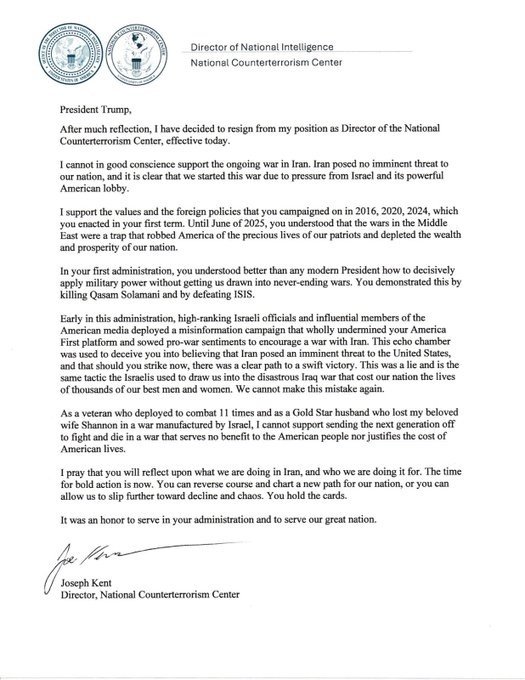
https://x.com/joekent16jan19/status/2033897242986209689?s=20
Kent also warned that the perception of an imminent Iranian threat was shaped by misinformation. He wrote that officials were led to believe Iran posed an immediate danger and that military action would be swift and decisive, adding: “This was a lie.”
He further cautioned against repeating past policy mistakes, comparing the situation to previous conflicts in the Middle East that resulted in prolonged wars and heavy costs.
Debate over threat assessment
Kent’s resignation comes amid growing debate in Washington over the justification for the conflict. Analysts note that under international law, evidence of an imminent threat is typically required to justify military action.
US Senator Mark Warner also said there was no credible evidence indicating an immediate threat from Iran, echoing concerns raised in Kent’s statement.
Intelligence warnings and risks
US intelligence assessments had previously outlined risks linked to military escalation, including potential retaliation by Iran against US interests and regional allies. Reports by the National Intelligence Council, overseen by Tulsi Gabbard, highlighted possible consequences before and after the strikes.
Background and policy stance
Kent has been associated with an “America First” foreign policy approach and has previously opposed prolonged US military interventions abroad. In his letter, he said earlier policies had aimed to avoid “never-ending wars” and warned against returning to such strategies.
Also Read: Trump doesn’t know Imam Ali, Imam Hussain or Karbala, lost Iran war on day one: Scott Ritter
His resignation comes as the conflict continues with no clear resolution, and military exchanges persist across the region.