
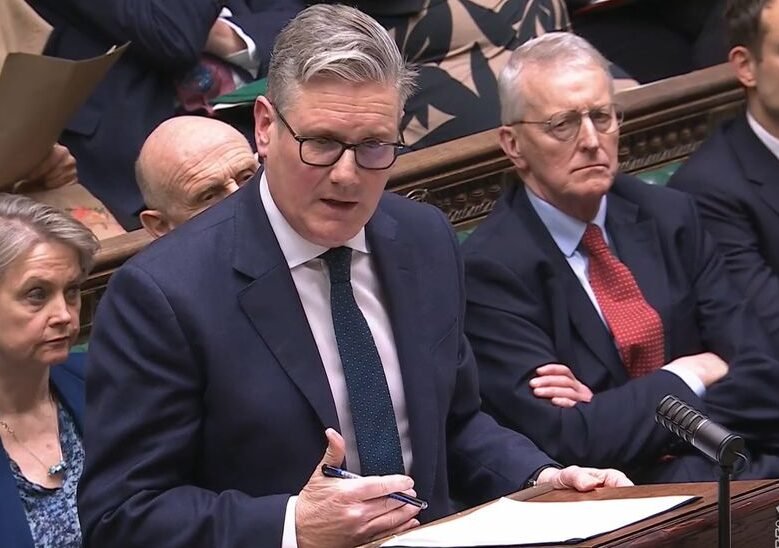
LONDON: Prime Minister Keir Starmer has approved a US request to use British military bases for what he described as “defensive” operations linked to the escalating conflict with Iran, placing the United Kingdom in a complex legal and military position as tensions widen across the region.
The decision followed a suspected Iranian drone incident at RAF Akrotiri in Cyprus early Monday, where a drone crashed on the runway without causing casualties, according to British and Cypriot officials. Two additional drones heading toward the base were intercepted later the same day. The developments have intensified scrutiny of Britain’s role as Washington expands military action against Iran.
In a joint statement with France and Germany, Starmer said the European partners were prepared to take “proportionate defensive action” against threats. In a televised address, he confirmed that the UK had granted the United States permission to use British bases to target Iranian missiles at their storage sites or launch points, describing the move as defensive in nature.
Drone incident at RAF Akrotiri
Officials in Cyprus said the damage from the drone impact at RAF Akrotiri was limited. Military analyst Sean Bell said the projectile that struck the base appeared unarmed and may have been launched from Lebanon, although that claim has not been independently verified.
The incident underscored concerns about the vulnerability of British facilities in the region. RAF Akrotiri is a key UK air base in the eastern Mediterranean and has been used in previous Middle East operations.
Legal basis and self-defence argument
Starmer said the decision to permit US operations from British soil was grounded in collective self-defence and the protection of British nationals and allied partners in the region. He told Parliament that the UK does not support “regime change from the skies” but would act to protect its interests and personnel.
Under international law, countries supporting military action can be viewed as participants, a point raised by analysts who say the distinction between direct involvement and logistical support can carry legal implications.
Tim Ripley, editor of Defence Eye, said UK officials initially assessed that US and Israeli strikes on Iran did not clearly meet the United Nations Charter’s definition of self-defence.
Explosions reported in Saudi Arabia, UAE and Bahrain as Iran launches missile retaliation
However, Iranian retaliatory attacks targeting Gulf states — where British nationals and treaty partners are present — shifted the legal framing toward collective self-defence.
The UK government has not published detailed legal advice, but Starmer said the decision was consistent with international law.
Operational risks and strategic exposure
Allowing US aircraft to operate from bases such as RAF Fairford in Gloucestershire and Diego Garcia in the Indian Ocean raises operational considerations. Aircraft flying from those locations would face extended flight times to reach Iranian airspace, potentially limiting real-time oversight of targeting decisions.
Analysts note that Iran’s ballistic missile systems are mobile, making pre-emptive targeting complex. Britain does not operate a domestic ballistic missile defence system capable of intercepting long-range missiles aimed at the UK mainland.
The arrangement leaves the UK reliant on US assurances that operations launched from British territory remain within agreed defensive parameters.
Domestic political pressure
The decision also carries domestic political implications. A YouGov poll conducted on February 20 found that 58 percent of respondents opposed allowing the US to launch air strikes on Iran from UK bases, while 21 percent supported the move.
As tensions continue, the UK government faces the challenge of balancing alliance commitments with legal constraints and public opinion, while seeking to limit its exposure in a conflict driven primarily by US-Iran hostilities.




 Today's E-Paper