
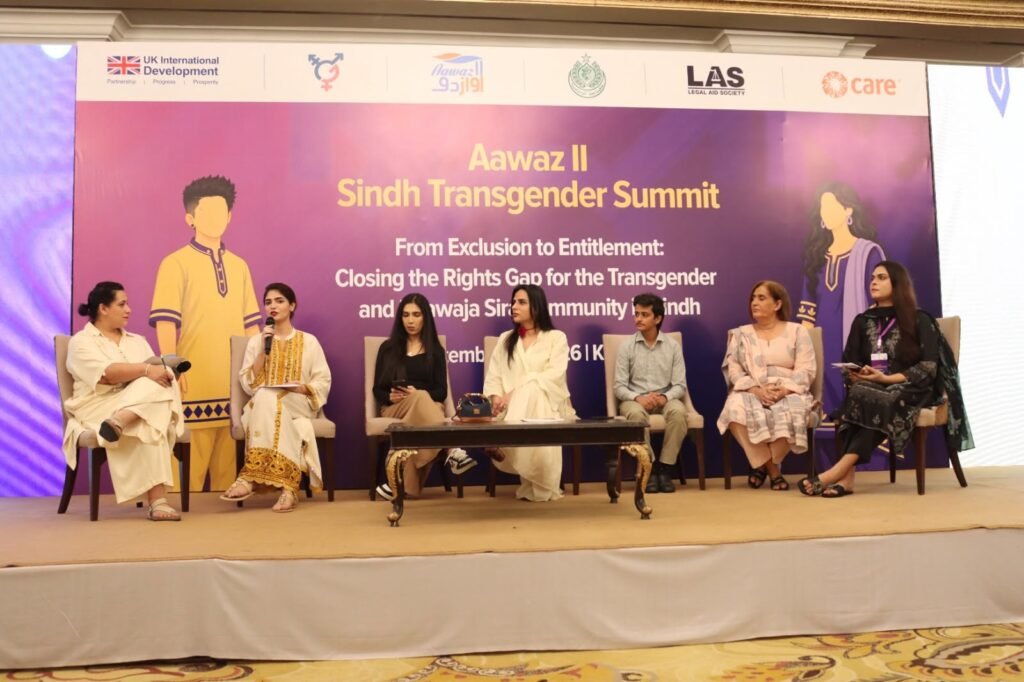
KARACHI, September 30, 2026: The Legal Aid Society (LAS), in partnership with the Gender Interactive Alliance (GIA), convened the Sindh Transgender Summit in Karachi, calling for stronger implementation of legal and policy commitments for the transgender and Khawaja Sira community across Sindh.
Held under the Aawaz II Programme, led by CARE Pakistan and funded by UK International Development from the UK government, the summit was titled “From Exclusion to Entitlement: Closing the Rights Gap for the Khawaja Sira Community in Sindh.”
The event brought together senior officials from the Social Welfare, Health, Education, Home and Labour departments, BISP/Ehsaas, NADRA, the Sindh Human Rights Commission and the Sindh Commission on the Status of Women. Khawaja Sira community leaders from across Sindh, civil society organisations and development partners also participated.
GIA Executive Director Bindiya Rana opened the summit, describing it as a platform for translating community concerns into institutional accountability. Aawaz II Team Lead at CARE Pakistan Arif Tabassum provided an overview of the programme, while Sana Ahmed of GIA delivered a “Voices of Resilience” address.
The programme also featured “Stories from the Margins,” a theatre performance by Khwab-e-Raqs and Transcend Theatre depicting the lived experiences of the Khawaja Sira community.
Community Highlights Eight Key Reform Areas
A panel discussion moderated by Legal Aid Society advocate Maliha Zia examined challenges faced by transgender and Khawaja Sira people in Sindh.
The panel included Shahzadi Rai, Kami Chaudhry, Sanam Fakeer, Dr. Sara Gill, Rayhan Muqadam and Aradhiya Khan.
Discussions covered emergency safe houses, implementation of the Transgender Education Policy, enforcement of the 0.5% government employment quota, removal of medical certificate requirements, dedicated hospital wards, BISP activation, police sensitisation, transgender focal persons at district level, legal recognition of the Guru system and government-supported vocational training.
Five-Point Charter of Demands
On behalf of the transgender and Khawaja Sira community of Sindh, Aradhiya Khan presented a five-point Charter of Demands:
- Safe Homes: Establish emergency safe houses managed by transgender-led organisations.
- Education for All: Fully implement Sindh’s Transgender Education Policy, including scholarships and protection against discrimination.
- Equal Employment: Enforce the 0.5% government job quota and remove discriminatory medical certification requirements.
- Healthcare with Dignity: Establish dedicated wards in public hospitals and provide sensitive, gender-affirming healthcare.
- Social Protection: Activate BISP inclusion and provide immediate financial assistance to registered Khawaja Sira individuals.
Government Signals Commitment
Chief Guest Munawar Ali Mithani, Secretary of the Social Welfare Department, Government of Sindh, acknowledged the gap between legal commitments and the community’s lived experiences.
He said the provincial government was committed to action in areas including the Transgender Education Policy, employment quota, BISP integration and dedicated healthcare facilities.
Amir Ali Khan, Director General NADRA, reaffirmed the organisation’s commitment to working with the Social Welfare Department and relevant stakeholders to identify gaps, improve registration and access to services, review policies and make services more accessible and responsive.
CARE Pakistan Country Director Adil Sheraz said the summit represented an important step toward translating rights on paper into practical outcomes, stressing the importance of community participation and institutional accountability.
Legal Aid Society CEO Haya Emaan Zahid said the summit marked a shift from consultation toward commitment. She called on government departments to use the Commitment Tracker as a roadmap for implementation and reaffirmed LAS’s commitment to continued monitoring, legal assistance and advocacy.
The summit concluded with a renewed commitment to addressing the implementation gap and developing a rights-centred system for the Khawaja Sira community across Sindh.