
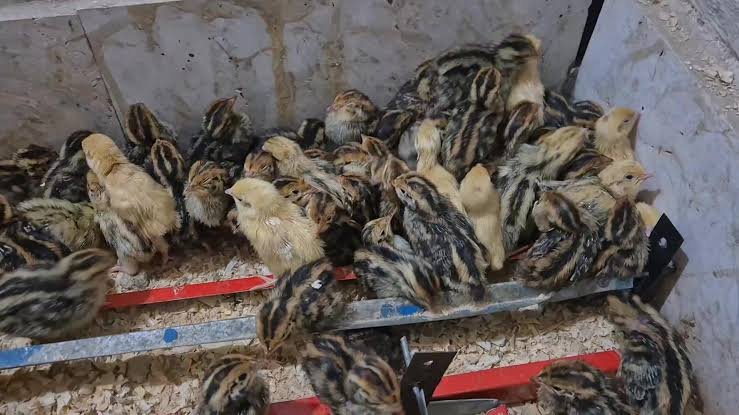
ISLAMABAD, Nov 03 (ABC):Quail farming is emerging as a growing niche livestock business in Punjab, with rising demand from hotels and restaurants in Lahore, Gujranwala and Multan prompting farmers to establish small scale farms in rural and suburban areas, attracted by the bird’s short production cycle, low space requirements and relatively modest start-up costs.
“Quail meat is considered a luxury food item and is mainly consumed in major urban centres, where people have greater purchasing power.
Despite having a nutritional profile comparable to mutton, quail meat costs almost half as much as lamb,” said Dr Faizan Rashid, owner of a quail farm in Pattoki, near Lahore.
Talking to Wealth Pakistan, he said quail meat is selling for around Rs1,450 per kilogram against Rs2,400 per kilogram for mutton, making it a comparatively affordable alternative for consumers seeking specialty meat products.
Dr Faizan Rashid said quail farming required substantially less investment than conventional poultry farming, primarily because of the birds’ short production cycle and limited space requirements.
“A room measuring 100 square feet can accommodate up to 1,000 birds,” he said.
Dr Rashid said the initial rearing process, including brooding and general management, is broadly similar to that of conventional poultry.
Temperature control was particularly important during the first few days, although quails were generally hardier and more resistant to diseases.
Unlike conventional poultry, quails did not routinely require vaccination under certain farming practices, he said, adding that disease prevention and veterinary care remained essential, while antibiotics could be administered when prescribed for bacterial infections.
Feed, he said, is the biggest recurring expense in quail production. A day old chick cost around Rs17, while a mature bird could fetch between Rs70 and Rs100, depending on its size and prevailing market demand.
He said profitability largely depended on efficient flock management, feed consumption, mortality control and access to reliable buyers.
A Japanese-breed quail chick weighed around eight to nine grams at birth and could reach approximately 100 grams at maturity, he added.
Dr Rashid said the Avian Research and Training Centre at the University of Veterinary and Animal Sciences (UVAS), Lahore, had developed a jumbo quail breed to improve bird size and meat yield.
The initiative increased egg weight from 9.5 grams to 12 grams and the weight of day old chicks from 6.5 grams to eight grams, he said.
“The live weight of birds at 28 days of age has increased from 100 grams to 200 grams. Consequently, the dressed weight has increased from 50 grams to 100 grams,” he added.
However, the farmer said the jumbo variety had yet to gain widespread acceptance among hotel and restaurant operators, who generally preferred smaller birds for serving customers.
“The UVAS breed is popular among consumers who purchase the birds and cook them at home,” he said.
Dr Farhan Afzal, director of the Poultry Research Institute, Punjab, described quail farming as an attractive emerging business opportunity, citing compact housing, limited land requirements, early maturity and a short production cycle as its key advantages.
However, he cautioned that uncertain demand, price fluctuations and limited access to regular buyers continued to constrain the sector’s commercial expansion.
“These potential advantages do not automatically guarantee profitability. Reliable buyers, feed costs, chick quality, mortality rates and farm management practices determine the commercial viability of quail farming,” he said.
Dr Afzal said the Punjab Livestock Department supported the sector mainly through broader poultry research, extension services, farmer training, veterinary diagnostics and regulation, rather than through a dedicated quail-farming assistance programme.
He said the sector’s growth depended not only on the birds’ production potential but also on addressing market uncertainty, controlling production costs, improving stock quality and developing a reliable value chain.