
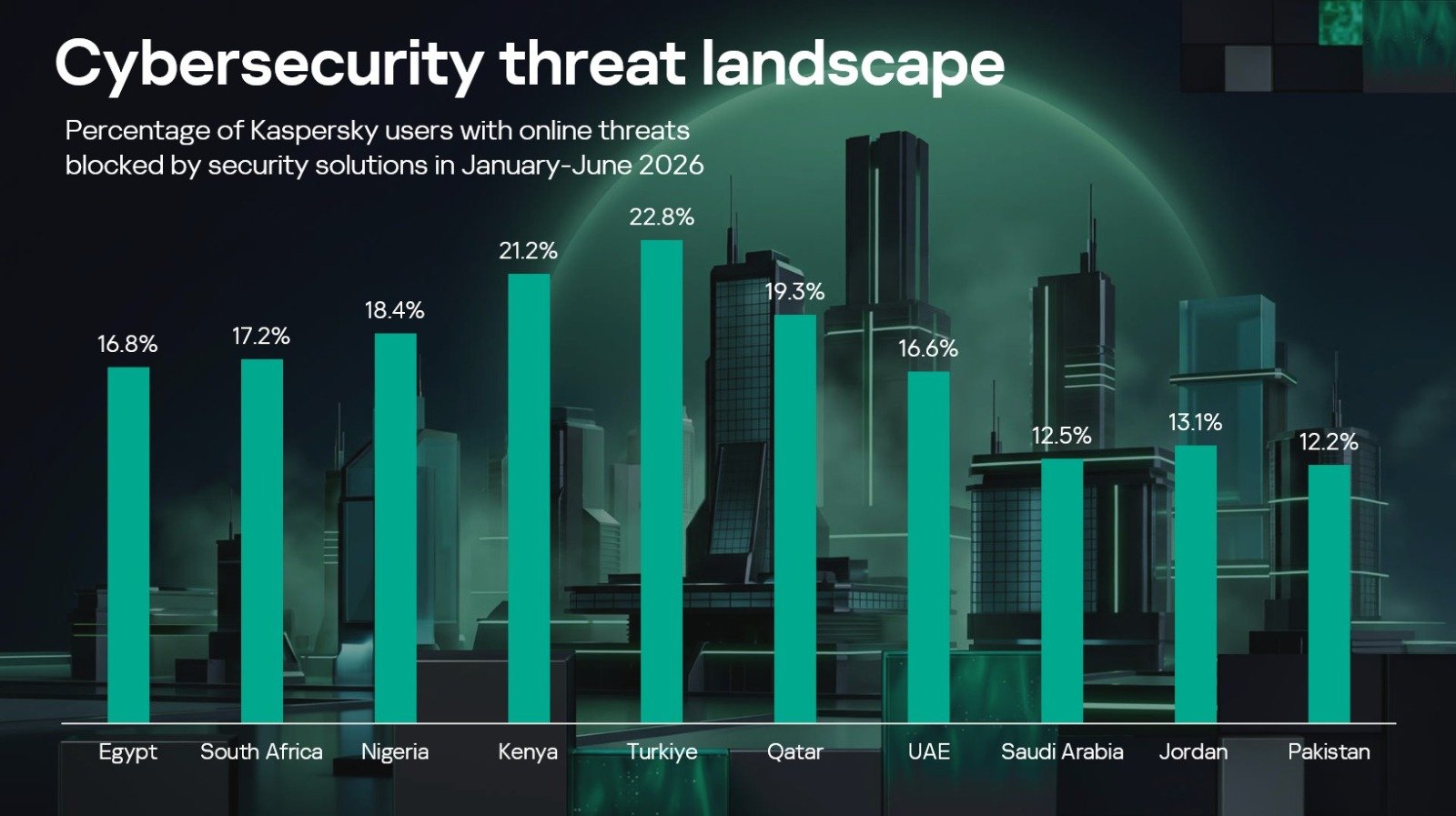
ISLAMABAD: Around 12.2% of users in Pakistan were attacked by online threats during the first half of 2026, according to findings shared by Kaspersky’s Global Research and Analysis Team (GReAT) at the company’s Cyber Security Weekend for the Middle East, Türkiye and Africa region.
Kaspersky said the cyber threat landscape is becoming more complex as criminals adopt increasingly sophisticated techniques. The rapid use of artificial intelligence, along with geopolitical and economic instability, is also contributing to the growth of cybercrime and more advanced attacks.
According to Kaspersky’s telemetry, online threats exploiting weaknesses in websites, emails and web-based services continued to affect millions of users across the META region during the first six months of 2026.
Türkiye recorded the highest share of users affected by web-based threats at 22.8%, followed by Kenya at 21.2% and Qatar at 19.3%. Saudi Arabia, Jordan and Pakistan recorded comparatively lower levels of web-borne attacks.
In Pakistan, Kaspersky solutions blocked online threats affecting 12.2% of users during the first half of the year.
AI Increasingly Used in Cyberattacks
Kaspersky experts said threat actors are increasingly using artificial intelligence at different stages of their operations. Large language models are already being used to create phishing emails, malicious code and other material supporting cyberattacks.
AI is also playing a growing role in malware development. Researchers have observed AI-assisted malware in campaigns linked to the FunkSec group, which used Rust-based malicious software capable of stealing data, encrypting files and manipulating system processes.
During the RevengeHotels campaign in 2025, threat actors also used large language models to generate parts of the infector and downloader code, according to Kaspersky.
“We expect AI to remain one of the key factors shaping the threat landscape in 2026, as we already see how it is reshaping attacker workflows and accelerating their operations,” said Sergey Lozhkin, head of Kaspersky’s Global Research and Analysis Team for the Asia-Pacific and META regions.
He said AI reduces the time and cost required to develop and modify malicious tools, allowing attackers to move faster and expand their operations.
“Defenders should be prepared for quicker shifts in tactics,” Lozhkin added.
Cloud Services, Ransomware and AI Agents Pose New Risks
Kaspersky also identified several emerging trends that organisations should closely monitor.
One of these is cloud-based data exfiltration, in which attackers use legitimate cloud and file-sharing services to transfer stolen information while blending in with normal network traffic.
Ransomware groups are also increasingly targeting production systems and business operations instead of only encrypting files. By disrupting critical processes, attackers seek to place greater pressure on victims to pay a ransom.
Kaspersky also warned about risks linked to AI agents that are given broad or full access to enterprise systems.
If such an agent is compromised, attackers could change its system instructions or configuration, potentially forcing it to download malicious software whenever it starts.
As AI agents gain wider access to corporate systems, attackers may exploit compromised tools to manipulate their behaviour, steal sensitive information, carry out unauthorised actions and maintain long-term access.
Kaspersky said this creates an additional security risk, as trusted AI systems could be turned into powerful tools for cyberattacks.
The company advised organisations to strengthen their cybersecurity measures through continuous vulnerability management, timely software updates, employee awareness training, threat intelligence and advanced protection against sophisticated and AI-assisted attacks.
Also Read: Kaspersky Warns Mobile Data Buyers About Fake Telecom Websites