
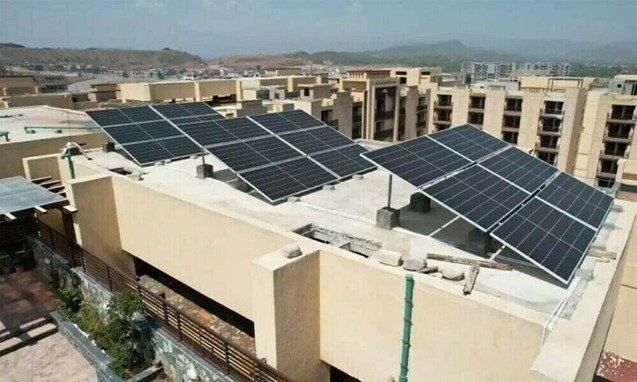
ISLAMABAD, Tuesday, September 22, 2026: Pakistan’s rapidly expanding rooftop solar and battery network could pave the way for millions of households and businesses to share, store and potentially trade surplus electricity through locally connected energy networks, opening a new phase in the country’s solar transition.
Energy experts say the concept, known as “swarm electrification,” could transform privately owned rooftop panels and batteries from isolated household systems into a coordinated energy resource capable of lowering consumer costs and providing greater flexibility to the national grid.
Instead of individual solar systems operating independently, digital platforms could connect groups of consumers, enabling surplus electricity to be stored, shared or traded locally.
At a larger scale, thousands of such systems could be aggregated through a virtual power plant (VPP), allowing rooftop solar, batteries and other distributed energy resources to respond collectively when the electricity grid requires additional power or flexibility.
The concept is becoming increasingly relevant as Pakistan experiences rapid growth in distributed solar generation.
Analysis by the Pakistan Solar Association estimates that distributed solar supplied nearly 27% of the country’s electricity during FY2025, representing around 51 terawatt-hours of generation, much of which remains outside conventional grid-side data.
Battery adoption is also accelerating.
Renewables First estimates Pakistan imported around 4.6 gigawatt-hours of lithium-ion battery energy storage during 2025, an increase of approximately 220% year-on-year.
The growth suggests consumers are increasingly moving beyond simply producing electricity during daylight hours and towards storing and managing their own power.
The next challenge is determining how these privately financed energy assets can create value beyond individual homes and businesses.
A recent assessment by the Policy Research Institute for Equitable Development (PRIED) found swarm-grid arrangements technically feasible in both urban and rural Pakistan, although their economics differed depending on location.
Speaking to Wealth Pakistan, Power Division Energy Adviser Syed Faizan Shah said Pakistan could move from millions of individual distributed energy resources towards coordinated systems incorporating rooftop solar, batteries, electric vehicles and flexible electricity demand.
Through VPPs, he said, these resources could effectively operate as a single intelligent source of power.
Such coordination could extract greater value from investments consumers have already made while allowing households and businesses to participate more actively in the electricity system.
Grid Integration Remains A Challenge
Connecting millions of privately owned energy systems, however, would require more than digital platforms.
Muhammad Zakria, Executive Director for System Operations at the Independent System and Market Operator (ISMO), said distributed energy resources could provide substantial flexibility to Pakistan’s electricity system, but appropriate regulatory and technological foundations would be essential.
Real-time visibility, accurate forecasting, communication and control systems and suitable grid standards would be needed to ensure distributed resources respond to system requirements without compromising grid security, he said.
Rural Areas Need Different Financing Model
The economics of decentralised electricity systems could be significantly different in rural and underserved areas.
Ahsan Gaylani of the United Nations Industrial Development Organization (UNIDO) said electricity access in rural and marginalised communities was closely linked with livelihoods and economic activity, making both affordability and reliability critical.
He said financing structures could combine communities, private investors, banks and development finance institutions.
Blended finance, concessional funding and government-backed mechanisms to reduce investment risk could help overcome the high upfront costs that might otherwise prevent viable projects from moving forward.
Thousands Of Homes Can Act Like One Power Plant
International experience suggests household energy aggregation can operate at substantial scale.
South Australia has developed a large virtual power plant connecting thousands of household solar and battery systems so they can operate collectively.
More than 7,000 public-housing tenants are participating in the programme, according to the South Australian government.
The network has also provided grid-stability services during power-station disruptions and network outages, demonstrating how thousands of relatively small household batteries can collectively perform some functions traditionally associated with conventional power plants.
For Pakistan, experts believe the next stage of the solar transition may therefore depend less on simply adding more panels and more on creating the regulations, technology, electricity-market mechanisms and financial incentives required to connect existing systems.
If those foundations are developed, millions of rooftop solar panels, household batteries, electric vehicles and flexible loads could eventually become part of a coordinated electricity network — turning Pakistan’s consumer-led solar boom into a broader resource for the power system.